
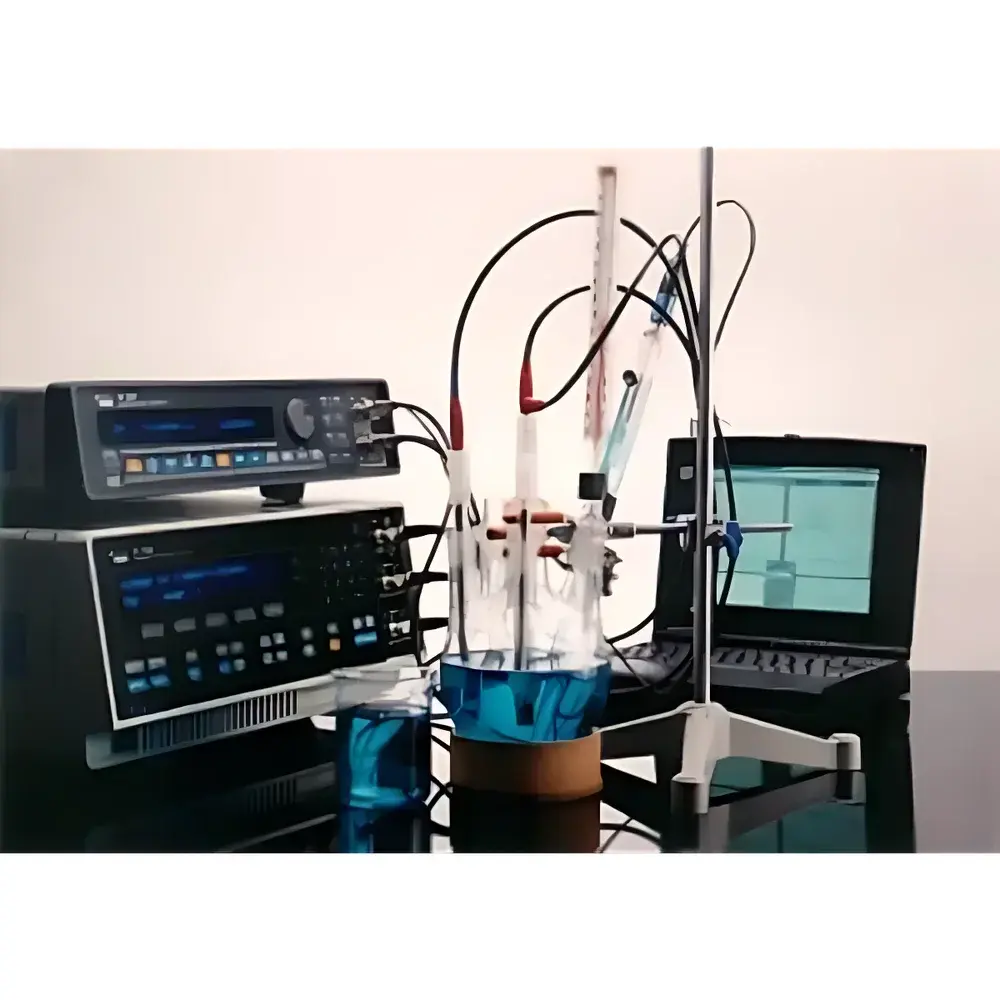
Solartron Analytical 1287/1260 Electrochemical Workstation
| Brand | Solartron Analytical |
|---|---|
| Origin | United Kingdom |
| Model | 1287/1260 |
| Channel Count | Single-Channel |
| Current Range | ±2 A |
| Current Accuracy | ±0.2% of reading |
| Potential Accuracy | ±0.2% of reading |
| Potentiostatic Range | ±14.5 V |
| EIS Frequency Range | 10 µHz – 32 MHz |
| Voltage Resolution | 1 µV |
| Current Resolution | 1 pA |
| Polarization Voltage (1260A) | ±40.95 V |
| Frequency Resolution | 15 ppm (0.000015) |
| Phase Accuracy | ±0.1° |
| Magnitude Accuracy | ±0.1 dB |
| Measurement Configurations | 2-, 3-, and 4-terminal |
Overview
The Solartron Analytical 1287/1260 Electrochemical Workstation is a high-precision, dual-unit system engineered for advanced electrochemical characterization in research and industrial laboratories. It integrates the 1287 Potentiostat/Galvanostat with the 1260 Frequency Response Analyzer (FRA), forming a modular platform optimized for both DC electrochemical techniques and high-fidelity Electrochemical Impedance Spectroscopy (EIS). The system operates on the principle of controlled perturbation—applying small-signal AC excitation superimposed on DC bias to extract complex impedance spectra without altering sample integrity. Its design reflects decades of refinement in low-noise analog signal conditioning, active shielding, and digital signal processing, making it particularly suited for applications where signal-to-noise ratio is critical—such as corrosion monitoring under ultra-low current conditions (<1 nA), interfacial charge transfer analysis in solid-state batteries, or dielectric spectroscopy of thin-film coatings.
Key Features
- Patented single-sine correlation algorithm in the 1260 FRA delivers exceptional harmonic and broadband noise rejection—essential for measurements at millivolt-level signal amplitudes typical in corrosion and sensor studies.
- Dual high-resolution digital acquisition channels enable simultaneous, time-synchronized measurement of potential and current with 1 µV and 1 pA resolution respectively—supporting electrochemical noise analysis (ECN) and transient detection.
- Active guarding architecture minimizes stray capacitance and cable-induced impedance artifacts, ensuring fidelity across the full 10 µHz–32 MHz EIS range—even during high-frequency measurements on conductive or shielded cells.
- Floating measurement capability allows safe operation in grounded systems such as pressurized autoclaves, buried pipeline coupons, or fuel cell stacks with common-mode potentials exceeding ±10 V.
- Configurable 2-, 3-, and 4-terminal measurement modes: 2-terminal for bulk conductivity; 3-terminal for corrosion and coating integrity (Luggin capillary compensation); 4-terminal for precise battery/fuel cell electrode characterization with lead resistance cancellation.
- Wide dynamic range: ±2 A current compliance with ±14.5 V potentiostatic control, extendable to ±40.95 V using the 1260A’s auxiliary voltage output—enabling aggressive polarization protocols for passivation or breakdown studies.
Sample Compatibility & Compliance
The 1287/1260 system supports aqueous, non-aqueous, molten salt, and solid-electrolyte electrochemical cells—including three-electrode configurations with reference electrodes (e.g., Ag/AgCl, SCE, Hg/HgO) and inert counter electrodes (Pt, graphite, Ni). Its hardware architecture meets key requirements for GLP-compliant environments: traceable calibration paths, hardware-based timestamping, and deterministic real-time data acquisition. When operated with CorrWare/ZPlot software under validated configurations, the system supports audit trails and electronic signatures compliant with FDA 21 CFR Part 11 for regulated battery safety testing or pharmaceutical electrochemical stability assessment. While not certified to ISO/IEC 17025 out-of-the-box, its metrological traceability to NIST standards (via factory calibration certificates) enables laboratory-specific accreditation pathways per ASTM G102 (calculation of corrosion rates), ASTM E1466 (low-noise ECN), and IEC 62660-2 (secondary lithium cell impedance validation).
Software & Data Management
CorrWare and ZPlot software provide a unified interface for experiment design, execution, and model-based interpretation. CorrWare focuses on corrosion-specific protocols—including zero-resistance ammetry (ZRA), electrochemical noise, and galvanostatic pulse techniques—while ZPlot specializes in EIS modeling, equivalent circuit fitting (using Levenberg-Marquardt or simplex algorithms), and multi-sine analysis. Both support real-time plotting, multi-channel overlay, batch processing, and export to standard formats (CSV, TXT, IMP). Data files include embedded metadata: instrument ID, firmware version, calibration date, user-defined notes, and hardware configuration flags—ensuring reproducibility and chain-of-custody integrity. The software architecture separates acquisition logic from analysis modules, allowing raw time-series data to be reprocessed offline with updated models or correction algorithms—critical for long-term archival compliance under ISO 14644-1 or EU GMP Annex 11 guidelines.
Applications
- Battery R&D: SEI formation kinetics, Li-ion electrode degradation mapping, solid-electrolyte interphase (SEI) capacitance profiling, and pouch cell impedance tomography.
- Corrosion Science: Coating delamination onset detection, inhibitor efficiency quantification, localized corrosion susceptibility (e.g., pitting factor via EIS phase angle minima), and cathodic protection system validation.
- Fuel Cells & Electrolysers: Membrane electrode assembly (MEA) ohmic resistance decomposition, catalyst layer charge transfer resistance, and mass transport limitations in PEM and SOEC systems.
- Sensors & Biosensors: Redox mediator kinetics, surface-confined electron transfer rates, and interfacial capacitance changes upon biomolecular binding.
- Materials Electrochemistry: Conducting polymer doping/dedoping dynamics, oxide semiconductor Mott-Schottky analysis, and dielectric relaxation in ferroelectric thin films.
FAQ
What distinguishes the 1260’s single-sine correlation technique from multi-sine FFT-based FRAs?
The 1260 employs real-time, narrowband correlation against a synthesized pure sine wave—rejecting out-of-band harmonics and asynchronous noise more effectively than FFT methods, especially below 1 Hz where spectral leakage dominates.
Can the 1287/1260 perform simultaneous potentiostatic EIS and cyclic voltammetry?
No—EIS and DC techniques are executed sequentially due to fundamental signal orthogonality constraints; however, ZPlot supports automated protocol chaining (e.g., CV → rest → EIS) with synchronized metadata tagging.
Is four-wire measurement supported for impedance at high frequencies?
Yes—the 1287’s active guard and differential input stages maintain 4-terminal integrity up to 1 MHz; above this, parasitic inductance requires careful cell fixture design, but the 1260’s 32 MHz bandwidth permits de-embedding corrections.
How is calibration traceability maintained over time?
Solartron provides NIST-traceable calibration certificates with each unit; annual verification kits (including precision resistors, capacitors, and dummy cells) allow labs to validate gain, offset, phase, and frequency response per ASTM E2680.
Does the system support custom waveform generation for non-standard pulse techniques?
Yes—ZPlot’s script editor accepts Python-based waveform definitions, enabling user-defined sequences (e.g., stochastic potential modulation, variable amplitude square waves) compiled into real-time DAC instructions.






