
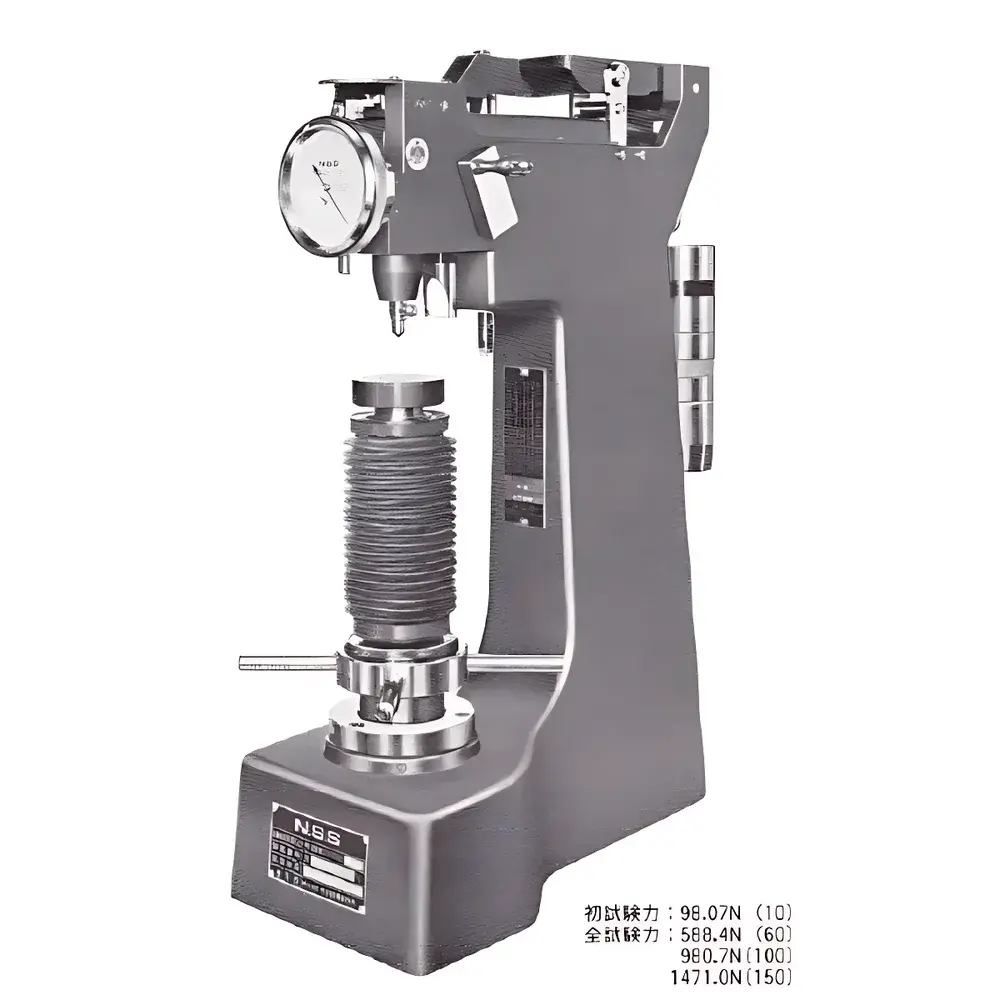
SOLY 3R Rockwell Hardness Tester
| Brand | SOLY |
|---|---|
| Origin | Italy |
| Manufacturer Type | Authorized Distributor |
| Origin Category | Imported |
| Model | 3R |
| Instrument Type | Rockwell Hardness Tester |
| Vertical Travel | 200 mm |
| Flat Anvil Area | 135 mm |
| Height | 640 mm |
| Footprint | 480 × 220 mm |
| Weight | 65 kg |
| Indenters | Diamond Cone (HRC scale), 1/16″ Steel Ball (HRB scale) |
| Hardness Test Blocks | 2 × C-scale, 1 × B-scale |
| Anvils | Flat Anvil (Ø65 mm), V-Anvil (Ø47 mm & Ø127 mm) |
| Accessories | Elevating Screw Cover Set, Rockwell Hardness Conversion Chart, Power Cord, Accessory Storage Case |
Overview
The SOLY 3R Rockwell Hardness Tester is a precision-engineered mechanical hardness testing instrument designed in accordance with ASTM E18 and ISO 6508-1 standards for Rockwell hardness measurement. It operates on the fundamental principle of depth-differential indentation: a preliminary minor load (typically 10 kgf) establishes a zero reference position; a major load (60, 100, or 150 kgf depending on scale) is then applied to produce permanent plastic deformation; and the residual depth difference between the two load states is converted into a dimensionless Rockwell hardness number (e.g., HRC, HRB). Its dual-load mechanism, rigid C-frame architecture, and newly engineered 3R loading axis—featuring reinforced vertical guidance, minimized torsional deflection, and thermally stable bearing alignment—ensure high repeatability (< ±0.5 HR) and long-term metrological stability across daily QC workflows in metallurgical labs, heat treatment facilities, and polymer quality control environments.
Key Features
- Robust cast-iron base and column structure with vibration-damping mass distribution, supporting consistent test force application under variable floor conditions.
- 3R-loading axis design: A proprietary three-point reactive support system for the main load train, significantly reducing lateral play and axial wobble during major load application—critical for minimizing measurement scatter in thin-section or low-modulus samples.
- Manual dual-scale operation: Direct selection of HRC (diamond cone, 150 kgf major load) and HRB (1/16″ steel ball, 100 kgf major load) via calibrated lever actuation; no electronic calibration drift or software dependency.
- Integrated mechanical counterbalance and friction-damped elevation screw for smooth, backlash-free sample height adjustment across 200 mm vertical travel.
- Dedicated anvil set including flat anvil (Ø65 mm) for sheet and plate, and dual-diameter V-anvil (Ø47 mm / Ø127 mm) for cylindrical specimens per ASTM E18 §7.3.2.
- Full accessory suite compliant with ISO 6508-2: certified hardness reference blocks (2 × C-scale, 1 × B-scale), indenter verification tools, and traceable conversion chart aligned with NIST SRM 126x series.
Sample Compatibility & Compliance
The SOLY 3R accommodates specimens up to 640 mm in height and 135 mm in planar dimension, supporting routine testing of forged components, machined shafts, extruded profiles, and molded thermoplastics (e.g., ABS, PC, POM). Its mechanical design conforms to essential safety and metrological requirements of EN ISO 6508-1:2016 and ASTM E18–23. All indenters are manufactured to ISO 6508-2 tolerances (cone apex angle 120° ± 0.5°, tip radius 0.2 mm ± 0.005 mm; steel ball sphericity ≤ 0.2 µm). The instrument supports GLP-compliant manual recordkeeping—hardness values are read directly from the analog dial gauge (0.5 HR resolution), eliminating digital audit trail requirements while maintaining full traceability through physical test logs and certified reference block usage.
Software & Data Management
As a fully mechanical tester, the SOLY 3R does not incorporate embedded electronics or data logging firmware. This architecture ensures immunity to electromagnetic interference, zero firmware obsolescence risk, and unambiguous compliance with legacy validation protocols in regulated manufacturing (e.g., aerospace MRO, medical device forging). Users maintain hardness records manually using standardized test report forms referencing ASTM E18 Annex A1. For laboratories requiring digitization, optional third-party USB microscope-based imaging systems (e.g., with 10×–50× magnification and calibrated stage) may be integrated externally to capture indenter impressions for archival review—though such setups fall outside the instrument’s certified measurement scope.
Applications
- Verification of case-hardened depth and core hardness in automotive transmission gears (per SAE J429, ISO 898-1).
- Batch release testing of stainless steel fasteners post-heat treatment (HRC 32–45 range).
- Quality conformance checks of injection-molded engineering plastics against ISO 2039-2 specifications.
- In-process monitoring of aluminum alloy T6 temper in extrusion lines (HRB 60–75).
- Educational use in materials science laboratories for teaching indentation mechanics and scale selection logic (e.g., why HRC is unsuitable for annealed Cu, while HRB is).
FAQ
Is the SOLY 3R compliant with ISO/IEC 17025 accredited testing requirements?
Yes—when operated with certified reference blocks, calibrated indenters, and documented procedural adherence to ASTM E18, it satisfies the technical competence criteria for hardness testing in ISO/IEC 17025:2017 Clause 6.4.1.
Can the 3R perform superficial Rockwell tests (e.g., HR15N)?
No—it is configured exclusively for standard Rockwell scales (HRA, HRB, HRC) per ISO 6508-1. Superficial scales require separate dead-weight loading mechanisms and shallower depth sensing, which are not supported.
What maintenance schedule is recommended for long-term accuracy?
Monthly visual inspection of indenter tip integrity under 10× magnification; biannual verification of major load accuracy using Class M1 test weights per ISO 6508-2; annual recalibration of the dial indicator by an accredited metrology lab.



