
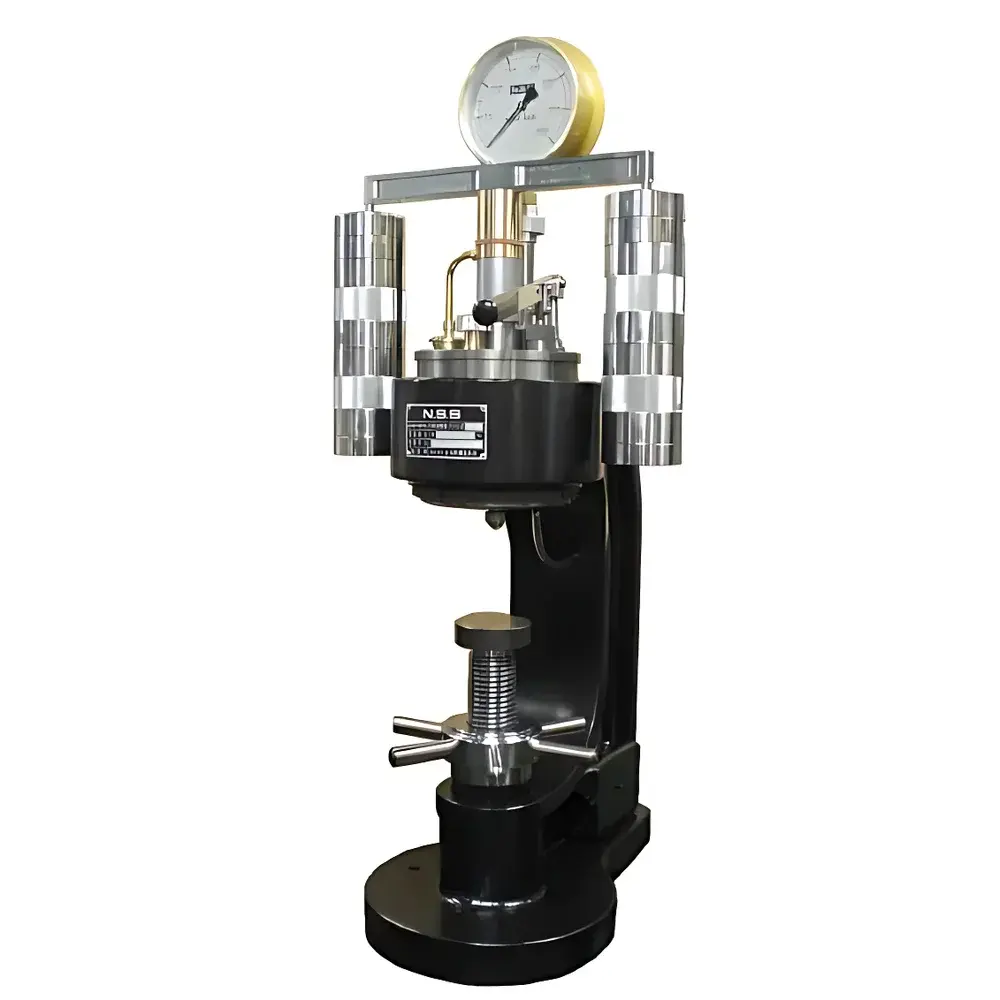
SOLY NBH3 Hydraulic Brinell Hardness Tester
| Brand | SOLY |
|---|---|
| Origin | Italy |
| Model | NBH3 |
| Instrument Type | Brinell Hardness Tester |
| Operating Principle | Hydraulic Load Application |
| Vertical Clearance | 200 mm |
| Height | 1100 mm |
| Depth (Front-to-Back) | 155 mm |
| Footprint | 430 × 510 mm |
| Weight | 175 kg |
| Standard Accessories | Brinell measuring microscope, 5 mm & 10 mm indentor holders, Brinell hardness conversion chart, Flat anvil, V-anvil, Storage case with vinyl cover |
Overview
The SOLY NBH3 Hydraulic Brinell Hardness Tester is a precision-engineered mechanical hardness testing system designed for reliable, repeatable Brinell hardness measurements in industrial quality control and metallurgical laboratories. Based on the standardized Brinell method (ISO 6506-1, ASTM E10), the NBH3 applies test loads—typically ranging from 500 kgf to 3000 kgf—via a calibrated hydraulic loading mechanism, ensuring stable force delivery without manual lever fatigue or operator-induced variability. Unlike electronic or servo-controlled systems, the NBH3’s purely hydraulic actuation provides inherent robustness, long-term stability, and immunity to power fluctuations—critical for foundries, rail infrastructure maintenance facilities, and heavy manufacturing environments where uptime and mechanical integrity are paramount. The instrument employs a hardened steel ball indenter (standard diameters: 10 mm, 5 mm) pressed into the surface of metallic specimens under controlled load duration (typically 10–15 seconds), and the resulting spherical indentation diameter is measured optically using the included Brinell measuring microscope. Hardness values (HBW) are calculated per the fundamental Brinell equation and cross-referenced against the supplied conversion chart.
Key Features
- Hydraulic load generation system delivering high-force consistency across the full range (500–3000 kgf), compliant with ISO 6506-2 verification requirements for force accuracy (±1.0% of indicated value).
- Rigid C-frame architecture with cast-iron base and reinforced upright column, engineered to minimize deflection during high-load indentation—essential for maintaining measurement fidelity on large, irregularly shaped components such as railway rails, crankshafts, and structural forgings.
- Adjustable vertical clearance of 200 mm accommodates thick-section samples including cast iron blocks, rolled steel plates, and heat-treated billets without repositioning or auxiliary support.
- Dual-indentor holder configuration (5 mm and 10 mm) enables rapid switching between standard Brinell test forces (e.g., 3000 kgf/10 mm for aluminum alloys; 500 kgf/5 mm for thin-walled ductile iron).
- Ergonomic manual operation with tactile load engagement lever and visual pressure gauge—designed for use in environments where dust, moisture, or electromagnetic interference preclude reliance on digital interfaces.
- Integrated flat and V-shaped anvils facilitate secure positioning of both planar and cylindrical workpieces (e.g., pipe sections, axles, gear blanks), minimizing slippage and ensuring perpendicular load application.
Sample Compatibility & Compliance
The NBH3 is optimized for bulk metallic materials exhibiting sufficient thickness (>10× indentation depth) and surface homogeneity, including carbon steels, alloy steels, cast irons, non-ferrous alloys (aluminum, copper, brass), and sintered metal parts. It complies with international standards governing Brinell hardness testing methodology and equipment verification: ISO 6506-1 (test method), ISO 6506-2 (verification of testing machines), ASTM E10 (standard test method for Brinell hardness), and EN ISO 6506-3 (calibration of reference blocks). Its mechanical design meets general requirements for GLP-compliant hardness testing stations—particularly where audit trails are maintained manually via logbooks and calibrated reference blocks traceable to national metrology institutes (e.g., NIST, PTB).
Software & Data Management
The NBH3 operates as a standalone mechanical tester and does not incorporate embedded firmware, touchscreens, or data export functionality. All measurement data—including indentation diameter (measured to ±0.01 mm via microscope reticle), applied load, dwell time, and calculated HBW—are recorded manually in laboratory notebooks or QC forms. Users may integrate the instrument into broader quality management systems by pairing it with external digital microscopes equipped with image-capture and analysis software (e.g., ImageJ-compatible platforms), though such configurations fall outside the scope of factory calibration. Calibration certificates for the hydraulic pressure gauge and reference hardness blocks must be renewed annually per ISO/IEC 17025 requirements.
Applications
- Verification of heat treatment efficacy in forged crankshafts and connecting rods used in locomotive and marine diesel engines.
- In-process hardness screening of continuously cast rail steel prior to milling and welding—ensuring compliance with UIC 860-2 and EN 13674-1 specifications.
- Acceptance testing of gray and ductile iron castings for infrastructure components (manhole covers, pump housings, valve bodies).
- Quality assurance of hot-rolled structural sections (I-beams, channels) in bridge and building construction supply chains.
- Metallurgical failure analysis labs conducting comparative hardness profiling across weld zones, HAZ regions, and base metal in rail joint assemblies.
FAQ
What standards does the NBH3 comply with for Brinell hardness testing?
The NBH3 conforms to ISO 6506-1, ASTM E10, and EN ISO 6506-2 for test execution and machine verification.
Can the NBH3 perform tests on curved surfaces?
Yes—using the supplied V-anvil, the instrument supports hardness evaluation of cylindrical parts such as shafts and pipes, provided surface curvature does not exceed allowable deviation per ISO 6506-1 Annex A.
Is periodic recalibration required?
Yes—the hydraulic pressure gauge and reference hardness blocks must be recalibrated annually by an accredited metrology laboratory per ISO/IEC 17025.
Does the NBH3 include automatic indentation measurement?
No—it relies on manual optical measurement using the included Brinell measuring microscope; no digital image analysis module is integrated.
What is the recommended maintenance schedule?
Daily cleaning of the anvil and indenter contact surfaces; biannual inspection of hydraulic oil level and seal integrity; annual full verification including force accuracy and indenter geometry assessment.



