
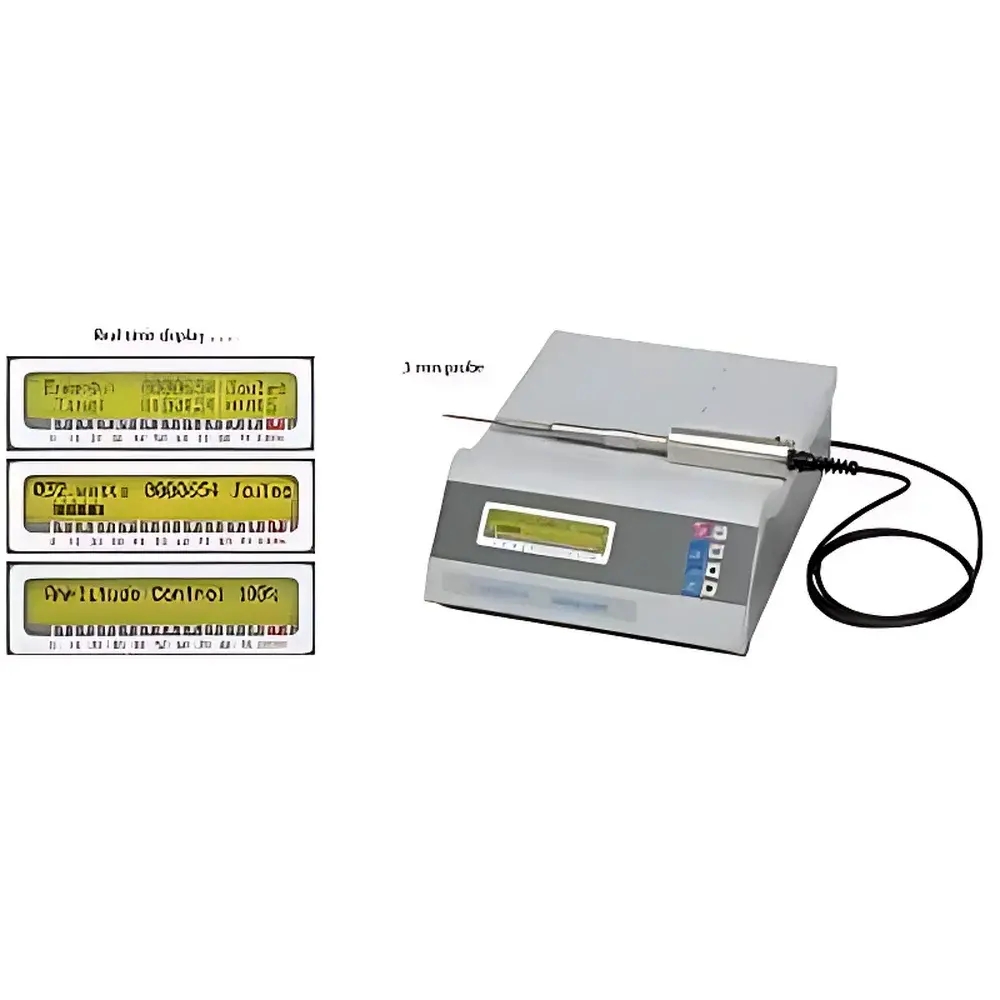
Sonics VCX130PB Hand-Triggered Pulsed Ultrasonic Cell Disruptor & VCX130FSJ Foot-Switch Pulsed Ultrasonic Cell Disruptor
| Brand | Sonics |
|---|---|
| Origin | USA |
| Model | VCX130PB (Hand-Triggered Pulse) & VCX130FSJ (Foot-Switch Pulse) |
| Output Power | 130 W |
| Frequency | 20 kHz |
| Dimensions (H×W×D) | 115 × 250 × 320 mm |
| Weight | 3.0 kg (VCX130PB), 3.2 kg (VCX130FSJ) |
| Transducer Models | CV188 (VCX130PB), CV18 (VCX130FSJ) |
| Transducer Specs | Ø32 mm × 146 mm, 340 g, cable length 1.5 m (VCX130PB), 1.8 m (VCX130FSJ) |
| Standard Probe | Ø3 mm titanium alloy (Ti-6Al-4V), 138 mm length, volume range 250 µL–10 mL, part #630-0422 |
| Input Power | 220 V, 50/60 Hz |
Overview
The Sonics VCX130PB and VCX130FSJ are benchtop ultrasonic cell disruptors engineered for precise, reproducible lysis of microbial, mammalian, and plant cells under controlled thermal and mechanical conditions. Based on piezoelectric transduction at a fixed resonant frequency of 20 kHz, these instruments generate high-intensity cavitation in liquid media via longitudinal acoustic energy transmission through a titanium alloy probe. The resulting transient microbubble collapse produces localized shear forces, pressure differentials exceeding 1000 atm, and rapid fluid streaming—mechanisms that effectively disrupt cellular membranes and subcellular structures without denaturing labile proteins or nucleic acids when operated with appropriate pulse parameters. Designed for routine use in molecular biology labs, bioprocessing development, and quality control environments, both models deliver a nominal 130 W of net acoustic output power with real-time amplitude stability ensured by automatic frequency tracking and closed-loop amplitude compensation.
Key Features
- Microprocessor-controlled operation with digital power display (0–100% full scale) and elapsed time counter for protocol traceability
- Automatic frequency tuning to maintain resonance despite load variation or probe wear
- Real-time amplitude compensation to sustain consistent energy delivery across sample viscosity changes
- Dual pulse activation options: VCX130PB features an ergonomic hand-held trigger switch enabling precise manual timing; VCX130FSJ integrates a heavy-duty footswitch for hands-free operation during multi-step workflows or glove-compatible environments
- Programmable pulse mode (on/off duration adjustable in 0.1-s increments) to minimize sample heating and preserve biomolecule integrity
- Robust titanium alloy (Ti-6Al-4V) probe construction—corrosion-resistant, non-reactive, and rated for repeated sterilization via autoclaving (121°C, 20 min)
- Compact footprint (115 × 250 × 320 mm) and low mass (<3.3 kg) facilitate integration into biosafety cabinets and cold rooms
Sample Compatibility & Compliance
These disruptors accommodate volumes from 250 µL to 10 mL using the standard Ø3 mm probe (P/N 630-0422), with optional probes (Ø2 mm, Ø6 mm, microtip, cup horn) available for specialized applications. Sample compatibility includes Gram-positive and Gram-negative bacteria (e.g., E. coli, B. subtilis), yeast (S. cerevisiae), cultured mammalian cells (HEK293, CHO), and plant tissue homogenates. Instrument design complies with IEC 61010-1 for electrical safety in laboratory equipment. When operated within validated pulse parameters and documented thermal management protocols (e.g., ice-water bath immersion, intermittent pulsing), data generated supports GLP-compliant reporting and aligns with common regulatory expectations for upstream bioprocessing documentation per FDA 21 CFR Part 11—particularly when paired with audit-trail-enabled third-party data capture software.
Software & Data Management
While the VCX130PB and VCX130FSJ operate as standalone instruments with embedded firmware, they support external data logging via RS-232 serial interface (optional USB-to-serial adapter). Time-stamped operational logs—including total run time, cumulative pulse count, average amplitude setting, and fault codes—can be exported for integration into LIMS or electronic lab notebooks (ELN). For laboratories requiring 21 CFR Part 11 compliance, Sonics recommends coupling device operation with validated third-party software platforms that provide user authentication, electronic signatures, and immutable audit trails. Firmware updates are distributed directly by Sonics Technical Support and require authorized service personnel.
Applications
- Preparation of soluble protein extracts for SDS-PAGE, Western blotting, and enzymatic assays
- Nuclear and mitochondrial isolation from eukaryotic cells with minimal organelle damage
- Chromatin shearing for ChIP-seq and ATAC-seq library preparation (when combined with optimized buffer systems)
- Endotoxin reduction in recombinant protein preparations via selective membrane disruption
- Cell lysis validation studies in QC release testing of biologics manufacturing processes
- Exosome and extracellular vesicle isolation from conditioned media
- Routine plasmid DNA extraction from bacterial cultures prior to alkaline lysis enhancement
FAQ
What is the difference between VCX130PB and VCX130FSJ?
The VCX130PB uses a handheld push-button switch for pulse initiation, offering tactile feedback and fine temporal control. The VCX130FSJ replaces this with a rugged footswitch, enabling hands-free activation—ideal for users wearing gloves or managing multiple vessels simultaneously.
Can the same probe be used interchangeably between both models?
Yes. Both instruments accept the same CV-series transducers (CV188 for VCX130PB; CV18 for VCX130FSJ) and share identical probe threading (standard 3/8″-24 UNF), allowing full probe compatibility across the VCX130 platform.
Is the 220 V version compatible with 230 V / 50 Hz European mains supply?
Yes—the power supply is auto-ranging (200–240 V, 50/60 Hz); no internal modification is required for operation in EU, UK, or APAC regions.
How often should the probe tip be inspected for erosion?
Visual inspection is recommended before each use. Tip pitting or diameter reduction >5% warrants replacement to ensure consistent energy transfer and avoid inconsistent lysis efficiency.
Does Sonics provide IQ/OQ documentation for GMP environments?
Standard units ship with factory calibration certificates. Site-specific Installation Qualification (IQ) and Operational Qualification (OQ) protocols are available upon request through Sonics Application Support and may be executed by certified field service engineers.




