
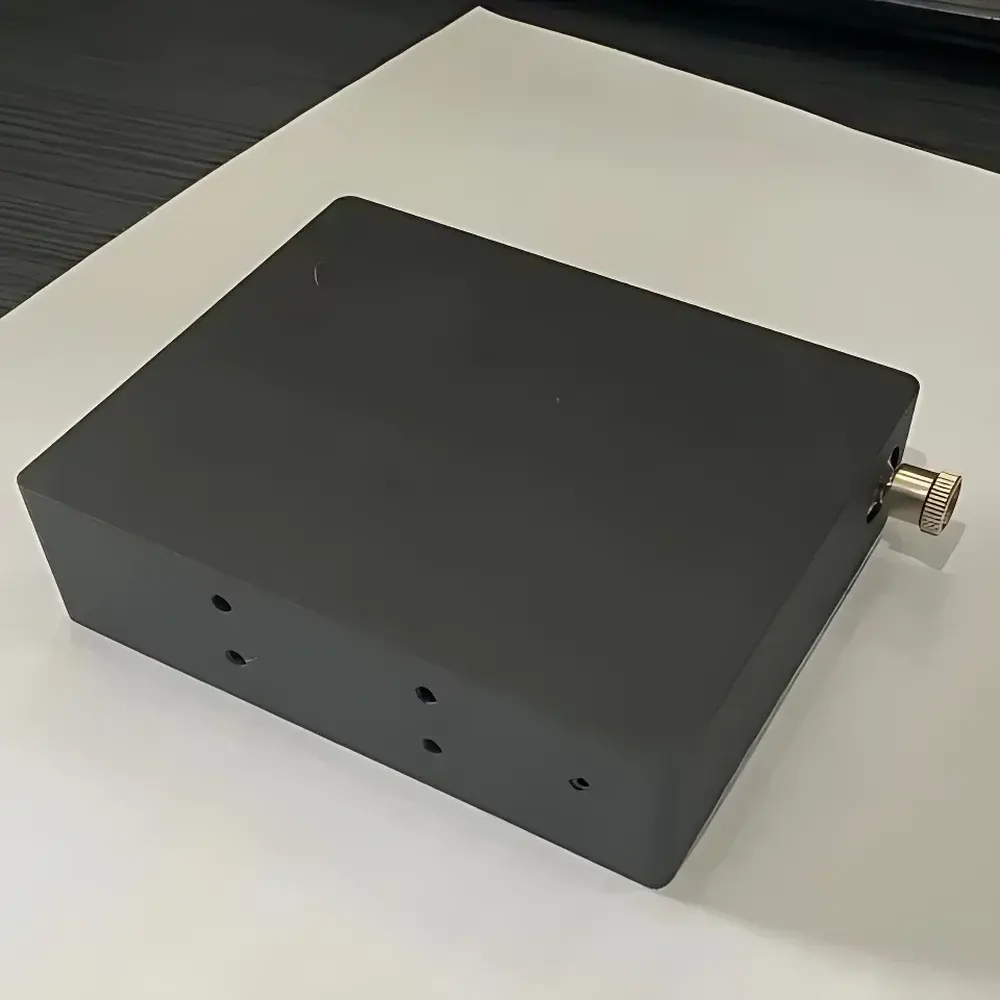
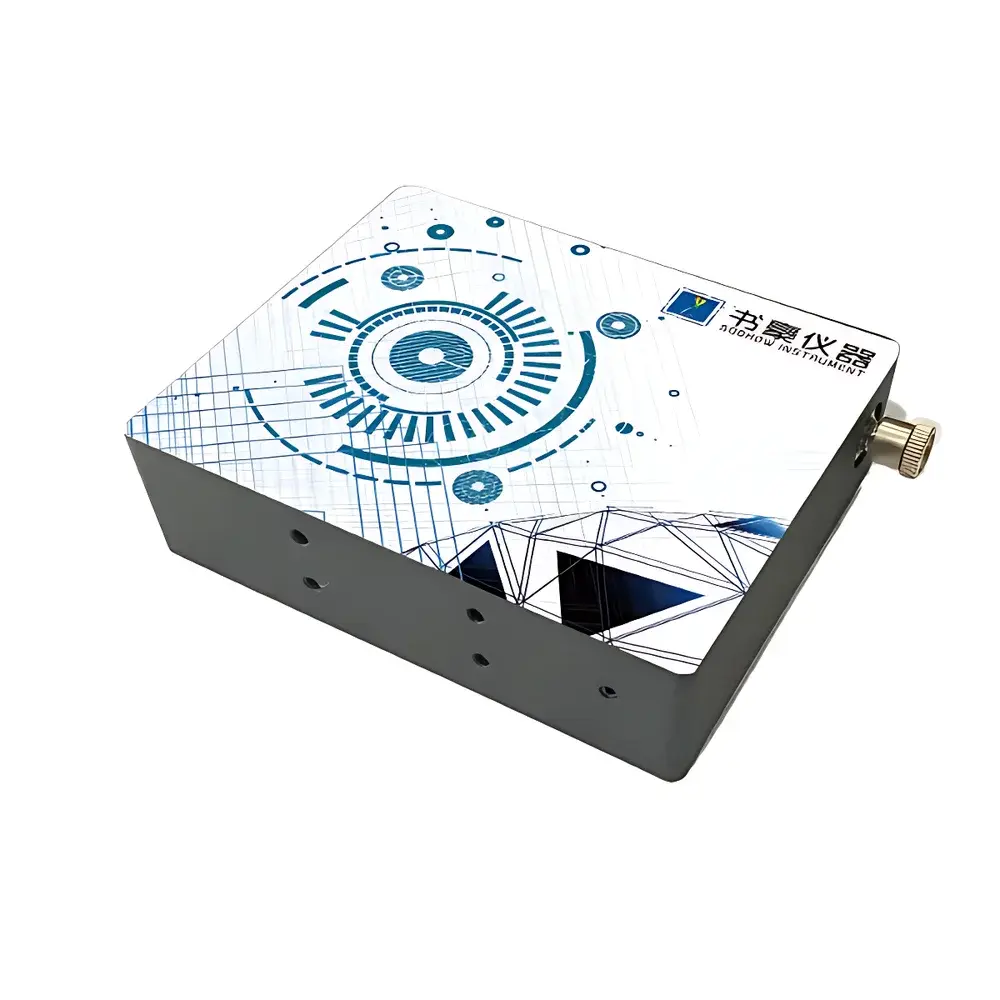
SOOHOW INSTRUMENT Cube2000 Fiber Optic Spectrometer
| Brand | SOOHOW INSTRUMENT |
|---|---|
| Origin | Jiangsu, China |
| Manufacturer Type | Direct Manufacturer |
| Detector Type | Linear CCD |
| Spectral Range | 500–800 nm |
| Optical Resolution (FWHM) | 0.4 nm |
| Slit Width | ≤30 µm |
| Grating | 1200 lines/mm, blazed reflective holographic grating |
| Fiber Interface | SMA905 (includes bundled optical fiber) |
| Output Interface | Standard linear CCD analog/digital output |
| Dimensions | ≤150 mm × 100 mm × 30 mm |
Overview
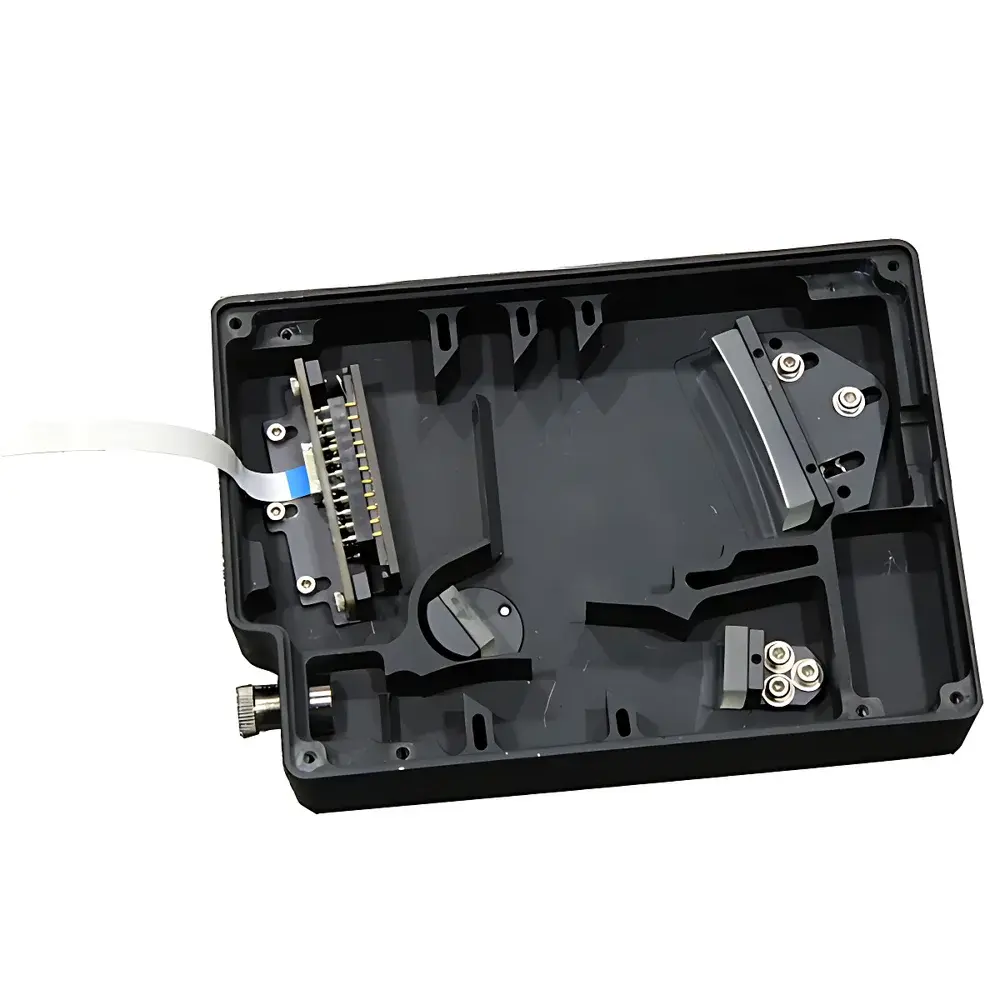
The SOOHOW INSTRUMENT Cube2000 Fiber Optic Spectrometer is a compact, high-performance benchtop spectrometer engineered for precise spectral acquisition in laboratory, industrial, and field-deployable applications. Based on a Czerny–Turner optical architecture with symmetric reflective collimating and focusing optics, the Cube2000 employs a blazed reflective holographic grating (1200 lines/mm) to achieve consistent dispersion across its designated spectral window. Light enters via an integrated SMA905 fiber connector, passes through a precision-machined slit (≤30 µm), is collimated, diffracted, and then focused onto a linear CCD detector array. This optomechanical design ensures high wavelength reproducibility, minimal stray light, and thermal stability under ambient operating conditions. The instrument operates within a fixed spectral range of 500–800 nm—optimized for visible-light characterization of LEDs, laser diodes, fluorescence emissions, colorimetric assays, and thin-film reflectance measurements.
Key Features
- Compact form factor (≤150 × 100 × 30 mm) enables integration into OEM systems, portable analyzers, and automated QC stations.
- Optimized Czerny–Turner layout with symmetric reflective optics minimizes aberrations and enhances signal-to-noise ratio (SNR) across the full spectral band.
- Blazed 1200 lines/mm reflective holographic grating delivers high diffraction efficiency (>65% at peak blaze wavelength) and low polarization sensitivity.
- Fixed-slit optical input (≤30 µm width) ensures repeatable spectral resolution of 0.4 nm (FWHM), verified per ISO 17025 traceable calibration protocols.
- Integrated SMA905 fiber interface supports standard 400 µm core multimode fibers; includes factory-aligned fiber patch cable with FC/PC or SMA terminations.
- Linear CCD detector provides analog and digital output compatibility, supporting both custom embedded firmware and third-party DAQ platforms (e.g., National Instruments, MATLAB Data Acquisition Toolbox).
Sample Compatibility & Compliance
The Cube2000 is compatible with any light source deliverable via optical fiber—including pulsed and continuous-wave (CW) sources such as halogen lamps, LEDs, laser diodes, and plasma emitters. It supports transmittance, reflectance, absorbance, and emission measurements when paired with appropriate reference standards (e.g., NIST-traceable tungsten halogen lamps, diffuse reflectance tiles). The device complies with CE marking requirements for electromagnetic compatibility (EMC Directive 2014/30/EU) and low-voltage safety (LVD Directive 2014/35/EU). While not certified for IEC 61000-4-x immunity testing out-of-box, its robust metal housing and grounded PCB layout provide inherent resilience in typical lab and light-industrial environments. For regulated environments (e.g., pharmaceutical QC labs), the Cube2000 can be validated per ASTM E275, ISO/IEC 17025, and USP spectroscopic system suitability guidelines when used with documented calibration procedures and reference materials.
Software & Data Management
The Cube2000 operates without proprietary lock-in software. It outputs raw CCD pixel intensity data via configurable analog voltage or digital TTL/CMOS signals, enabling direct integration with LabVIEW, Python (via PySerial or custom FPGA drivers), or C/C++-based control frameworks. Optional SDKs support real-time spectrum acquisition, dark current subtraction, wavelength calibration (polynomial or lookup-table-based), and photometric correction. All calibration coefficients—including pixel-to-wavelength mapping, nonlinearity correction, and temperature drift compensation coefficients—are stored in onboard EEPROM and accessible via serial command set. Audit trails, user-defined metadata tagging, and timestamped data export (CSV, HDF5) are supported in customer-developed applications aligned with FDA 21 CFR Part 11 requirements when deployed with validated electronic record systems.
Applications
- LED and OLED spectral power distribution (SPD) analysis for color rendering index (CRI), correlated color temperature (CCT), and chromaticity coordinate (x,y) calculation per CIE 15:2018.
- In-line monitoring of UV-Vis absorption peaks in liquid-phase chemical reactions, including kinetics studies of dye degradation or enzyme-catalyzed processes.
- Fluorescence excitation/emission profiling for bioassays, quantum dot characterization, and sensor development.
- Thin-film interference measurement using reflectance spectra to extract thickness and refractive index via envelope analysis or transfer-matrix modeling.
- Plasma emission fingerprinting in semiconductor process chambers or environmental combustion diagnostics.
- Educational use in undergraduate optics and analytical chemistry laboratories for hands-on spectroscopy training and instrument design projects.
FAQ
What calibration standards are recommended for routine verification?
NIST-traceable tungsten halogen lamps (e.g., Ocean Insight STAN-SSH or Avantes HL-2000) are recommended for irradiance calibration; calibrated reflectance standards (e.g., Labsphere SRS-99-020) are advised for reflectance mode.
Can the Cube2000 operate in triggered acquisition mode?
Yes—external TTL trigger input is available on the rear I/O header, supporting synchronization with pulsed light sources or motion stages.
Is temperature stabilization included?
No active thermoelectric cooling is integrated; however, the optical bench and CCD mounting are designed for passive thermal equilibrium, with spectral drift <0.05 nm/°C over 15–35 °C ambient range.
What is the maximum integration time supported?
Integration time is software-defined and ranges from 1 ms to 10 s, limited only by the connected DAQ system’s timing resolution and CCD saturation threshold.
Does SOOHOW provide OEM customization options?
Yes—custom slit widths, alternate gratings (e.g., 600 or 1800 lines/mm), alternative detectors (e.g., back-thinned CCD or CMOS), and enclosure modifications are available under NDA and volume agreement.






