
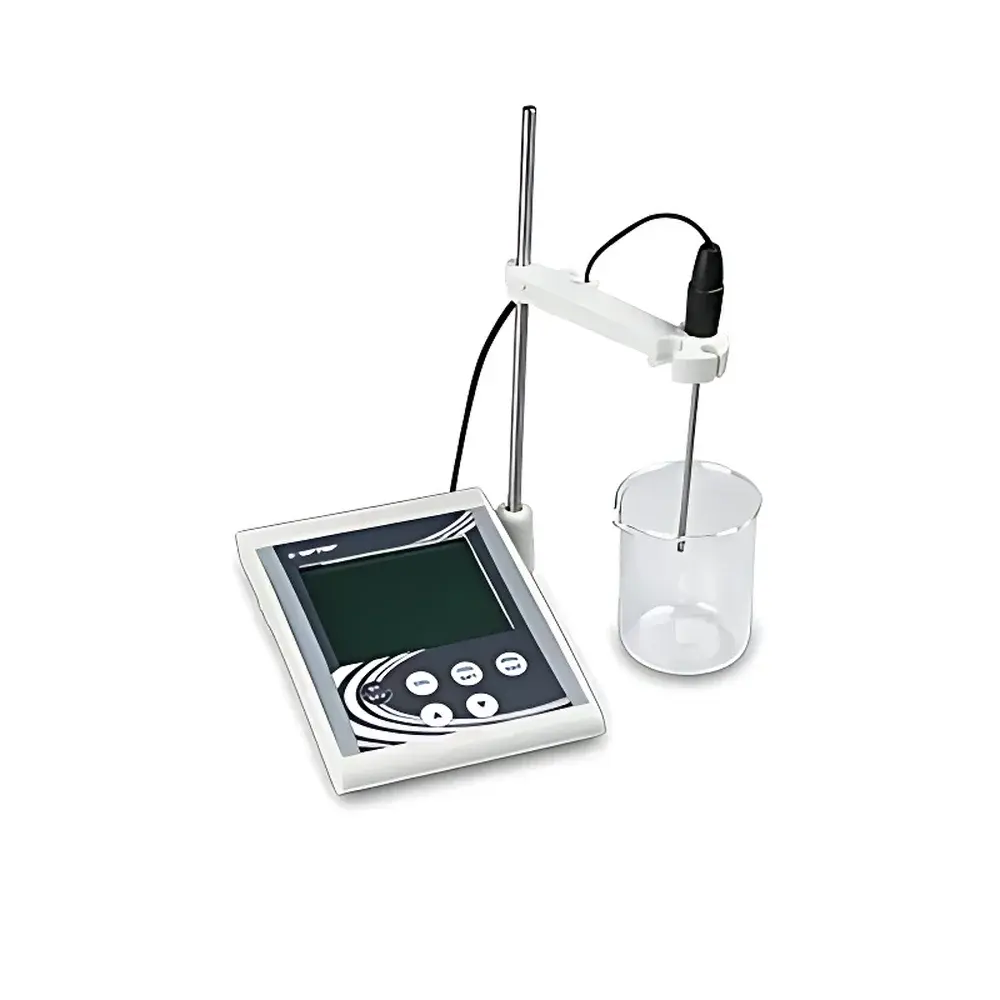
SOP TOP DO6400 Benchtop Dissolved Oxygen Meter
| Brand | SOP TOP |
|---|---|
| Origin | Shanghai, China |
| Model | DO6400 |
| Measurement Range | 0.00–40.00 mg/L, 0.0–400.0% |
| Resolution | 0.01 mg/L, 0.1% |
| Accuracy | ±1.5% F.S. |
| Temperature Range | −5.0–120.0 °C (23.0–248.0 °F) |
| Temp. Resolution | 0.1 °C/°F |
| Temp. Accuracy | ±0.3 °C, ±0.5 °F |
| Salinity Compensation | 0.0–45.0 ppt |
| Pressure Compensation | 450–800 mmHg (0.500–1.100 bar) |
| Pipeline Pressure Compensation | 0.00–1.00 kg |
| Depth Compensation | 0.0–10.0 m |
| Data Storage | 100 sets |
| Auto-off | Configurable (default: 10 min idle) |
Overview
The SOP TOP DO6400 Benchtop Dissolved Oxygen Meter is a precision electrochemical instrument engineered for reliable, repeatable measurement of dissolved oxygen (DO) concentration in aqueous solutions across laboratory, quality control, environmental monitoring, and process validation applications. It employs polarographic (Clark-type) or galvanic cell sensor technology—depending on the configured electrode—to quantify oxygen partial pressure via amperometric current generation proportional to O₂ diffusion through a selective membrane. The instrument integrates dual-unit reporting (mg/L and % saturation), automatic temperature compensation (ATC), and multi-parameter environmental correction (salinity, barometric pressure, pipeline pressure, and liquid depth) to ensure traceable accuracy under variable field and lab conditions. Designed for ISO/IEC 17025-aligned workflows, the DO6400 supports calibration verification per ASTM D888 and EPA Method 360.5, delivering measurement integrity suitable for GLP-compliant documentation and regulatory submissions.
Key Features
- High-contrast 5-inch multi-line LCD display with scratch-resistant surface and user-selectable high-brightness backlight for optimal readability in ambient or low-light environments
- Comprehensive environmental compensation: automatic temperature (−5.0 to 120.0 °C), salinity (0.0–45.0 ppt), barometric pressure (450–800 mmHg), pipeline pressure (0.00–1.00 kg), and immersion depth (0.0–10.0 m)
- Real-time electrode diagnostics including slope (%/decade) and offset (mV) display during calibration—enabling rapid assessment of membrane integrity and electrolyte stability
- Configurable auto-power-off (default 10-minute idle timeout) and audible keypress feedback (Beep) for tactile confirmation without visual distraction
- Onboard data logging for up to 100 measurement records, each timestamped and tagged with temperature, compensation parameters, and electrode status
- Dual-mode temperature adjustment: automatic sensing via integrated Pt1000 thermistor or manual offset correction (±5.0 °C range) to accommodate non-standard thermal equilibration scenarios
- USB-B interface compliant with USB 2.0 standards; supports direct connection to Windows-based PCs for real-time data streaming and firmware updates
Sample Compatibility & Compliance
The DO6400 is validated for use with standard BOD bottles, flow-through cells, and static beaker configurations. It accepts industry-standard Clark-type and galvanic DO probes with TPE or silicone membranes (e.g., SOP TOP DO-100 series). All measurements adhere to temperature-dependent solubility models aligned with APHA Standard Methods 4500-O G and ISO 5814:2012. The instrument’s pressure and salinity compensation algorithms are derived from the Benson–Krause equation and Weiss–Price empirical corrections, ensuring conformity with USP and EP 2.2.47 requirements for oxygen quantification in pharmaceutical water systems. Device firmware and calibration logs maintain audit trails compatible with FDA 21 CFR Part 11 readiness when used with validated software.
Software & Data Management
The included PC-based data acquisition software provides full bidirectional communication via USB. It enables real-time graphing, customizable report templates (PDF/CSV/XLSX export), and batch calibration certificate generation with operator ID, date/time stamp, and reference standard traceability (NIST-traceable zero and span gases or Winkler titration references). Software features include configurable alarm thresholds, statistical summaries (mean, SD, RSD), and GLP-compliant electronic signatures. Raw data files retain native metadata—including sensor serial number, compensation flags, and diagnostic flags—ensuring full chain-of-custody integrity for internal audits or regulatory inspections.
Applications
- Environmental laboratories performing wastewater effluent monitoring per NPDES permit requirements
- Pharmaceutical manufacturing units validating purified water (PW) and water-for-injection (WFI) systems per USP
- Academic research labs studying aerobic biodegradation kinetics, microbial respiration rates, or aquatic ecosystem modeling
- Beverage and food processing QA/QC teams verifying deaeration efficiency in carbonated drink production lines
- Aquaculture facilities maintaining optimal DO levels in recirculating aquaculture systems (RAS) with depth- and salinity-compensated readings
- Chemical process development labs assessing oxygen mass transfer coefficients (kLa) in stirred-tank reactors
FAQ
What electrode types are compatible with the DO6400?
The meter supports both polarographic (with external polarization voltage) and galvanic (self-polarizing) dissolved oxygen sensors featuring standardized BNC or DIN connectors and 12-mm shaft diameters.
Does the DO6400 meet regulatory requirements for pharmaceutical water testing?
Yes—when operated with calibrated electrodes and documented procedures, it satisfies USP , EP 2.2.47, and ISO 5814:2012 for DO measurement in PW/WFI, provided environmental compensation parameters are recorded and verified.
Can measurement data be exported directly to LIMS?
Yes—the included software supports CSV and Excel exports with column headers mapped to common LIMS ingestion schemas; custom API integration is available upon request via SOP TOP’s technical support team.
Is firmware upgrade capability built into the device?
Yes—USB-connected firmware updates are performed via the desktop software, with version rollback and checksum verification to ensure system integrity.
How is calibration traceability maintained?
Each calibration event stores sensor slope, offset, reference values, operator ID, and timestamp in non-volatile memory; reports generated by the software include digital signatures and NIST-traceable reference standard identifiers where applicable.






