
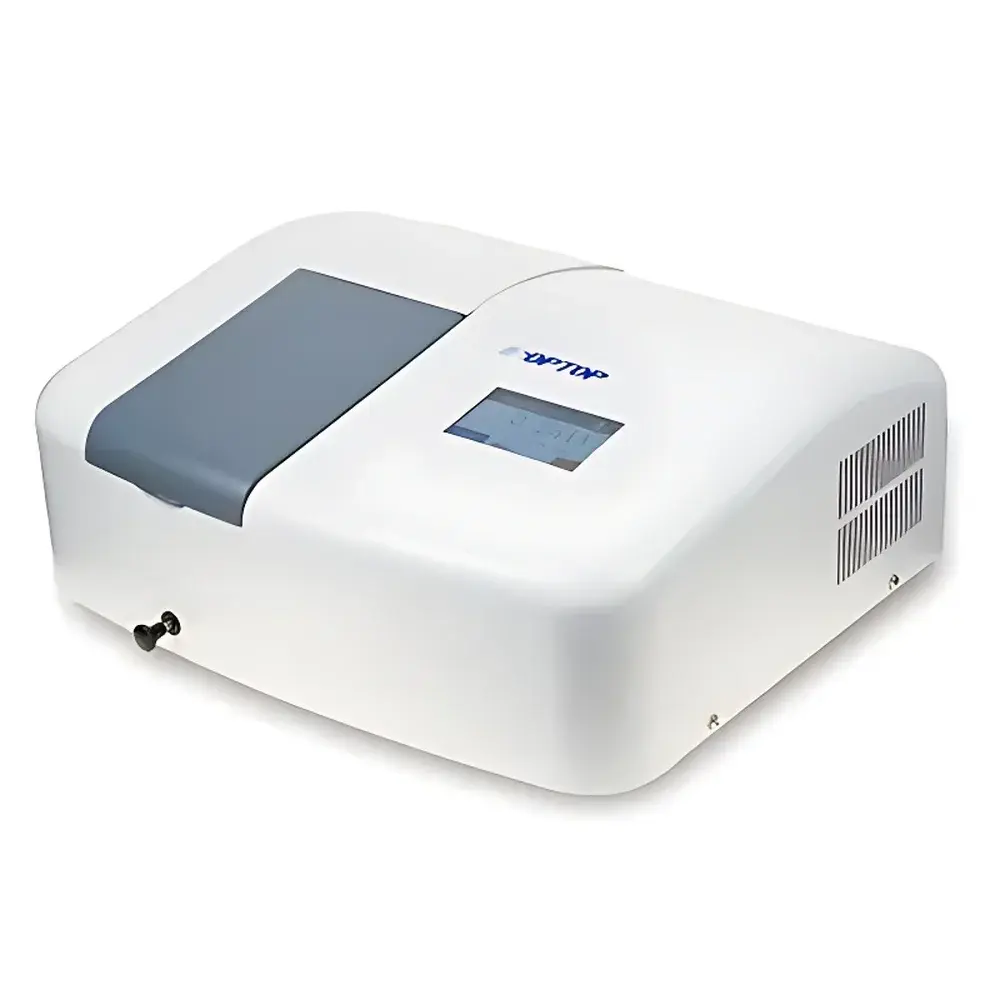
SOPOTOP 754 UV-Vis Spectrophotometer
| Brand | SOPOTOP |
|---|---|
| Origin | Shanghai, China |
| Model | 754 |
| Optical System | Single-beam |
| Detector Type | Photocell |
| Wavelength Range | 190–1100 nm |
| Wavelength Accuracy | ±0.5 nm |
| Spectral Bandwidth | 4 nm |
| Wavelength Scanning Step | 0.1 nm |
| Display | 4.3-inch color touchscreen (480×272) |
| Data Interface | USB |
| Software | UV-Solution workstation (optional) |
| Power Supply | 220 V ±10%, 50 Hz / 110 V ±10%, 60 Hz, 90 W |
| Net Weight | 10.5 kg |
| Dimensions (W×D×H) | 470×380×225 mm |
Overview
The SOPOTOP 754 UV-Vis Spectrophotometer is a single-beam, microprocessor-controlled optical instrument engineered for routine quantitative and qualitative analysis in academic laboratories, quality control environments, and industrial R&D settings. It operates on the fundamental principle of Beer–Lambert law-based absorbance measurement, utilizing a Czerny–Turner (C-T) monochromator with a 1200-line/mm holographic grating to deliver stable spectral dispersion across a broad wavelength range from 190 nm to 1100 nm. With a fixed spectral bandwidth of 4 nm and wavelength setting accuracy of ±0.5 nm, the system ensures high reproducibility for applications requiring compliance with standard methods defined in ISO 6425, ASTM E275, and USP . Its compact benchtop architecture, integrated 4.3-inch color touchscreen interface, and low power consumption (90 W) support deployment in space-constrained labs without compromising analytical robustness.
Key Features
- Single-beam optical design optimized for stability and cost-effective operation in high-throughput educational and QC labs
- Automated wavelength selection with 0.1 nm step resolution and rapid scanning capability
- 4.3-inch high-resolution color touchscreen (480 × 272 pixels) enabling intuitive navigation and real-time parameter adjustment
- Direct concentration readout functionality with user-definable concentration factors and multi-point calibration support
- Linear regression and polynomial curve fitting (up to third-order) for quantitative analysis across single-, dual-, and triple-wavelength modes
- DNA/protein quantification module with built-in A260/A280 ratio calculation, preloaded protocols for nucleic acid and protein assays, and customizable wavelength/factor configurations
- Comprehensive spectral acquisition modes: photometric measurement, wavelength scanning (absorbance/transmittance/energy), kinetic time-scanning, multi-wavelength analysis, and 3D spectral mapping
Sample Compatibility & Compliance
The SOPOTOP 754 accommodates standard 10 mm pathlength cuvettes (glass, quartz, or plastic), supporting liquid-phase samples across aqueous, organic, and buffered matrices. Its wavelength coverage—from deep UV (190 nm) through visible to near-IR (1100 nm)—enables analysis of transition metal complexes, organic chromophores, biological macromolecules, and semiconductor nanomaterials. The instrument complies with general safety requirements per IEC 61010-1 and electromagnetic compatibility standards EN 61326-1. Optional UV-Solution software supports audit trail functionality aligned with FDA 21 CFR Part 11 requirements when configured with user authentication, electronic signatures, and immutable data logging—making it suitable for GLP- and GMP-regulated environments where traceability and data integrity are mandatory.
Software & Data Management
UV-Solution workstation software (optional add-on) provides full instrument control and advanced data processing capabilities. It enables export of raw and processed datasets to Excel (.xlsx) format, BMP image export for publication-ready spectral figures, and standardized reporting templates compliant with internal lab documentation protocols. Data handling includes baseline correction, smoothing (Savitzky–Golay), derivative spectroscopy (up to fourth order), peak/valley detection, overlay comparison, and arithmetic operations between spectra. All measurement sessions—including method parameters, operator ID, timestamp, and instrument configuration—are recorded in a tamper-evident log when audit trail mode is enabled. USB connectivity facilitates seamless transfer of methods, calibration files, and results between instruments and centralized data repositories.
Applications
This spectrophotometer serves as a foundational tool for teaching spectroscopic principles in undergraduate chemistry curricula and for performing validated assays in pharmaceutical, food, environmental, and biochemical laboratories. Typical use cases include determination of molar absorptivity coefficients, verification of reagent purity, monitoring enzymatic reaction kinetics, quantifying residual solvents via UV absorption, assessing water quality parameters (e.g., nitrate, phosphate), and verifying dye concentrations in textile manufacturing. Its DNA/protein analysis module supports rapid assessment of nucleic acid integrity and protein concentration in molecular biology workflows, while multi-wavelength and time-scan functions support formulation stability studies and photochemical degradation monitoring.
FAQ
What is the minimum detectable absorbance value for the SOPOTOP 754?
The instrument achieves a photometric noise level of ≤0.002 Abs at 500 nm (RMS), enabling reliable measurements down to approximately 0.005 Abs under optimal conditions.
Is quartz cuvette compatibility supported across the full 190–1100 nm range?
Yes—quartz cuvettes are required for measurements below 350 nm; standard optical glass cuvettes are suitable for wavelengths above 350 nm.
Can UV-Solution software be installed on Windows 11 systems?
Yes, UV-Solution v3.2 and later versions are certified for Windows 10 and Windows 11 (64-bit) platforms.
Does the 754 model support method validation per ICH Q2(R2)?
While the hardware meets basic performance criteria (wavelength accuracy, photometric linearity), formal method validation requires supplementary system suitability testing using NIST-traceable reference standards and documented protocol execution.
Is remote instrument control possible via LAN or Ethernet?
No—the 754 features only USB 2.0 connectivity; networked operation requires external USB-to-Ethernet adapters and third-party middleware integration.







