
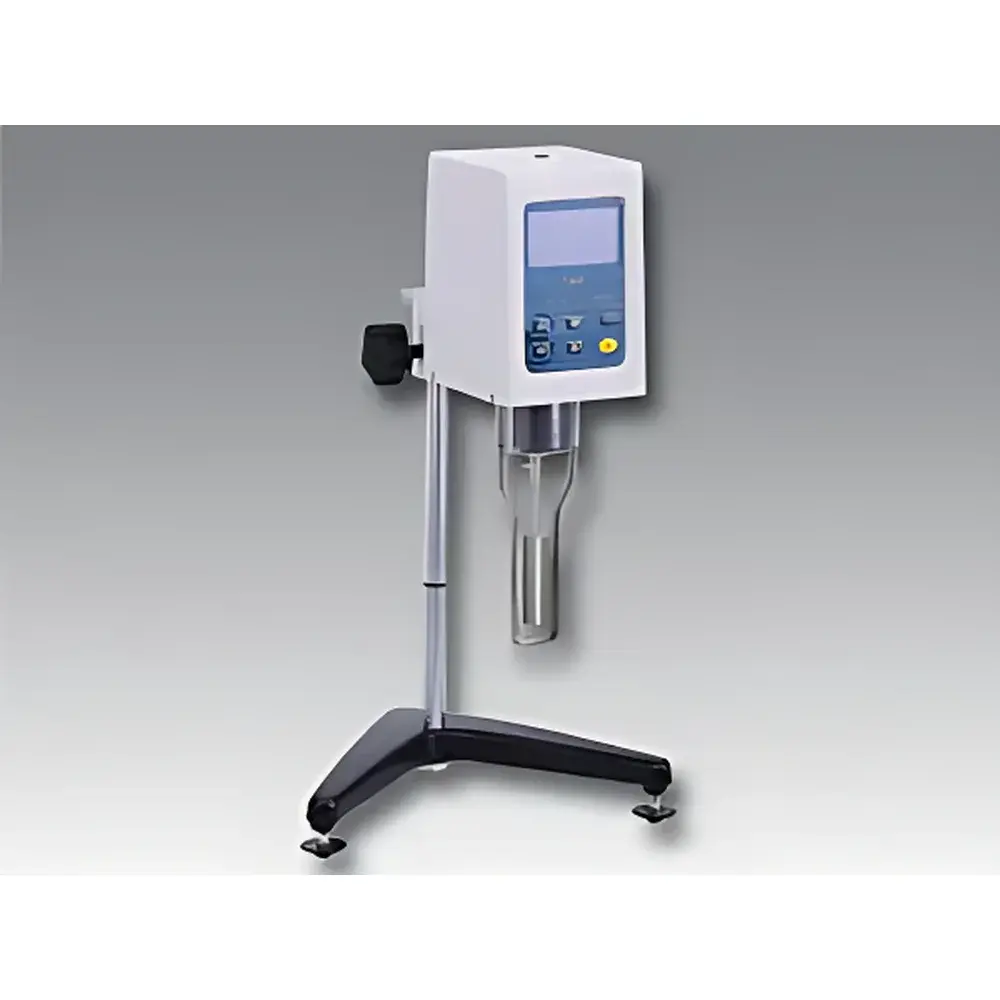
SOPOTOP NDJ-8S Digital Rotational Viscometer
| Brand | SOPOTOP |
|---|---|
| Origin | Shanghai, China |
| Model | NDJ-8S |
| Instrument Type | Rotational Viscometer |
| Viscosity Range | 10–2×10⁶ mPa·s |
| Speed Settings | 0.3, 0.6, 1.5, 3, 6, 12, 30, 60 rpm |
| Accuracy (Newtonian fluids) | ±5% |
| Dimensions | 275 × 230 × 475 mm |
| Power Input | 110–240 V AC, 50/60 Hz |
| Display | Digital LCD with English interface |
| Motor Control | Microprocessor-controlled synchronous motor |
| Compliance | Designed for routine QC and R&D use in accordance with ISO 2555 and ASTM D2196 principles |
Overview
The SOPOTOP NDJ-8S Digital Rotational Viscometer is a precision-engineered instrument designed for the reliable measurement of dynamic (absolute) viscosity in Newtonian and near-Newtonian fluids. Operating on the principle of rotational viscometry—where torque required to rotate a spindle at a defined angular velocity within a fluid sample is quantified—the NDJ-8S delivers reproducible results across an extended viscosity range from 10 to 2×10⁶ mPa·s. Its robust mechanical architecture, coupled with a microprocessor-controlled synchronous motor, ensures consistent rotational speed regardless of minor fluctuations in mains frequency—a critical advantage in laboratory environments where stable power supply cannot be guaranteed. The device complies with fundamental measurement principles outlined in ISO 2555 (Plastics — Resins in the liquid state — Determination of apparent viscosity) and ASTM D2196 (Standard Test Methods for Rheological Properties of Non-Newtonian Materials by Rotational (Brookfield) Viscometer), making it suitable for method transfer and comparative analysis in regulated and non-regulated settings.
Key Features
- Digital LCD display with full English user interface, supporting intuitive operation and real-time parameter readout
- Eight precisely calibrated rotational speeds (0.3, 0.6, 1.5, 3, 6, 12, 30, and 60 rpm) to accommodate diverse sample rheology and shear rate requirements
- Four standard L-type spindles (No. 1–4) enabling optimal torque matching across low-, medium-, and high-viscosity regimes
- Wide input voltage tolerance (110–240 V AC, 50/60 Hz), eliminating need for external voltage stabilizers in global lab deployments
- High-stability synchronous motor with closed-loop speed feedback, delivering ±0.5% speed accuracy under load
- Compact benchtop footprint (275 × 230 × 475 mm) optimized for space-constrained QC laboratories and pilot-scale development facilities
Sample Compatibility & Compliance
The NDJ-8S is routinely deployed for quality control and formulation screening of industrial fluids including lubricating oils, edible oils, polymer solutions, pharmaceutical suspensions, cosmetic emulsions, adhesives, and coating formulations. It supports manual sample loading in standard 600-mL beakers or optional jacketed vessels for temperature-controlled measurements (when used with external circulators). While the instrument itself does not include integrated temperature sensing or Peltier control, its mechanical design permits seamless integration with third-party thermal management systems. All measurements adhere to the fundamental definition of dynamic viscosity (η = τ/γ̇), where τ is shear stress and γ̇ is shear rate—ensuring traceability to SI units. Documentation and calibration records are structured to support GLP-compliant workflows; audit trails for operator entries, speed selections, and spindle identification may be maintained manually per internal SOPs.
Software & Data Management
The NDJ-8S operates as a standalone instrument with no proprietary software dependency. All measurement data—including viscosity value (mPa·s), selected speed (rpm), spindle number, and elapsed time—is displayed and retained on-screen until overwritten. For laboratories requiring electronic data capture, analog output (0–5 V DC) is available via rear-panel connector for integration with PLCs, DAQ systems, or custom LabVIEW-based acquisition platforms. When paired with optional RS-232 or USB-to-serial adapters (sold separately), the device supports ASCII-formatted data streaming for automated logging into CSV or database formats. This architecture aligns with FDA 21 CFR Part 11 readiness when implemented alongside validated third-party data acquisition software that enforces user authentication, electronic signatures, and change control.
Applications
- Batch release testing of industrial lubricants and hydraulic fluids per OEM specifications
- Formulation development of food-grade thickeners (e.g., xanthan gum, CMC) and monitoring of thermal degradation effects
- Stability assessment of topical pharmaceutical gels and ointments during accelerated aging studies
- QC verification of paint and ink viscosity prior to spray application or gravure printing
- Educational use in university materials science and chemical engineering labs for teaching Newtonian flow behavior
- Raw material qualification of silicone oils, epoxy resins, and polyol prepolymers in adhesive manufacturing
FAQ
What spindle configurations are included with the NDJ-8S?
The instrument ships with four L-type spindles (No. 1–4), each optimized for specific viscosity sub-ranges within the overall 10–2×10⁶ mPa·s span.
Does the NDJ-8S support temperature-controlled measurements?
It does not feature built-in temperature control; however, it is fully compatible with external water baths or Peltier-cooled sample holders via standard 600-mL beaker mounting.
Is calibration traceable to national standards?
Yes—calibration can be performed using NIST-traceable silicone oil standards (e.g., Cannon, Brookfield CertiCal series), and SOPOTOP provides calibration certificate templates aligned with ISO/IEC 17025 documentation practices.
Can the NDJ-8S measure non-Newtonian fluids?
It provides single-point viscosity values at discrete shear rates; for full shear-rate sweeps or yield stress determination, a controlled-stress rheometer is recommended.
What maintenance is required for long-term accuracy?
Annual verification of spindle geometry (diameter, length, surface finish) and torque sensor linearity is advised; cleaning with isopropanol after each use prevents residue buildup and preserves measurement fidelity.



