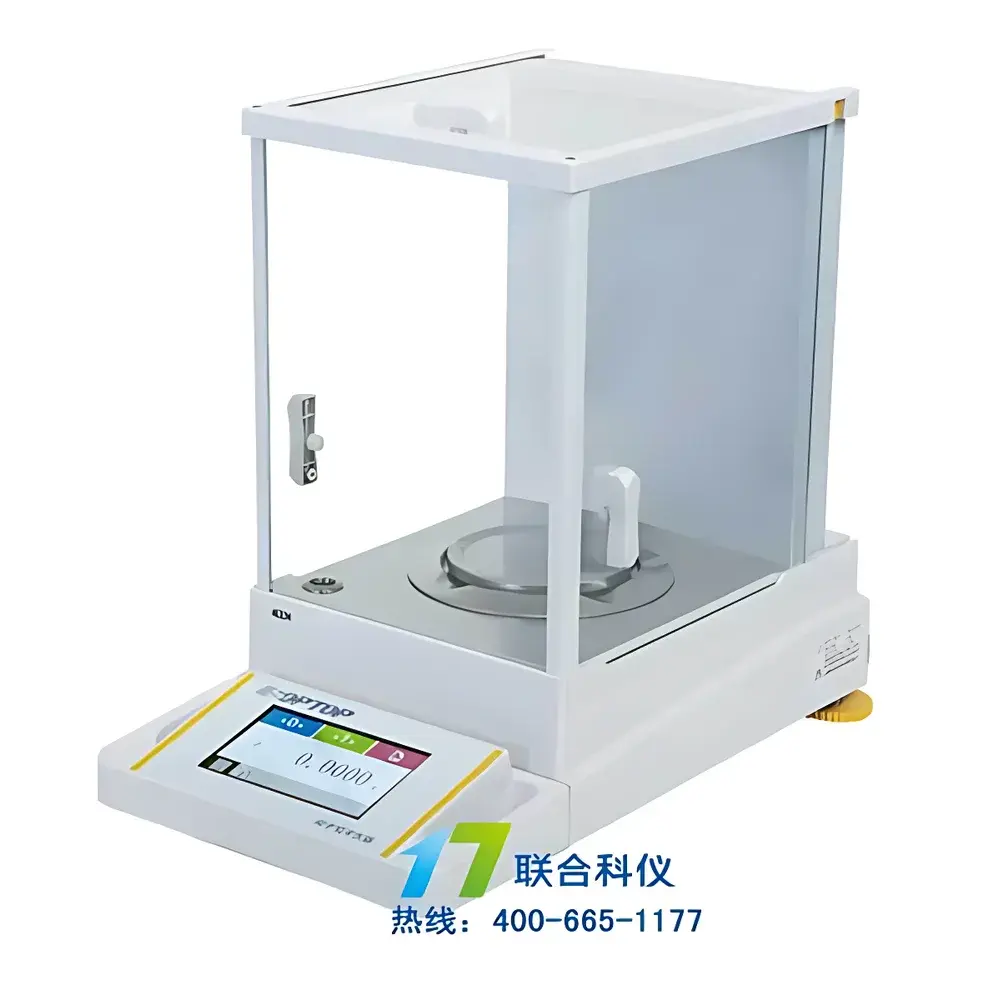
Soptop AE523 Precision Laboratory Balance
| Brand | Soptop |
|---|---|
| Origin | Shanghai, China |
| Model | AE523 |
| Instrument Type | Precision Balance |
| Maximum Capacity | 500 g |
| Readability | 0.001 g |
| Repeatability | 0.001 g |
| Calibration | External |
| Pan Diameter | Ø90 mm |
| Dimensions (W×D×H) | 365 × 223 × 338 mm |
| Net Weight | 5.5 kg |
| Windshield Internal Volume | 160 × 165 × 200 mm |
Overview
The Soptop AE523 Precision Laboratory Balance is an entry-level analytical-grade instrument engineered for routine quantitative weighing tasks in quality control laboratories, educational institutions, and R&D environments where reproducibility and operational efficiency are prioritized over ultra-micro resolution. Based on electromagnetic force compensation (EMFC) transduction technology, the AE523 delivers stable, drift-compensated mass measurements under standard ambient conditions (20–25 °C, ≤60% RH). Its 500 g maximum capacity and 1 mg readability meet the performance requirements defined in ISO 9001-compliant weighing processes and align with general-purpose applications outlined in USP for non-critical pharmaceutical weighing operations. The balance is designed to operate within Class II laboratory environments per ISO/IEC 17025:2017 guidelines and supports traceable calibration using NIST-traceable external weights.
Key Features
- True-color TFT LCD display with high-contrast graphics and intuitive icon-based navigation — optimized for rapid visual interpretation of weight values, stability indicators, and status alerts.
- Capacitive full-screen touch interface with glove-compatible sensitivity — enables reliable operation with standard nitrile or latex gloves without requiring stylus or pressure adjustment.
- Ergonomic front-panel leveling system with integrated bubble level indicator — simplifies horizontal alignment verification and minimizes setup time before first-use calibration.
- Integrated overload protection mechanism at the weighing pan — employs a mechanical stop-and-dampening structure to safeguard the EMFC sensor from accidental impact or excessive load beyond 110% of rated capacity.
- Dual-layer acrylic windshield with sliding front door and removable side panels — provides effective draft shielding while allowing unobstructed access during sample placement and cleaning.
- Transport lock with reinforced glass-door retention system — secures the pan assembly and optical components during relocation, reducing risk of internal misalignment.
- Pre-installed application modes including parts counting, percentage weighing, density determination (with optional kit), and dynamic weighing — accessible via hierarchical menu navigation without software installation.
- Robust ABS housing with chemical-resistant surface finish — withstands incidental exposure to common solvents, acids, and bases encountered in general lab workflows.
Sample Compatibility & Compliance
The AE523 accommodates standard laboratory vessels (e.g., beakers, crucibles, weighing boats) up to Ø90 mm diameter and 200 mm height within its enclosed windscreen. It complies with CE marking requirements under the EU Measuring Instruments Directive (MID 2014/32/EU) for non-automatic weighing instruments (NAWI). While not certified for GLP/GMP-regulated critical weighing (e.g., API dispensing), it satisfies documentation and procedural requirements for ISO/IEC 17025 Clause 6.4.8 regarding equipment suitability and verification. Routine calibration records, zero-point verification logs, and user-defined calibration intervals can be manually documented to support internal audit trails.
Software & Data Management
The AE523 features RS232 serial interface for direct connection to PCs or label printers; no proprietary drivers required. ASCII-formatted output supports seamless integration with LIMS platforms, Excel-based data logging, and custom Python or LabVIEW scripts. All communication adheres to standard Mettler Toledo-compatible protocol (MT-SICS), enabling interoperability with third-party data acquisition tools. Though the device lacks built-in Ethernet or Wi-Fi, its serial interface permits connection to USB-to-RS232 adapters compliant with FTDI chipset standards. Audit trail functionality is maintained externally through timestamped log files generated by host software — consistent with FDA 21 CFR Part 11 principles when paired with validated data capture systems.
Applications
- Raw material verification and batch release testing in food, cosmetics, and fine chemical manufacturing.
- Student laboratory exercises in chemistry, biology, and materials science curricula requiring sub-milligram precision.
- Weighing of reagents, catalysts, and standards for HPLC, GC, and titration preparation workflows.
- Parts counting for small hardware components (e.g., screws, washers, electronic connectors) in production QA settings.
- Moisture content estimation via loss-on-drying protocols when used with compatible heating modules (sold separately).
- Calibration verification of pipettes and volumetric glassware using gravimetric methods per ISO 8655-6.
FAQ
What calibration weight is required for the AE523?
A 500 g Class M2 or better external calibration weight, certified to ISO/IEC 17025, is recommended for full-range verification.
Is the AE523 suitable for GMP-regulated environments?
It may be deployed in non-critical GMP areas (e.g., packaging line checks) provided calibration, maintenance, and usage records are fully documented per site SOPs; however, it does not include 21 CFR Part 11-compliant electronic signature or automated audit trail capabilities.
Can the balance be used in a fume hood?
No — operation inside a fume hood is not advised due to airflow-induced instability; use only in still-air, vibration-isolated benchtop locations.
Does the AE523 support automatic internal calibration?
No — calibration is external only; no motorized internal weight or temperature-compensated self-calibration module is included.
What is the warm-up time before first measurement?
Minimum 30 minutes at stable room temperature (20–25 °C) is required to achieve thermal equilibrium of the EMFC sensor and ensure specified repeatability.