
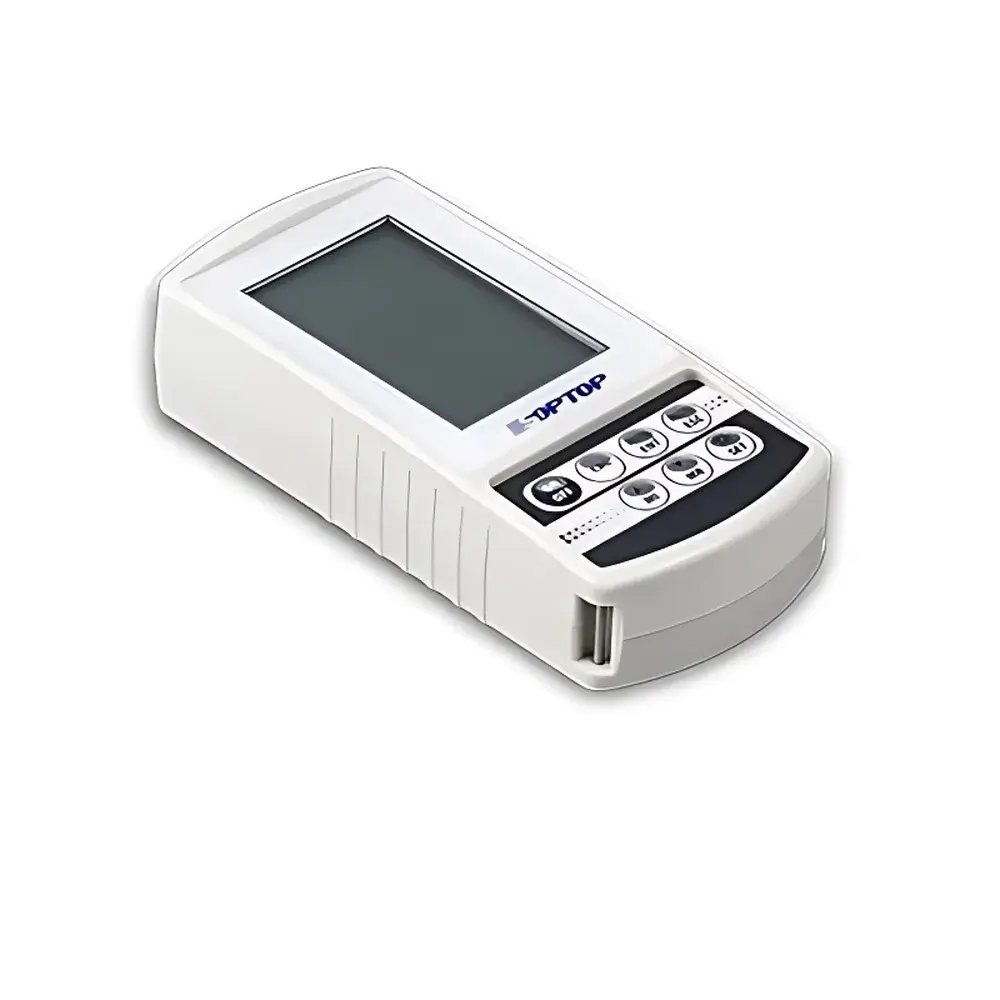
SOPTOP PH6221 Portable Standard pH Meter
| Brand | SOPTOP |
|---|---|
| Origin | Shanghai, China |
| Model | PH6221 |
| Instrument Type | Portable |
| Parameter Type | Single-Parameter (pH) |
| Measurement Range | -2.00 to 16.00 pH |
| Resolution | 0.01 pH |
| Accuracy | ±0.01 pH |
| Calibration Standards | NIST-traceable buffer solutions |
| mV Range | -2000 to +2000 mV |
| Temperature Range | -5.0 to 120.0 °C (23.0 to 248.0 °F) |
| Temperature Compensation | Automatic or Manual |
| Calibration Points | Up to 5-point calibration |
| Data Storage | 100 measurement records |
| Display | 3.2-inch multi-line LCD with anti-scratch coating |
| Power Supply | 2 × 1.5 V AA batteries |
| IP Rating | IP65 |
| Backlight | Adjustable high-brightness LED |
| Auto-power-off | Configurable (default: 10 min inactivity) |
| Electrode Diagnostics | Real-time slope and offset display |
| Connectivity | Optional USB interface |
| Software | Optional data acquisition software with PC compatibility |
Overview
The SOPTOP PH6221 Portable Standard pH Meter is a field-deployable, single-parameter electrochemical analyzer engineered for precision pH measurement across diverse environmental, industrial, and educational applications. It operates on the potentiometric principle—measuring the potential difference between a glass pH electrode and a reference electrode immersed in aqueous solution—converted into pH units via the Nernst equation. Designed for robustness and operational simplicity, the PH6221 delivers laboratory-grade accuracy (±0.01 pH) in a compact, battery-powered form factor suitable for routine field testing, quality control checks, wastewater monitoring, aquaculture management, and classroom instruction. Its extended pH range (–2.00 to 16.00) supports measurements in highly acidic or alkaline media—including cleaning agents, etchants, and caustic process streams—while its integrated temperature sensor enables accurate automatic temperature compensation (ATC) per ISO 7027 and ASTM D1293 guidelines.
Key Features
- High-resolution 3.2-inch multi-line LCD display with anti-scratch surface and user-adjustable backlight for optimal readability under variable lighting conditions
- True 0.01 pH resolution and ±0.01 pH accuracy certified against NIST-traceable calibration standards (e.g., pH 4.01, 7.00, 10.01)
- Five-point calibration capability with real-time electrode diagnostics—simultaneous display of slope (%), offset (mV), and status indicators for electrode health assessment
- Comprehensive temperature support: –5.0 to 120.0 °C with 0.1 °C resolution; selectable ATC or manual temperature input
- IP65-rated enclosure ensures protection against dust ingress and low-pressure water jets—suitable for outdoor, plant-floor, or humid laboratory environments
- Configurable auto-power-off (default: 10 minutes), readout hold function, audible keypress feedback (Beep), and temperature offset adjustment for probe-specific compensation
- Onboard memory stores up to 100 timestamped measurement records, including pH, mV, temperature, date, and time
Sample Compatibility & Compliance
The PH6221 is optimized for aqueous and mildly buffered liquid samples, including drinking water, surface water, effluent, soil extracts, food/beverage preparations, and chemical process solutions. It is not intended for non-aqueous solvents, viscous slurries, or strongly oxidizing media without appropriate electrode selection and procedural validation. The instrument complies with general requirements for portable electrochemical meters outlined in IEC 62264-1 (industrial automation integration) and supports traceability frameworks aligned with ISO/IEC 17025:2017 for calibration management. While not inherently 21 CFR Part 11 compliant, audit-ready data export (via optional USB interface and companion software) facilitates GLP/GMP-aligned recordkeeping when paired with validated procedures and electronic signature protocols.
Software & Data Management
An optional Windows-compatible data acquisition software package is available for the PH6221, enabling direct USB transfer of stored measurements—including pH, mV, temperature, calibration logs, and electrode diagnostics—to CSV or Excel formats. The software supports batch export, trend visualization, report generation with customizable headers, and metadata tagging (operator ID, location, sample ID). All exported datasets retain full traceability to instrument serial number, calibration timestamps, and buffer lot numbers entered during setup. For regulated environments, users may implement supplementary controls—such as file integrity hashing, access-restricted directories, and version-controlled SOPs—to meet internal QA documentation standards.
Applications
- Environmental fieldwork: On-site pH profiling of rivers, lakes, groundwater wells, and stormwater runoff
- Food & beverage QC: Monitoring acidity in dairy products, juices, sauces, and fermentation tanks
- Education: Undergraduate chemistry labs requiring reliable, intuitive instrumentation for acid-base titration support and electrode theory demonstrations
- Industrial maintenance: Routine verification of boiler feedwater, cooling tower chemistry, and rinse bath neutrality
- Aquaculture & hydroponics: Daily pH tracking in recirculating aquaculture systems (RAS) and nutrient film technique (NFT) channels
- Pharmaceutical water systems: Preliminary checks of purified water (PW) and water-for-injection (WFI) distribution loops prior to formal conductivity/pH validation
FAQ
What calibration buffers are recommended for routine use with the PH6221?
NIST-traceable pH 4.01, 7.00, and 10.01 standard solutions are recommended for two- or three-point calibration. Five-point calibration may include pH 1.68 and 12.45 for extended-range verification.
Can the PH6221 measure ORP (oxidation-reduction potential)?
Yes—the instrument includes a dedicated mV mode (–2000 to +2000 mV) with 0.1 mV resolution and ±0.2 mV accuracy, suitable for relative ORP assessments using compatible combination electrodes.
Is temperature compensation mandatory during pH measurement?
Automatic temperature compensation (ATC) is strongly recommended for all quantitative work. Manual temperature entry is supported but introduces additional uncertainty if ambient or sample temperature deviates significantly from probe reading.
How often should the pH electrode be calibrated?
Calibration frequency depends on usage intensity and application criticality. For daily field use, a two-point calibration before each session is advised; for lab-based intermittent use, calibration prior to each measurement series is sufficient.
Does the PH6221 support GLP-compliant data export?
While the base instrument does not provide electronic signatures or audit trails, the optional software enables export of fully attributable datasets. Users must implement complementary administrative and technical controls to satisfy GLP requirements per OECD Principles.





