
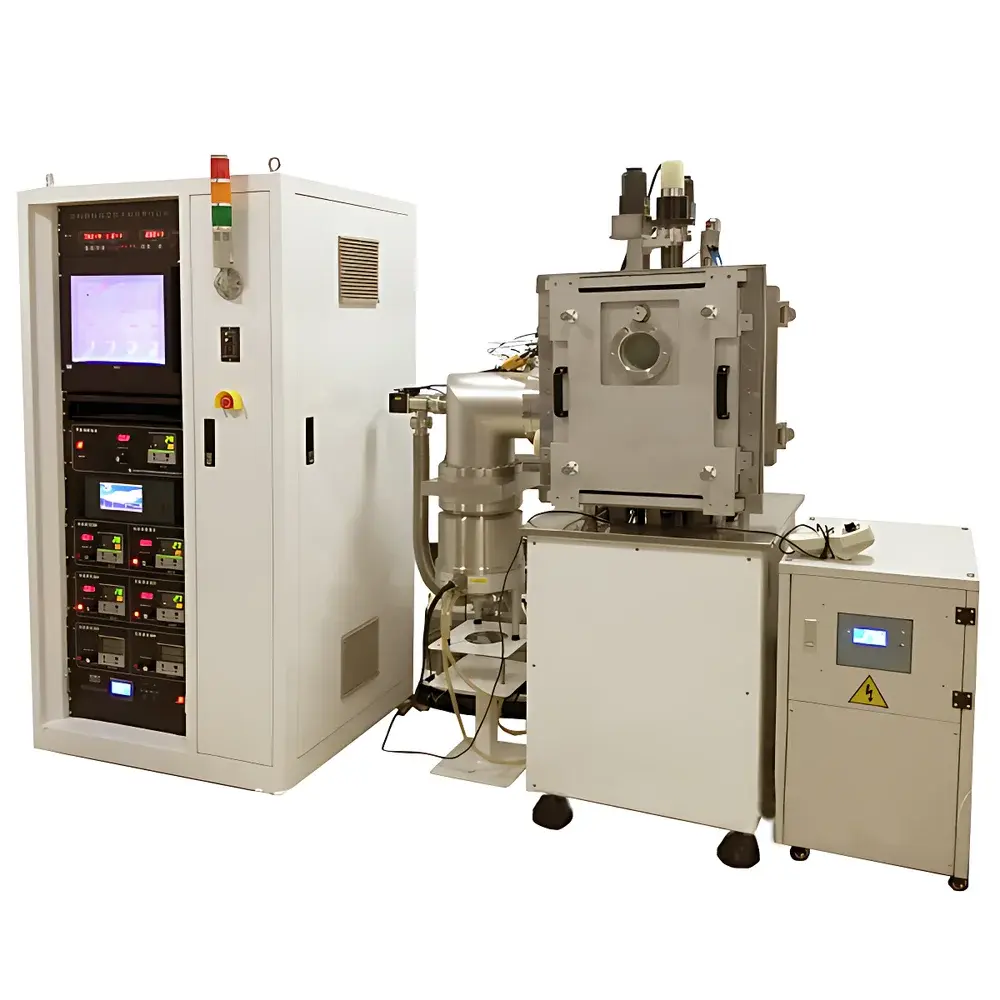
Six-Source Organic-Inorganic Co-Evaporation Deposition System by KJ Group
| Brand | KJ Group (Shenyang Kejing) |
|---|---|
| Origin | Liaoning, China |
| Manufacturer Type | Authorized Distributor |
| Country of Origin | China |
| Model | Six-Source Organic-Inorganic Co-Evaporation Deposition System |
| Pricing | Available Upon Request |
Overview
The Six-Source Organic-Inorganic Co-Evaporation Deposition System by KJ Group is a high-precision physical vapor deposition (PVD) platform engineered for simultaneous or sequential thermal evaporation of both organic molecular materials and inorganic compounds under ultra-high vacuum (UHV) conditions. Designed specifically for advanced thin-film research and pre-production process development, the system enables controlled co-deposition of multi-component layers—critical for emerging optoelectronic devices including perovskite solar cells (PSCs), organic light-emitting diodes (OLEDs), organic photovoltaics (OPVs), and hybrid semiconductor heterostructures. Its architecture integrates dual-source thermal evaporation capability with precise substrate temperature control, real-time quartz crystal microbalance (QCM) monitoring, and fail-safe interlock systems—ensuring reproducible film stoichiometry, uniformity, and interface integrity across R&D and pilot-scale workflows.
Key Features
- Multi-source co-evaporation architecture: Four independent organic evaporation sources (5 mL crucibles, 400 °C max, 0.5 kW each) and two high-power inorganic sources (5 mL crucibles, 300 A heating current, 3.2 kW total) enable flexible material combination and gradient layer synthesis.
- Substrate heating and rotation: Integrated sample stage with programmable heating (room temperature to 180 °C, PID-controlled) and rotational speed adjustment (0–30 rpm) ensures enhanced film homogeneity and interfacial adhesion.
- UHV-compatible chamber: Stainless steel cubic vacuum chamber (600 × 450 × 450 mm) with front/rear dual access doors and internal anti-contamination shields minimizes particulate generation and facilitates rapid sample exchange.
- Automated source shuttering: Magnetically actuated, synchronized shutters for all six evaporation sources provide precise temporal control over deposition initiation/termination—essential for multilayer stack fabrication.
- Comprehensive safety interlocks: Integrated water-flow failure detection, power interruption monitoring, and misoperation prevention logic trigger audible/visual alarms and automatically halt evaporation sequences to protect samples and hardware.
- Modular glovebox integration: Designed for seamless mechanical and electrical coupling with inert-atmosphere gloveboxes (e.g., N₂ or Ar < 0.1 ppm O₂/H₂O), enabling air-sensitive deposition without exposure to ambient contaminants.
Sample Compatibility & Compliance
The system accommodates standard substrates up to Φ120 mm—including silicon wafers, glass slides, ITO/PEDOT:PSS-coated substrates, and flexible polymer foils—supporting both rigid and bendable device architectures. All wetted components comply with ISO 8573-1 Class 2 compressed air quality standards where applicable; vacuum chamber surface finish meets ASTM B912-02 passivation requirements for stainless steel. The system’s design aligns with GLP-compliant laboratory practices, supporting audit-ready operation logs when paired with optional data acquisition modules. While not certified to UL/CE for standalone use, it conforms to IEC 61000-6-2 (immunity) and IEC 61000-6-4 (emissions) for industrial environments.
Software & Data Management
Deposition parameters—including source temperatures, shutter timing, substrate rotation speed, heater setpoints, and real-time QCM thickness readings—are managed via a dedicated Windows-based HMI interface with configurable recipe storage and execution. The quartz crystal monitor delivers thickness resolution down to 0.1 Å and supports dual-frequency operation for improved stability during long-duration depositions. Raw sensor data (thickness, rate, temperature) is timestamped and exportable in CSV format for post-processing in MATLAB, OriginLab, or Python-based analysis pipelines. Optional audit trail functionality supports 21 CFR Part 11–compliant electronic records when deployed in regulated GMP/QC environments.
Applications
- Perovskite photovoltaic research: Sequential or co-evaporated PbI₂/CsBr/organic cation stacks with sub-monolayer control for phase-pure crystalline films.
- OLED emissive layer engineering: Precise doping ratios between host (e.g., CBP) and phosphorescent emitters (e.g., Ir(ppy)₃) via independent organic source modulation.
- Transparent conductive oxide (TCO) development: High-rate evaporation of In₂O₃:Sn (ITO) or ZnO:Al under UHV to minimize oxygen vacancy formation.
- Interfacial buffer layer optimization: Bilayer deposition of LiF/Al or MoO₃/Au for charge injection tuning in organic transistors and photodetectors.
- Hybrid tandem cell prototyping: Integration of evaporated inorganic bottom cells with solution-processed organic top cells inside glovebox-coupled configurations.
FAQ
Can this system be integrated with an existing nitrogen-purged glovebox?
Yes—the system features standardized flange interfaces (CF-63 and CF-100), pneumatic feedthroughs, and Ethernet/RS-485 communication ports compatible with major glovebox manufacturers (e.g., MBRAUN, J-KEM, Plasmax). Mechanical alignment fixtures and vacuum-tight electrical feedthroughs are included.
What vacuum level is required before initiating organic evaporation?
A base pressure ≤ 6 × 10⁻⁴ Pa is mandatory prior to organic source activation; residual gas analysis (RGA) is recommended to confirm hydrocarbon and water partial pressures remain below 1 × 10⁻⁷ Pa to prevent decomposition of thermally labile organics.
Is the quartz crystal monitor calibrated for both organic and inorganic materials?
Yes—the system includes user-selectable density presets for common materials (e.g., Al, Ag, Cu, Alq₃, NPB, Spiro-OMeTAD), and supports manual density input for novel compounds. Calibration drift compensation is performed automatically during chamber vent cycles.
Does the system support automated thickness feedback control during deposition?
While open-loop QCM monitoring is standard, closed-loop rate/thickness control requires optional integration with third-party PLC controllers or custom LabVIEW drivers—available upon request for OEM-level automation projects.
Are spare crucibles and quartz sensors supplied with the system?
Each configuration includes two sets of alumina crucibles (for organic sources) and molybdenum crucibles (for inorganic sources), plus ten calibrated quartz crystals (5 MHz fundamental frequency) with mounting clips and cleaning tools.



