
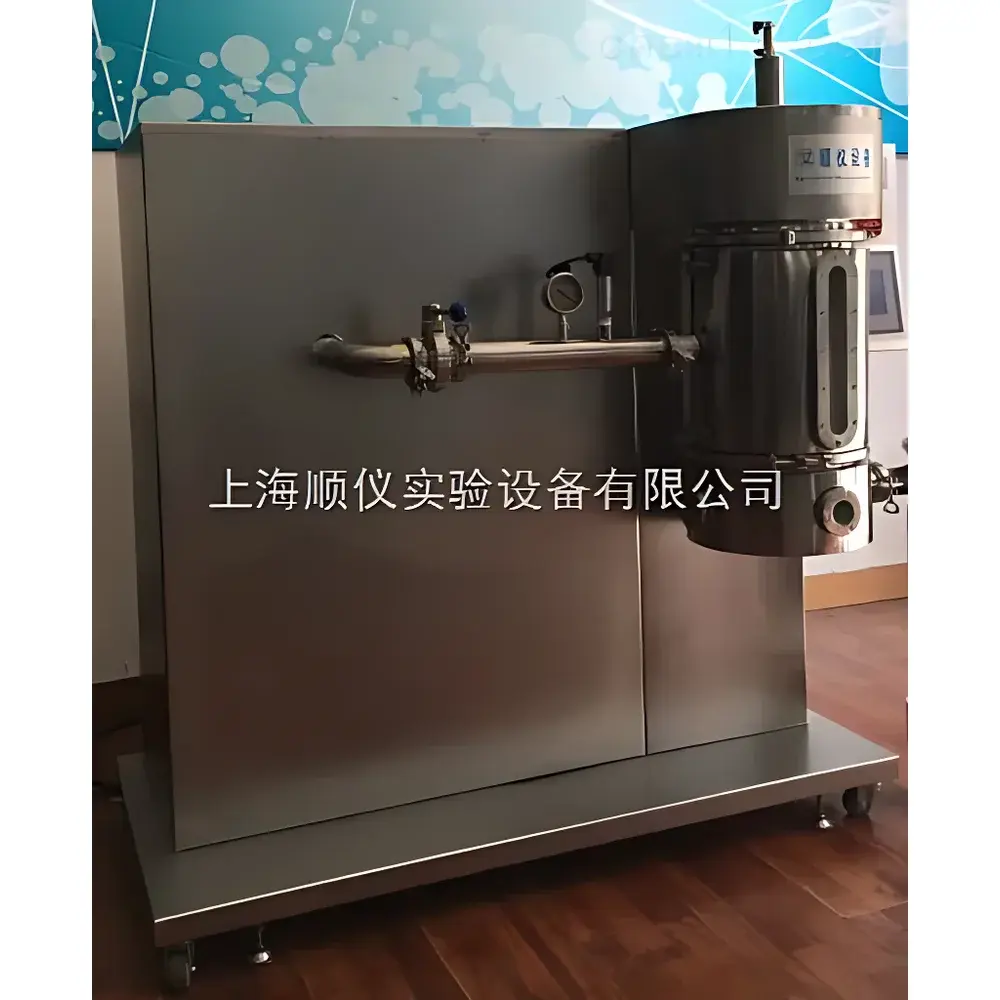
SP-3000 Lab-Scale Spray Freeze Dryer
| Origin | Shanghai, China |
|---|---|
| Manufacturer Type | Authorized Distributor |
| Origin Category | Domestic (PRC) |
| Model | SP-3000 |
| Price Range | USD 28,000 – 42,500 |
| Processing Capacity | 30–1000 mL per batch |
| Spray Freeze Temperature | ≤ −15 °C |
| Cold Trap Temperature | ≤ −60 °C |
| Ultimate Vacuum (Empty Chamber) | < 20 Pa |
| Spray Pressure Range | 2–5 bar (adjustable) |
| Compressed Air Supply | Built-in oil-free air compressor (4.2 m³/h, 0.2 kW, < 50 dB(A)) |
| Drying Air Flow | 0–330 m³/h (max), 686 Pa (max static pressure) |
| Nebulizer (Needle Cleaner) | Pneumatically actuated, frequency-adjustable (2.3 bar internal supply) |
| Condenser Cooling | Integrated air-cooled hermetic refrigeration system |
| Control Interface | Full-color LCD touchscreen (bilingual: English/Chinese), digital display of chamber temperature, peristaltic pump speed, fan frequency, needle purge frequency, and chamber pressure |
| Power Supply | 9 kW, 380 V, 50 Hz |
| Dimensions (L×W×H) | 1150 × 770 × 1350 mm |
| Compliance | Designed for GLP-compliant laboratory environments |
Overview
The SP-3000 Lab-Scale Spray Freeze Dryer is an integrated benchtop system engineered to combine the rapid atomization of spray drying with the low-temperature stabilization of lyophilization. Unlike conventional freeze dryers that rely on slow conductive heat transfer through frozen slabs, or standard spray dryers operating at elevated inlet temperatures (typically >100 °C), the SP-3000 performs *in-flight cryogenic solidification*: liquid feed is atomized under controlled pressure into a sub-zero drying chamber (≤ −15 °C), where droplets instantaneously freeze upon contact with chilled air. Subsequent primary drying occurs via sublimation under deep vacuum (<20 Pa), driven by gentle ambient-air heating—eliminating thermal stress while preserving labile macromolecular structures. This hybrid process delivers powder morphology with high particle uniformity, excellent flowability, and minimal aggregation—critical for downstream formulation of biologics, herbal extracts, probiotics, and polymer nanoparticles.
Key Features
- Integrated dual-mode architecture: combines high-velocity pneumatic nebulization with vacuum-assisted freeze-drying in a single, self-contained unit—no external chillers, compressors, or vacuum manifolds required.
- Full-color LCD touchscreen interface with bilingual (English/Chinese) navigation, real-time digital monitoring of chamber temperature, peristaltic feed rate (0.1–200 mL/min), fan frequency, needle purge cycle, and absolute chamber pressure.
- Onboard oil-free air compressor (4.2 m³/h, <50 dB(A)) ensures consistent nozzle clearance and eliminates hydrocarbon contamination risks in sensitive biological applications.
- Hermetically sealed, air-cooled refrigeration system achieves cold trap temperatures ≤ −60 °C and maintains stable spray freezing conditions ≤ −15 °C—enabling reproducible crystallinity control in amorphous/crystalline formulations.
- Safety interlocks: heater activation is disabled unless condenser fan is operational; vacuum pump power outlet integrated into main chassis for centralized circuit protection and grounding compliance.
- Modular design allows field-upgrade to conventional hot-air spray drying mode—supporting comparative process development across drying mechanisms (e.g., thermal vs. cryogenic stabilization).
- Standardized ISO-KF (KF25/KF40) vacuum flange connections ensure compatibility with third-party gauges, mass spectrometers, or residual gas analyzers for advanced process analytics.
Sample Compatibility & Compliance
The SP-3000 accommodates a broad range of thermolabile and viscous feedstocks—including aqueous suspensions, protein-rich broths, polysaccharide gels, emulsified nutraceuticals, and ethanol-based botanical extracts—without pre-dilution or surfactant addition. Its low-enthalpy drying pathway prevents Maillard reactions, enzyme denaturation, and racemization in chiral pharmaceuticals. The system meets essential engineering benchmarks for laboratory-scale GMP/GLP environments: temperature and vacuum sensors are NIST-traceable (calibration certificate available); all stainless-steel wetted parts conform to ASTM A276 Type 316L; electrical safety complies with IEC 61010-1. Optional 21 CFR Part 11–compliant software provides electronic signatures, audit trails, and role-based access control for regulated R&D workflows.
Software & Data Management
The embedded control firmware logs timestamped records of all critical parameters (chamber pressure, condenser temperature, feed rate, airflow) at user-defined intervals (1–60 s). Raw data exports to CSV or Excel formats; trend visualization is supported via optional PC-based analysis suite. For quality-critical labs, the upgradeable software package includes electronic batch records (EBR), deviation flagging, and automated report generation aligned with ISO 13485 and USP documentation requirements. All data storage resides locally on encrypted internal flash memory—no cloud dependency or external server licensing.
Applications
- Pharmaceutical R&D: Lyophilized vaccine adjuvants, inhalable peptide powders, and nanoparticle drug carriers requiring narrow particle size distribution (PSD) and high aerosol dispersibility.
- Natural product stabilization: Preservation of polyphenol integrity in berry extracts, volatile oil retention in citrus concentrates, and enzymatic activity in fermented plant hydrolysates.
- Food science: Production of instant coffee analogs with intact aroma volatiles; shelf-stable probiotic microcapsules with gastric acid resistance.
- Materials science: Synthesis of spherical silica, calcium phosphate, or PLGA microparticles for controlled-release studies and 3D-printing feedstock preparation.
- Academic research: High-throughput screening of excipient matrices (e.g., trehalose, dextran, HPMC) under cryogenic shear conditions mimicking industrial-scale continuous freeze spray processes.
FAQ
What is the minimum sample volume this system can process?
The SP-3000 supports batch volumes as low as 30 mL—ideal for precious biological samples or early-stage formulation screening.
Can the particle size be controlled during spray freeze-drying?
Yes. Particle diameter (typically 5–50 µm) is modulated via feed concentration, spray pressure (2–5 bar), airflow rate (0–330 m³/h), and chamber temperature—enabling empirical optimization for dissolution rate or aerodynamic performance.
Is the system compatible with organic solvents?
It supports water-miscible co-solvents (e.g., ethanol, acetone) at ≤30% v/v when paired with appropriate explosion-proof vacuum pump options and solvent-resistant gasket materials (Viton or EPDM).
Does the SP-3000 meet regulatory requirements for clinical trial material production?
While classified as a laboratory development tool, its design basis aligns with FDA Process Validation Guidance (Stage 1: Process Design) and ICH Q5C stability principles—making it suitable for non-GMP pilot batches used in preclinical toxicology and Phase I formulation studies.
What maintenance is required for long-term reliability?
Routine tasks include cold trap defrosting every 5–10 batches, nebulizer nozzle inspection after each run, and annual calibration of pressure and temperature transducers using certified reference standards.



