
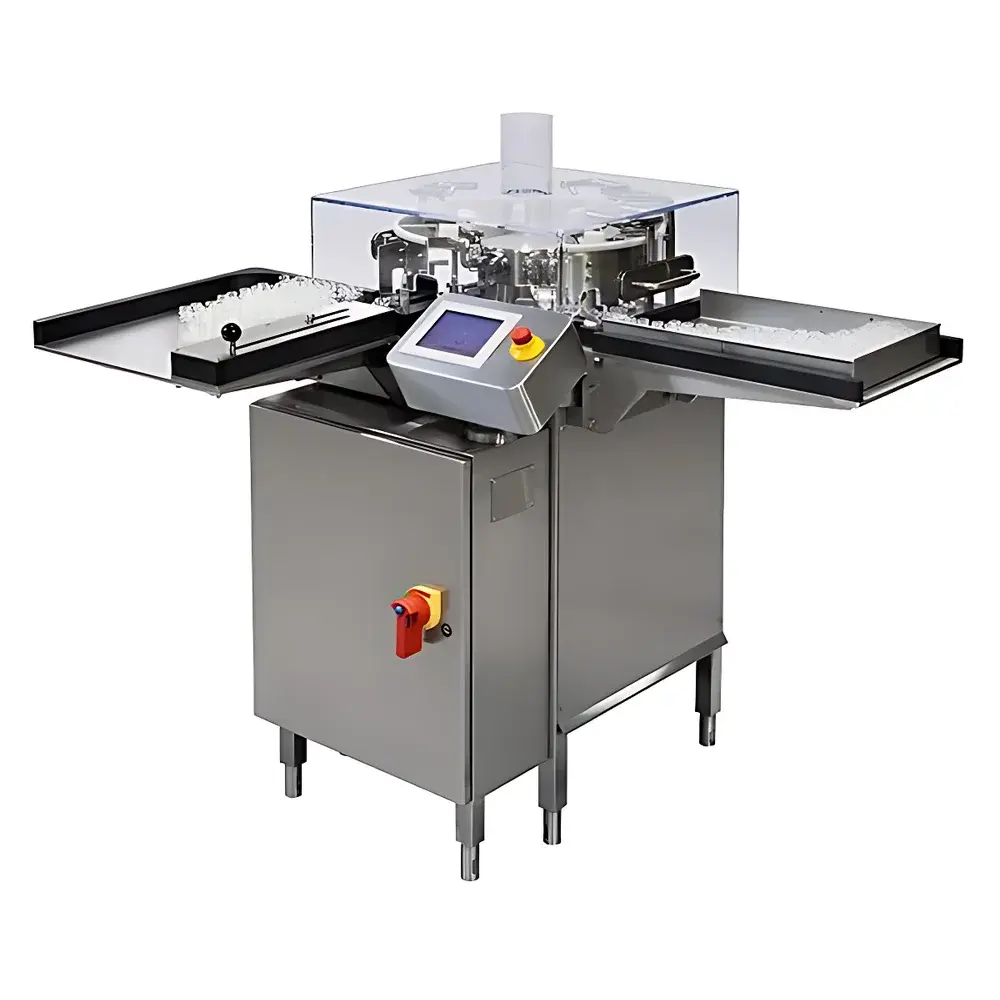
SP PennTech RW-Series Bottle Washer
| Origin | USA |
|---|---|
| Manufacturer Type | Authorized Distributor |
| Origin Category | Imported |
| Model | RW-Series (RW-250 / RW-500 / RW-800 / RW-1150) |
| Quotation | Upon Request |
| Chamber Volume | Not Applicable (Modular Conveyor-Based Design) |
| Heating Power | Not Integrated (External Rinse/Preheat Options Available) |
| Wash Temperature | Ambient to 85 °C (Configurable via External Hot Water Supply) |
| Wash Liquid Compatibility | Aqueous Detergents, Sterile Water, WFI, Purified Water |
| External Dimensions (L×W×D) | Model-Dependent (RW-250: ~1,800 × 900 × 1,200 mm |
| RW-1150 | ~3,200 × 1,300 × 1,450 mm) |
Overview
The SP PennTech RW-Series Bottle Washer is an engineered solution for high-integrity cleaning of pharmaceutical primary packaging—specifically vials, ampoules, and bottles ranging from 1 mL to 500 mL. Unlike conventional rotary or basket-type washers that rely on complex mechanical actuation inside the wash chamber, the RW-Series employs a minimalist, cGMP-aligned architecture grounded in linear motion control and servo-driven precision. Its core design principle eliminates internal moving parts prone to wear, particle generation, and maintenance-induced contamination—such as chains, belts, gears, springs, or sliding guide rods. Instead, only two dynamically active components reside within the wash zone: the central rotating shaft column and the discharge mechanism. This reductionist approach directly addresses a critical quality risk identified in ISO 13408-1 and EU Annex 1: minimizing bioburden and non-viable particulate carryover during pre-sterilization cleaning. The system operates as a continuous-flow conveyor washer, integrating with upstream depyrogenation tunnels and downstream filling lines to support fully automated aseptic processing trains.
Key Features
- Servo-motor-driven single-axis rotation and synchronized discharge—ensuring repeatable dwell time, consistent nozzle alignment, and zero backlash across operational life
- No internal lubrication points, no belts/chains/gears in wash chamber—reducing scheduled maintenance intervals and eliminating lubricant-related extractables
- Modular stainless-steel frame (AISI 316L contact surfaces) compliant with ASME BPE 2023 surface finish requirements (Ra ≤ 0.4 µm)
- Configurable multi-stage washing: pre-rinse (recirculated), main wash (heated detergent), intermediate rinse, final rinse (WFI or purified water), and optional vacuum-assisted drying
- Integrated validation ports for thermocouple mapping, pressure decay testing, and particulate monitoring per USP and
- PLC-based control system with password-protected user levels, electronic batch records, and audit trail functionality compliant with FDA 21 CFR Part 11
Sample Compatibility & Compliance
The RW-Series accommodates borosilicate glass (Type I & II), polymer vials (e.g., COP, COC), and molded plastic containers (HDPE, PP) from 1 mL to 500 mL capacity. Bottle geometries include round-bottom, flat-bottom, and shoulder-profiled formats with neck diameters ≥10 mm. All models conform to current Good Manufacturing Practice (cGMP) requirements for sterile product manufacturing and are designed to support qualification under ASTM E2500-13 (Science-Based Approach to Verification) and EU GMP Annex 15 (Qualification and Validation). Documentation packages include FAT/SAT protocols, IQ/OQ/PQ templates, and material traceability dossiers aligned with ICH Q5E and Q7 guidelines.
Software & Data Management
Control firmware runs on a validated Siemens SIMATIC S7-1500 PLC platform with HMI interface supporting multilingual operation (English, German, Chinese, Spanish). Process data—including flow rates, temperature setpoints, cycle duration, alarm logs, and servo torque signatures—is timestamped and stored locally on encrypted industrial SSDs. Export options include CSV, PDF, and XML formats compatible with LIMS and MES integration. Electronic signatures, role-based access control, and immutable audit trails meet ALCOA+ principles. Optional OPC UA server enables real-time data streaming to enterprise analytics platforms for predictive maintenance modeling.
Applications
- Pre-sterilization cleaning of Type I glass vials prior to depyrogenation in tunnel ovens
- Removal of residual API, excipients, or microbial contaminants from reusable process containers
- Final rinse validation for WFI-contact surfaces in aseptic fill-finish suites
- Supporting regulatory submissions requiring documented cleaning efficacy (e.g., FDA BLA, EMA MAA)
- Integration into end-to-end isolator-based filling lines for oncology and cell/gene therapy products
FAQ
Does the RW-Series require integrated heating elements?
No—the system is designed for external hot water supply (up to 85 °C) to maintain thermal stability and avoid localized overheating of sensitive components.
Can the RW-250 operate in fully automatic mode?
It is classified as semi-automatic due to manual loading/unloading; however, it supports programmable cycle sequencing and can be integrated with robotic loaders for full automation.
What validation support is provided with shipment?
Each unit ships with a complete commissioning dossier including URS, FDS, P&ID, material certifications, and pre-executed FAT documentation per ISO 13485 and ASME BPE.
Is the RW-Series suitable for cleaning silicone-coated vials?
Yes—provided detergent selection is validated for silicone compatibility; recommended detergents include Alconox® Tergazyme® and Solujet®.
How is particulate shedding quantified during PQ?
Particulate challenge studies follow ISO 21501-4 using light extinction particle counters (e.g., HIAC 9703+) with sampling at inlet, mid-chamber, and outlet points per USP .
Related Products



