
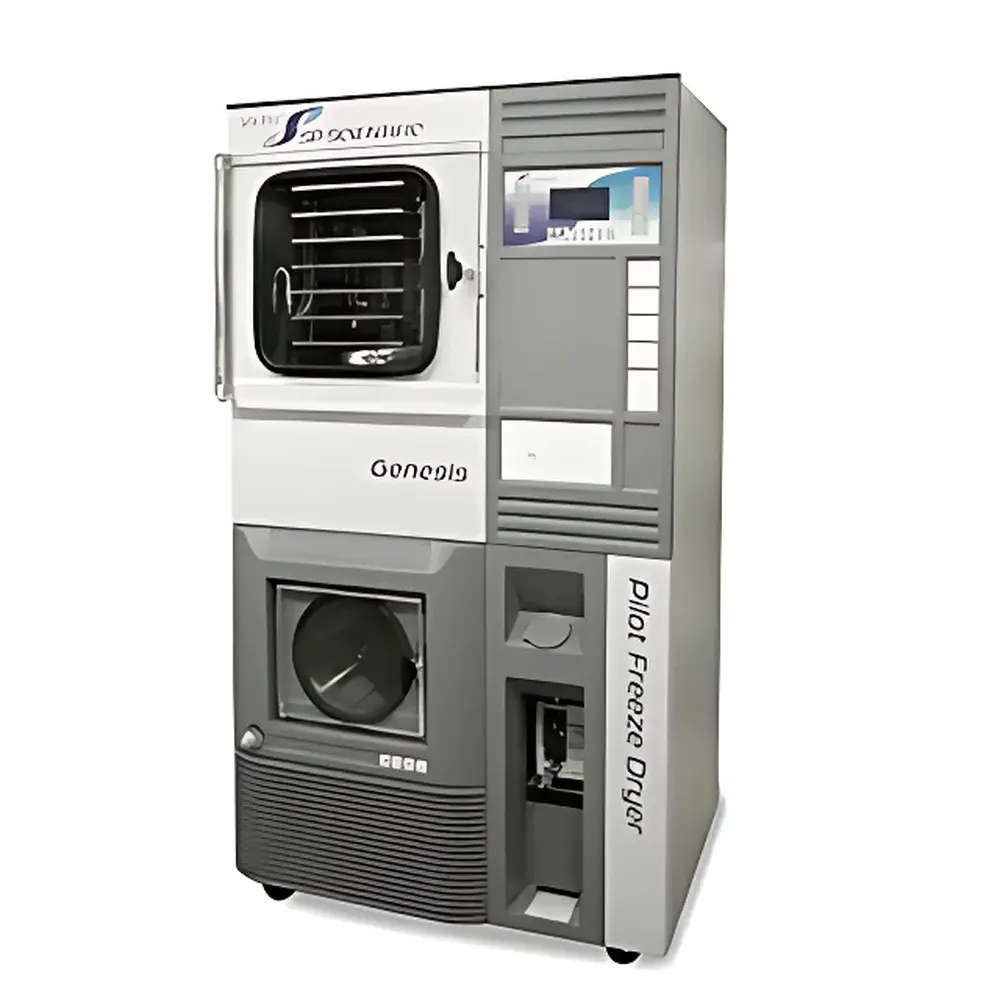
SP Scientific Genesis Pilot Lyophilizer
| Brand | SP Scientific |
|---|---|
| Origin | USA |
| Manufacturer | SP Scientific (integrated VirTis, FTS, Hull) |
| Type | Manifold & Shelf-Style Pilot-Scale Freeze Dryer |
| Application | Pilot Production & Process Development |
| Shelf Area | 2.13 m² |
| Ultimate Vacuum | ≤15 mTorr |
| Condenser Capacity (24 h) | 35 L |
| Condenser Temperature | −85 °C |
| Shelf Temperature Range | −55 °C to +65 °C |
| Shelf Uniformity | ±1.5 °C |
| Available Configurations | Tray-Loading or Stoppering |
| Optional Accessories | Pirani Gauge, Capacitance Manometer, Pressure Rise Test (PRT), Manifold Drying Module |
| Compliance | ISO 9001:2000 certified |
Overview
The SP Scientific Genesis Pilot Lyophilizer is a rigorously engineered pilot-scale freeze drying system designed for scalable process development, formulation optimization, and early-stage manufacturing support in pharmaceutical, biotechnology, and academic research environments. Built upon the legacy of three foundational U.S. freeze dryer brands—VirTis (founded 1953), FTS (specialized in precision thermal control systems), and Hull (industrial lyophilization expertise)—the Genesis platform integrates decades of empirical knowledge in heat and mass transfer dynamics under vacuum. It operates on the fundamental principles of sublimation-based dehydration: frozen product is subjected to controlled low-pressure conditions while shelf heat is precisely delivered to drive ice phase transition directly from solid to vapor, bypassing the liquid phase. This preserves labile biomolecules, maintains structural integrity of porous matrices, and enables reproducible residual moisture control—critical for stability assessment, regulatory filing (ICH Q5C), and tech transfer to commercial-scale units.
Key Features
- Modular pilot-scale architecture supporting both tray-loading and stoppering configurations, with 1–6 heated/cooled shelves (standard: 5-shelf stoppering system)
- Shelf temperature range from −55 °C to +65 °C, with uniformity maintained within ±1.5 °C across full surface area—validated per ASTM F2673 for thermal mapping
- High-capacity condenser operating at −85 °C, rated for 35 L/24 h ice load; smooth electro-polished condenser walls facilitate rapid, residue-free defrost cycles
- Ultimate vacuum performance ≤15 mTorr, compatible with both Pirani and capacitance manometers for accurate pressure monitoring across operational ranges
- Integrated pressure rise test (PRT) capability for endpoint determination, supporting USP and FDA guidance on lyophilization cycle validation
- Optional manifold drying module enables simultaneous vial, serum bottle, and 96-well plate processing without shelf loading constraints
- Compliant with ISO 9001:2000 quality management standards; design supports GLP/GMP-aligned documentation practices including audit trails and electronic signatures (when paired with validated software)
Sample Compatibility & Compliance
The Genesis Pilot Lyophilizer accommodates diverse primary containers—including 2 mL vials (up to 3,135 units per run, 14.75 mm OD × 40 mm height), serum bottles, scintillation vials, and standard 96-well microplates—without requiring custom fixtures. Its shelf geometry and temperature zoning support heterogeneous sample loads typical in formulation screening (e.g., varying excipient compositions, protein concentrations, or buffer pH). All wetted surfaces are constructed from 316L stainless steel with electropolished finishes meeting ASME BPE-2022 surface roughness requirements (<0.4 µm Ra). Vacuum system components comply with ISO 28560-2 for traceable calibration, and pressure sensors are NIST-traceable. The system meets essential safety standards per UL 61010-1 and IEC 61000-6-3 for electromagnetic compatibility.
Software & Data Management
Controlled via SP Scientific’s LyoWorks™ v5.2 software platform, the Genesis system delivers deterministic, recipe-driven operation with real-time monitoring of shelf temperature, condenser temperature, chamber pressure, and product thermocouple signals (optional). Software features include automated cycle sequencing, deviation alerts, configurable alarm thresholds, and secure user access levels (admin/operator/auditor). Raw data files are stored in vendor-neutral CSV format with time-stamped metadata, supporting 21 CFR Part 11 compliance when deployed with qualified IT infrastructure—including electronic signature workflows, audit trail logging, and role-based permissions. Exported datasets integrate seamlessly with statistical process control (SPC) tools and DOE platforms for DoE-driven lyo cycle optimization.
Applications
- Pharmaceutical process development: formulation screening, cycle parameter optimization (annealing, primary drying rate, secondary drying hold), and comparability studies
- Biologics stabilization: monoclonal antibodies, vaccines, viral vectors, and mRNA-LNPs requiring strict thermal history control
- Diagnostics: lyophilization of enzyme conjugates, antigen panels, and lateral flow assay reagents
- Agricultural & botanical research: preservation of plant extracts, microbial cultures, and enzymatic preparations without solvent exposure
- Academic translational research: bridging bench-scale discovery to GMP-compliant clinical trial material production
- Contract development and manufacturing organizations (CDMOs): serving as a qualification bridge between R&D and commercial freeze dryers
FAQ
What distinguishes the Genesis Pilot Lyophilizer from laboratory-scale models?
It combines shelf-based precision control with pilot-scale throughput (2.13 m² shelf area, 35 L/24 h condensation capacity), enabling representative process data generation under conditions directly translatable to production-scale equipment.
Can the system be qualified per GMP requirements?
Yes—when configured with validated software, calibrated sensors, and documented IQ/OQ protocols, it supports GMP-compliant operations in accordance with Annex 15 and ISPE Good Practice Guide for Lyophilization.
Is remote monitoring supported?
LyoWorks™ supports secure OPC UA connectivity for integration into centralized SCADA or MES systems, enabling off-site supervision and alarm notification via email/SMS.
What maintenance intervals are recommended for the vacuum pump and refrigeration system?
Oil-lubricated vacuum pumps require oil changes every 2,000 hours; scroll compressors undergo preventive service annually per SP Scientific’s Maintenance Schedule MS-GEN-PIL-01.
Does the system support automatic stoppering under vacuum or inert gas?
Yes—the optional stoppering configuration includes pneumatically actuated stopper compression with programmable timing, vacuum break control, and nitrogen purge capability for oxygen-sensitive products.



