
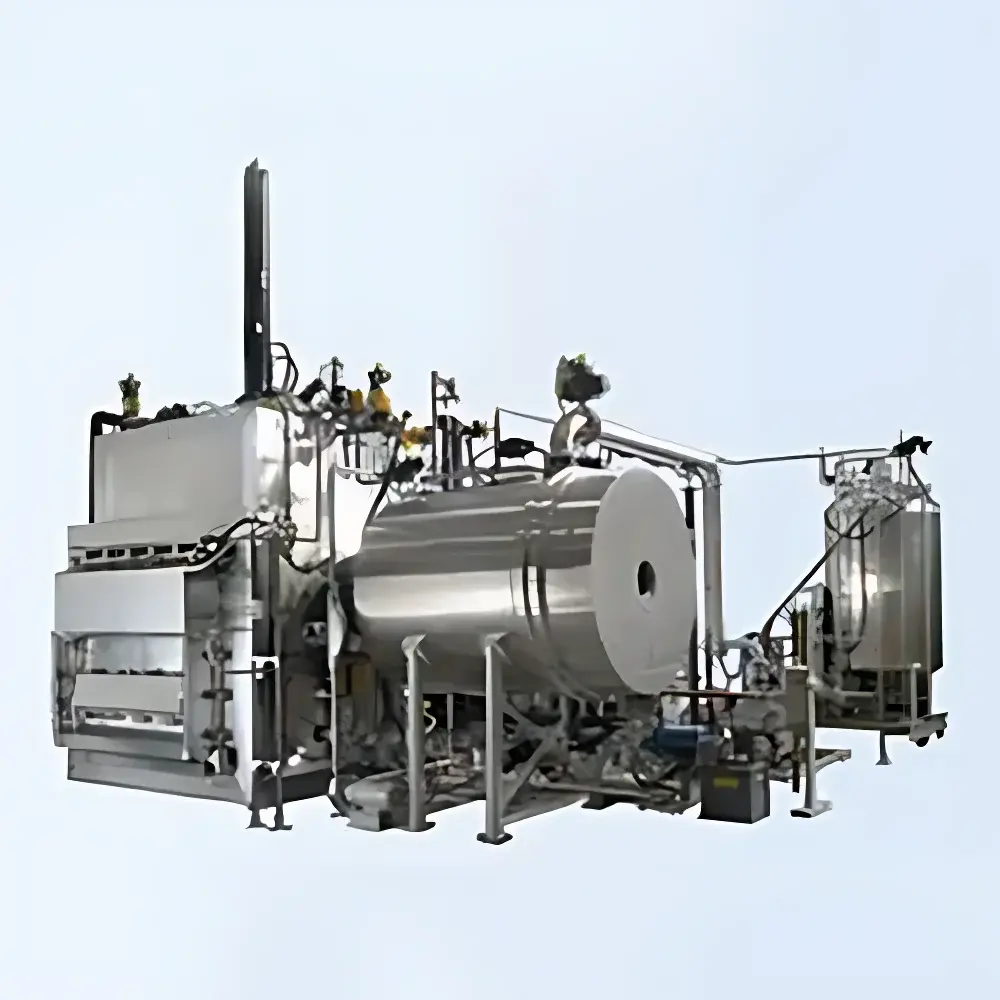
SP Scientific HULL Large-Scale Industrial Freeze Dryer
| Brand | SP Scientific |
|---|---|
| Origin | USA |
| Manufacturer Type | Authorized Distributor |
| Product Origin | Imported |
| Model | HULL |
| Instrument Type | Stoppering Freeze Dryer |
| Application Scope | Production-Scale |
| Shelf Area | Not Applicable (Modular System) |
| Ultimate Vacuum | ≤ 1 × 10⁻³ mbar (Typical Operating Range) |
| Condensate Capacity (24 h) | Up to 150 kg |
| Cold Trap Temperature | ≤ –85 °C |
| Footprint Dimensions | 609.6 mm × 914.4 mm (Base Frame Only |
Overview
The SP Scientific HULL Large-Scale Industrial Freeze Dryer is an engineered solution for cGMP-compliant, production-scale lyophilization of biopharmaceuticals, vaccines, and advanced therapeutics. Designed according to GAMP 5 principles, the system integrates seamlessly into pharmaceutical manufacturing environments with full validation support—including Factory Acceptance Testing (FAT), Installation Qualification (IQ), Operational Qualification (OQ), and Site Integration Testing (SIT) documentation packages. Unlike benchtop or pilot-scale units, the HULL platform operates as a modular, skid-mounted system optimized for integration into cleanroom suites (ISO Class 5–7) and continuous manufacturing workflows. Its core architecture employs primary drying via controlled sublimation under deep vacuum, secondary drying via desorption under elevated shelf temperature and reduced pressure, and precise thermal management through electrically heated, fluid-circulated shelves. The system conforms to fundamental lyophilization thermodynamics—maintaining product temperature below collapse temperature (Tc) and eutectic temperature (Teutectic) throughout primary drying—while enabling reproducible cycle development and scale-up from lab to commercial production.
Key Features
- Modular stoppering configuration with dual interlocked doors—maintains ISO Class 5 integrity during loading/unloading and prevents cross-contamination between cleanroom and non-classified areas
- Uniform shelf temperature distribution: ±1 °C across entire surface area, verified per ASTM E2251-22 using calibrated RTD mapping probes
- Integrated steam-in-place (SIP) and clean-in-place (CIP) systems compliant with ASME BPE-2023 surface finish (Ra ≤ 0.4 µm) and drainability requirements
- High-efficiency water-cooled condenser with disc-type geometry—optimized for rapid ice entrapment and minimal vapor path resistance
- Automated defrost cycle with dual-mode capability: hot gas (steam-assisted) and water flush—minimizing downtime between batches
- PLC-based control system with redundant I/O modules, audit trail functionality, and 21 CFR Part 11–compliant electronic signatures
- Scalable shelf capacity: configurable from 4 to 24 shelves (standard 12-shelf configuration); total active drying area determined by customer-specific chamber design
Sample Compatibility & Compliance
The HULL system supports vial, tray, and bulk container formats used in biologics manufacturing—including 2R–50R glass vials, stainless steel trays (316L), and flexible polymer bags (e.g., for cell therapy products). It meets critical regulatory expectations for process validation and data integrity: IQ/OQ/SAT protocols align with Annex 15 (EU GMP), FDA Guidance for Industry: Process Validation (2011), and ICH Q5C stability requirements. All firmware and HMI software are validated per GAMP 5 Category 4/5 standards. The system’s vacuum integrity, temperature uniformity, and pressure control repeatability are routinely verified during PQ execution per USP and ISO 20571:2019 (Lyophilization—Requirements for equipment qualification).
Software & Data Management
The integrated SCADA-grade control interface provides real-time monitoring of shelf temperature, chamber pressure, condenser temperature, and vapor flow rate—with automatic logging at user-defined intervals (minimum 1-second resolution). Historical data is stored in encrypted SQLite databases with SHA-256 hashing and exportable to CSV, PDF, or XML formats. Audit trails record all operator actions, parameter changes, alarm events, and system state transitions—with immutable timestamps traceable to NIST-traceable time servers. Optional integration with MES (Manufacturing Execution Systems) and LIMS platforms is supported via OPC UA 1.04 and RESTful API endpoints, enabling automated batch record generation and electronic batch release workflows.
Applications
- Vaccine stabilization: Lyophilization of mRNA-LNPs, viral vectors, and attenuated live virus formulations requiring strict thermal history control
- Monoclonal antibody (mAb) and fusion protein processing—preserving higher-order structure and biological activity post-drying
- Cell and gene therapy (CGT) products: Cryopreserved CAR-T cells, exosomes, and tissue-engineered constructs
- Wound care biologics: Platelet-rich fibrin (PRF), collagen scaffolds, and antimicrobial peptide formulations
- Oncology therapeutics: Lyophilized checkpoint inhibitors, tumor lysate vaccines, and oncolytic viruses
FAQ
Does the HULL system support sterile fill-finish integration?
Yes—the dual-door architecture and SIP/CIP capabilities enable direct connection to isolator-based or RABS-based aseptic filling lines.
What validation documentation is included with delivery?
Full FAT report, IQ/OQ protocol and executed reports, SIT summary, and 21 CFR Part 11 compliance statement—all provided in English and formatted per client-specified template requirements.
Is remote monitoring and troubleshooting supported?
Standard Ethernet/IP connectivity with optional TLS 1.2-secured VPN access allows authorized engineers to perform diagnostics, firmware updates, and alarm analysis without onsite presence.
Can the system be retrofitted for future capacity expansion?
Yes—modular electrical, pneumatic, and utility interfaces permit seamless addition of shelves, cold traps, or auxiliary condensers without plant shutdown.
What is the typical lead time for factory acceptance testing?
FAT scheduling occurs within 10 business days following final mechanical completion confirmation, with test duration averaging 72 hours inclusive of witness testing and documentation handover.



