
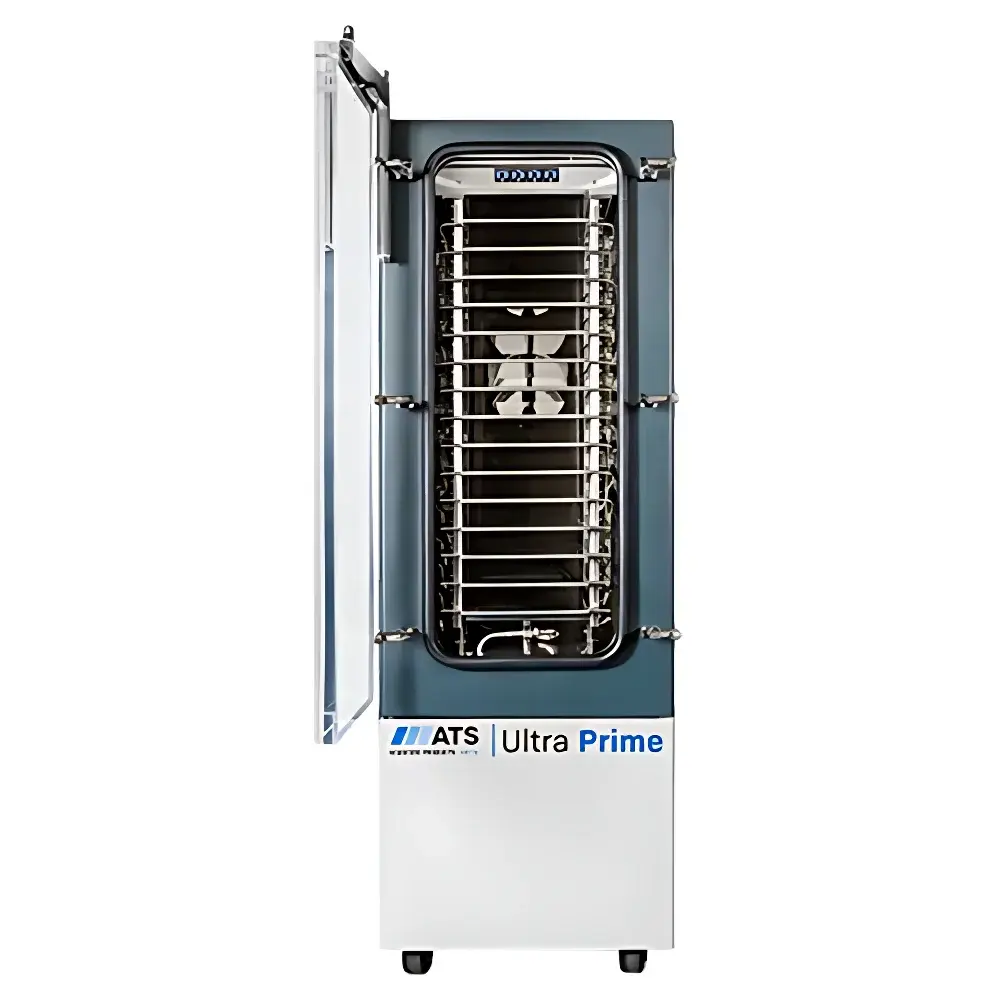
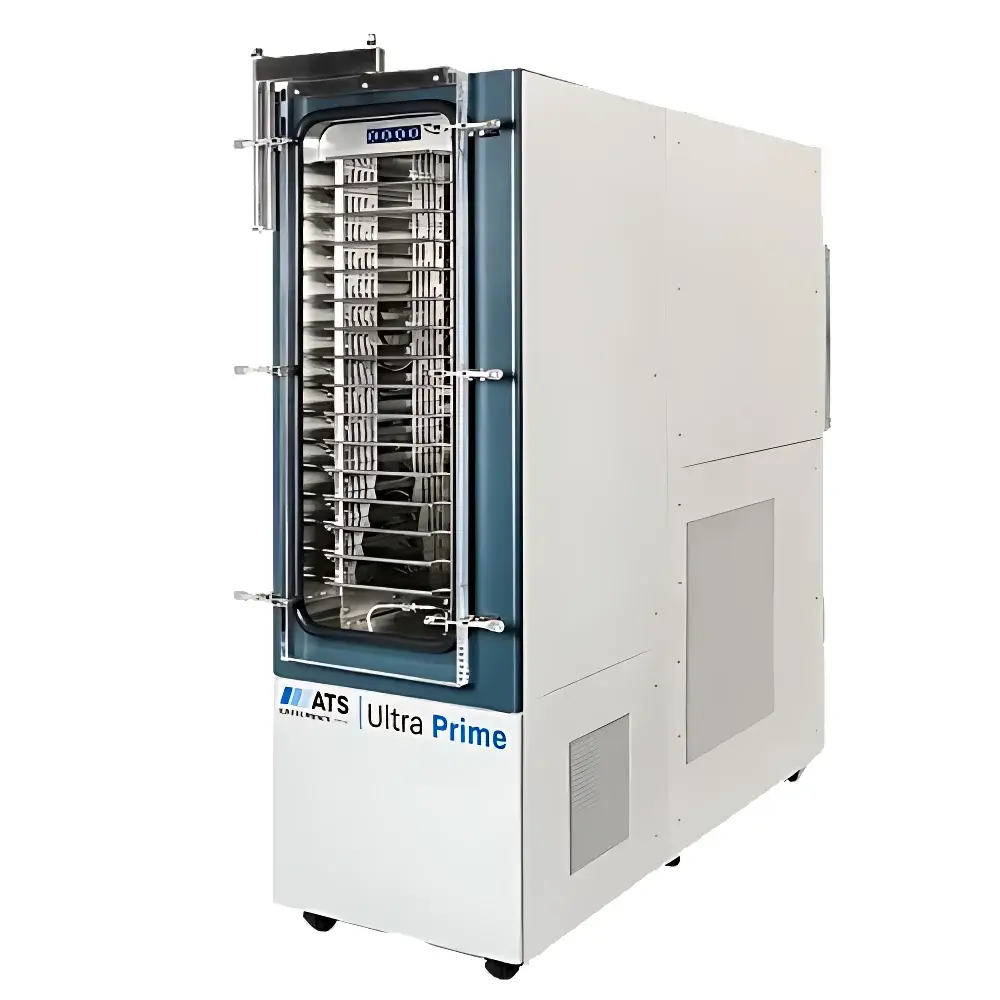
SP Scientific Ultra Prime 50 Freeze Dryer
| Brand | SP Scientific |
|---|---|
| Origin | USA |
| Model | Ultra Prime 50 |
| Condenser Capacity | 50 L |
| Shelf Temperature Range | −70 °C |
| Condenser Temperature | −85 °C |
| Shelf Area | up to 2.13 m² |
| Shelf Configuration | 8–15 adjustable shelves |
| Refrigerant | Low-GWP hydrofluoroolefin (HFO) blend (GWP = 2–6) |
| Construction Material | 316L stainless steel chamber, condenser, and shelves |
| Compliance | Designed for GLP/GMP environments |
Overview
The SP Scientific Ultra Prime 50 Freeze Dryer is an engineered solution for scalable lyophilization in regulated R&D, pilot-scale manufacturing, and cGMP-compliant production environments. Built upon SP Scientific’s validated platform architecture, it employs primary drying via sublimation under controlled vacuum and secondary drying via desorption at elevated shelf temperatures—both governed by precise, independent PID-controlled thermal management of shelves and condenser. Its modular, floor-standing configuration integrates seamlessly into cleanroom Class 5–8 (ISO 14644-1) installations and supports both batch process development and technology transfer to commercial freeze dryers. The system is purpose-built for applications demanding high reproducibility, full process traceability, and compliance-ready documentation—particularly where product critical quality attributes (CQAs) such as residual moisture, cake structure, reconstitution time, and stability are directly influenced by drying kinetics.
Key Features
- High-capacity condenser rated for 50 L of ice, operating continuously at −85 °C to ensure stable vacuum during extended primary drying cycles
- Shelf temperature control from −70 °C to +80 °C with ±0.5 °C uniformity across full shelf surface (per ASTM F2697)
- Modular shelving system supporting 8–15 independently controllable shelves, configurable for bulk loading or stopper-compatible vial processing
- Integrated Process Analytical Technology (PAT) suite including real-time product temperature monitoring (via calibrated thermocouples or resistance temperature detectors), pressure rise test (PRT) capability, and mass flow–based vacuum control
- 316L stainless steel construction throughout the drying chamber, condenser housing, and shelf surfaces—resistant to corrosion from organic solvents, acidic/basic formulations, and sterilants (e.g., hydrogen peroxide vapor)
- Low-global-warming-potential (GWP) refrigerant system using HFO-based blends (GWP = 2–6), compliant with EPA SNAP and EU F-Gas Regulation Annex I phase-down schedules
Sample Compatibility & Compliance
The Ultra Prime 50 accommodates a broad spectrum of sample formats: vials (2–50 mL), trays (up to 2.13 m² total area), serum bottles, and custom containment vessels. It supports lyophilization of aqueous and co-solvent systems—including formulations containing sucrose, trehalose, mannitol, polysorbates, and ethanol-based buffers. All wetted surfaces meet USP material classification requirements. The system architecture enables validation per IQ/OQ/PQ protocols aligned with ISO 13485, FDA Guidance for Industry: Lyophilization Process Validation, and EMA CHMP Guideline on Quality of Biotechnological Products. Data acquisition and audit trail functionality conform to 21 CFR Part 11 requirements when paired with SP’s LyoFlux™ or third-party compliant SCADA systems.
Software & Data Management
Control and monitoring are managed through SP Scientific’s proprietary LyoFlux™ software platform (v5.2+), featuring intuitive graphical workflow sequencing, multi-step ramp/soak profiles, and automated endpoint detection via pressure rise testing. Raw sensor data—including shelf temperature, chamber pressure, condenser temperature, and product thermocouple signals—is logged at user-defined intervals (down to 1-second resolution) with immutable timestamps and operator ID tagging. Electronic signatures, role-based access control, and encrypted database storage support GxP audit readiness. Export formats include CSV, PDF e-signature reports, and ASTM E2500–aligned XML for integration into LIMS or MES platforms.
Applications
- Pharmaceutical & biotech: Stabilization of monoclonal antibodies, viral vectors, mRNA-LNPs, sterile APIs, plasma-derived therapeutics, and probiotic strains
- In vitro diagnostics: Drying of enzyme conjugates, lateral flow assay components, lyophilized calibrators, and nucleic acid standards
- Bio-banking & regenerative medicine: Preservation of tissue scaffolds, decellularized matrices, stem cell monolayers, and corneal grafts
- Academic & CRO/CDMO research: Method development for novel excipients, formulation screening, and comparative drying kinetics studies
- Food & nutraceuticals: Stabilization of heat-labile phytochemicals, probiotics, enzymes, and botanical extracts without solvent residues
- Cultural heritage science: Controlled dehydration of water-damaged archival documents, archaeological wood specimens, and taxidermy specimens under inert atmosphere options
FAQ
What is the maximum allowable shelf load for thermal uniformity validation?
Per SP Scientific’s OQ protocol, full-load thermal mapping is performed with ≥90% shelf coverage using calibrated PT100 sensors; maximum validated load is 2.13 m² at ≤15 kg/m² density.
Does the system support nitrogen backfill and inert gas purge?
Yes—optional integrated N₂ or argon inlet manifold with mass flow controller and residual oxygen monitoring (0.1–10 ppm range) is available for oxygen-sensitive products.
Can the Ultra Prime 50 be qualified for use in a Grade A cleanroom environment?
When installed with ISO 14644-1 Class 5-rated HEPA filtration, electrostatic discharge–controlled flooring interface, and pass-through autoclave integration, it meets EU Annex 1 requirements for aseptic processing support equipment.
Is remote monitoring and alarm notification supported?
Via optional Ethernet/IP or OPC UA connectivity, real-time status, alarms, and historical trends can be accessed through secure web dashboard or integrated into facility-wide BMS infrastructure.
What documentation packages are provided with the system?
Standard delivery includes Factory Acceptance Test (FAT) report, User Requirements Specification (URS) cross-reference matrix, calibration certificates (NIST-traceable), and electronic copies of IQ/OQ templates compliant with ASTM E2500 and ISPE Baseline Guide Vol. 5.



