
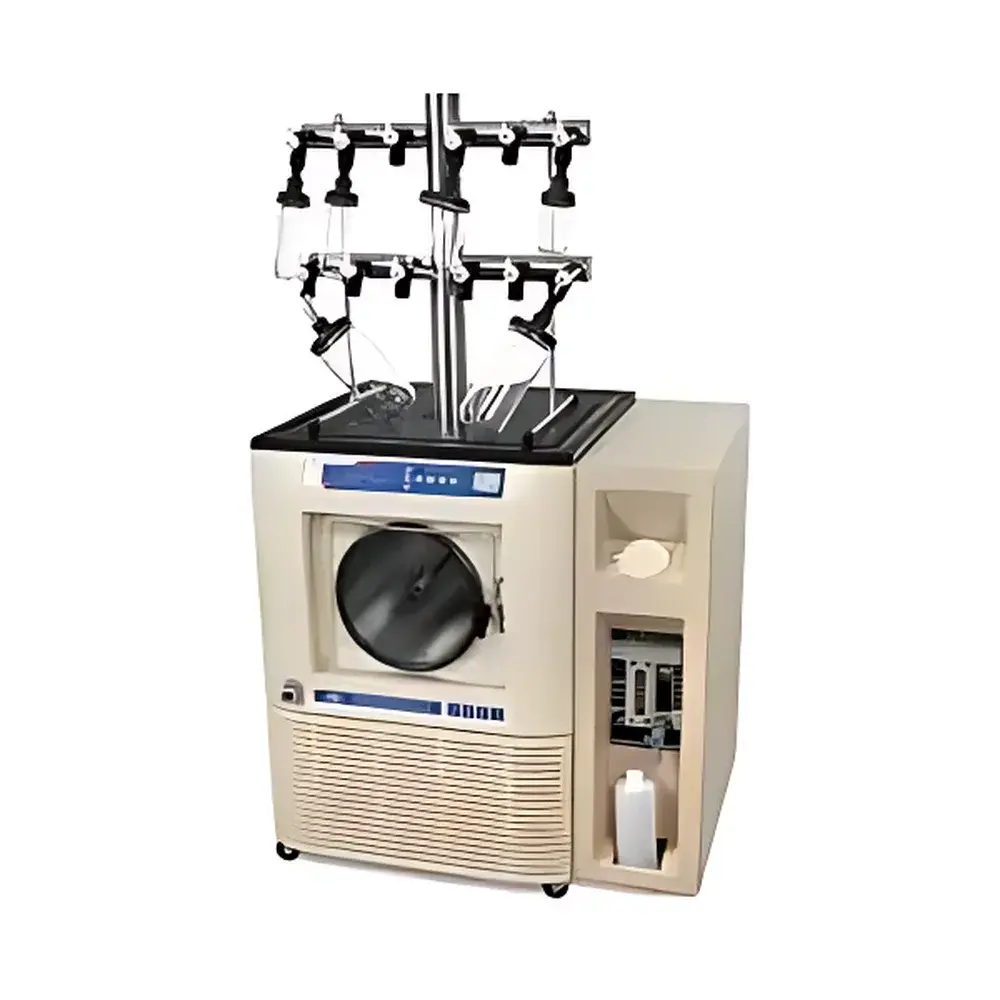
SP Scientific Virtis Freezemobile Manifold Freeze Dryer
| Brand | SP Scientific |
|---|---|
| Origin | USA |
| Model | Freezemobile |
| Type | Manifold Freeze Dryer |
| Scale | Pilot-Scale |
| Shelf Area | 0.12 m² |
| Ultimate Vacuum | < 20 Pa |
| Condensate Capacity | 4 kg/24 h |
| Condenser Temperature | < −80 °C |
Overview
The SP Scientific Virtis Freezemobile Manifold Freeze Dryer is a pilot-scale, benchtop-compatible lyophilization system engineered for reproducible, scalable freeze drying of heat-sensitive biological and pharmaceutical samples under controlled vacuum conditions. Based on the fundamental principles of sublimation—where ice transitions directly from solid to vapor phase below the triple point of water—the Freezemobile employs a dual-stage rotary vane vacuum pump (not included) and a high-efficiency cascade refrigeration condenser to achieve deep cold trapping (< −80 °C) and stable vacuum levels below 20 Pa. Designed for transitional research workflows—from early-stage formulation development to process validation—the system supports direct flask-based drying without shelf loading, enabling rapid method screening and solvent compatibility testing across diverse sample matrices including aqueous buffers, organic solvents (e.g., ethanol, acetone), and viscous biopolymer solutions.
Key Features
- Manifold architecture with up to 8 independent ports for simultaneous drying of multiple flasks (10–1000 mL), each equipped with individual stopcocks for selective isolation and pressure control
- Cascade condenser system achieving ≤ −80 °C operating temperature, optimized for high-volatility solvents and extended 24-hour condensate capture (up to 4 kg)
- Front-mounted digital interface with real-time vacuum display in user-selectable units (mTorr, µbar, or Pa) and programmable pressure regulation for optimized heat transfer kinetics
- Energy-efficient compressor design using environmentally compliant refrigerants (R-55C, R-70C, or R-90C depending on configuration), compliant with EPA SNAP and EU F-Gas Regulation requirements
- Hot-gas defrost system enabling full condenser regeneration in under 60 minutes, minimizing downtime between cycles
- Modular footprint options: narrow-body (63.5 × 67.3 × 92.7 cm) and wide-body (89 × 89 × 92.7 cm) configurations to accommodate lab space constraints
- Optional pre-freezing chamber (−45 °C to −70 °C) available for integrated primary freezing, reducing total cycle time and eliminating reliance on external ultra-low temperature freezers
Sample Compatibility & Compliance
The Freezemobile accommodates a broad range of sample types and container formats—including glass vials, serum bottles, centrifuge tubes, and custom-manifold flasks—supporting lyophilization of proteins, monoclonal antibodies, enzymes, plant extracts, microbial cultures, and environmental samples (e.g., soil leachates, wastewater concentrates). All wetted surfaces are constructed from 316 stainless steel and borosilicate glass, ensuring chemical resistance and cleanability per ISO 14644-1 Class 5 (ISO Class 5) cleanroom-compatible maintenance protocols. The system supports GLP-compliant documentation when paired with optional data logging modules and meets mechanical safety standards per UL 61010-1 and IEC 61010-1. While not inherently 21 CFR Part 11 compliant, audit-trail-ready software add-ons are available for regulated environments requiring electronic record integrity.
Software & Data Management
The Freezemobile operates via an embedded microprocessor controller with non-volatile memory for storing up to 10 user-defined drying profiles. Optional SP Scientific LyoWorks™ software (v5.2+) enables remote monitoring, real-time graphing of vacuum, condenser temperature, and elapsed time, as well as CSV export for post-cycle analysis. When configured with Ethernet or USB connectivity, the system supports timestamped event logging—including pump activation, valve actuation, and alarm triggers—for traceability in QA/QC and regulatory submissions. Data files are structured to align with ASTM E2500-21 guidelines for equipment qualification and can be integrated into LIMS platforms via standard OPC UA interfaces.
Applications
- Process development and scale-up studies for parenteral drug formulations requiring residual moisture control per USP <1211>
- Rapid desiccation of labile biomolecules prior to structural characterization (e.g., CD spectroscopy, XRD, TEM)
- Stabilization of reference standards and certified reference materials (CRMs) for environmental and clinical laboratories
- Preparation of dried cell pellets and tissue homogenates for metabolomic and proteomic profiling
- Lyophilization of botanical extracts and fermentation broths in natural product discovery pipelines
- Emergency preservation of field-collected biological specimens where −80 °C freezer access is limited
FAQ
Is a vacuum pump included with the Freezemobile system?
No. A two-stage oil-sealed rotary vane pump capable of reaching ≤ 1 × 10⁻² mbar base pressure is required and sold separately. SP Scientific recommends pumps meeting ISO 8573-1 Class 0 oil contamination specifications for GMP applications.
What is the maximum allowable solvent volume per flask during manifold drying?
For optimal sublimation efficiency and condenser load management, total solvent volume across all connected flasks should not exceed 80% of the 4 kg/24 h condensate capacity—i.e., ≤ 3.2 kg per full cycle. Individual flask fill limits depend on solvent volatility and freezing point depression.
Can the Freezemobile be validated for use in regulated pharmaceutical manufacturing?
Yes—when equipped with IQ/OQ documentation packages, calibrated sensors (NIST-traceable thermocouples and capacitance manometers), and optional 21 CFR Part 11-compliant software, the system supports qualification per ASTM E2500 and Annex 15 of the EU GMP Guide.
Does the system support automatic pressure rise test (PRT) functionality?
Not natively. However, manual PRT execution is supported via timed vacuum hold sequences and slope calculation using the onboard pressure sensor; automated PRT requires integration with LyoWorks™ software and external data acquisition hardware.
What maintenance intervals are recommended for the condenser and refrigeration system?
Compressor oil should be replaced every 2,000 operating hours or annually, whichever occurs first. Condenser coils require cleaning with isopropyl alcohol every 6 months; refrigerant charge verification is advised during annual preventive maintenance by certified HVAC-R technicians.



