
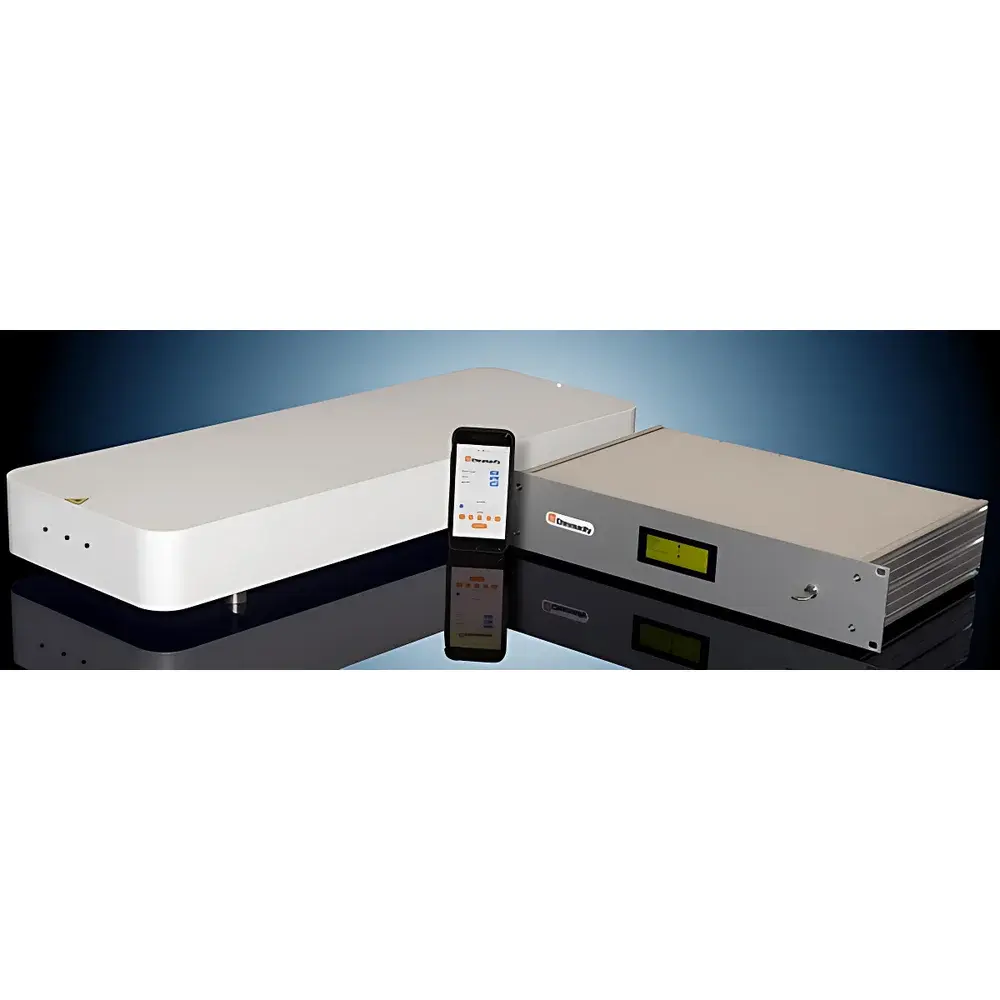
Spark-X 1280 nm Fiber-Based Femtosecond Laser System
| Origin | UK |
|---|---|
| Manufacturer Type | Authorized Distributor |
| Origin Category | Imported |
| Model | SPARK-X |
| Core Technology | Mode-Locked Erbium-Doped Fiber Oscillator with Nonlinear Pulse Compression |
| Output Power | >30 mW |
| Central Wavelength | 1280 nm ±25 nm |
| Pulse Duration | <200 fs (FWHM) |
| Spectral Bandwidth | >8 nm (FWHM) |
| Repetition Rate | 100 MHz |
| Amplitude Noise | <140 Hz RMS (measured over 50 hours) |
| Beam Quality | Diffraction-Limited (M² < 1.1) |
| Polarization | Linear, >100:1 Extinction Ratio |
| Output Coupling | FC/APC Connectorized Single-Mode Polarization-Maintaining Fiber |
| Control Interface | Ethernet (TCP/IP), SCPI-Compatible |
| Laser Head Dimensions | 770 × 300 × 110 mm |
| Controller Dimensions | 483 × 285 × 90 mm |
| Laser Head Weight | 14 kg |
| Controller Weight | 2.5 kg |
| Power Supply | 110–240 V AC, 50–60 Hz |
Overview
The Spark-X 1280 nm Fiber-Based Femtosecond Laser System is an engineered ultrafast light source optimized for semiconductor failure analysis, nonlinear optical microscopy, and time-resolved material characterization. Built upon a robust, all-fiber erbium-doped mode-locked oscillator architecture, the system delivers transform-limited sub-200 fs pulses centered at 1280 nm—strategically positioned within the low-dispersion, low-absorption region of silicon and many wide-bandgap semiconductors. Unlike free-space Ti:sapphire or OPO-based systems, the Spark-X leverages polarization-maintaining single-mode fiber delivery, eliminating alignment drift and enabling stable, turnkey operation in industrial metrology labs and cleanroom environments. Its wavelength range (1250–1310 nm) supports critical applications such as two-photon absorption in CMOS devices, optical beam-induced current (OBIC) imaging, and pump-probe spectroscopy where deep penetration into silicon substrates and minimal thermal loading are essential.
Key Features
- Fully integrated fiber-based design with diffraction-limited beam quality (M² 100:1 extinction ratio)
- Stable 100 MHz repetition rate with amplitude noise <140 Hz RMS over 50-hour continuous operation—validated for GLP-compliant long-duration experiments
- On-board pulse picker option (optional) enabling flexible repetition rate reduction down to kHz regimes without external amplification
- FC/APC connectorized output ensures repeatable, low-backreflection coupling into microscope scan heads, spectrometers, or delay stages
- Ethernet-based SCPI command interface enables seamless integration into automated test platforms and LabVIEW/Python-controlled workflows
- Compact dual-unit architecture: laser head (770 × 300 × 110 mm, 14 kg) and separate controller (483 × 285 × 90 mm, 2.5 kg) for thermal and EMI isolation
- Universal AC input (110–240 V, 50–60 Hz) with internal power conditioning suitable for shared lab infrastructure
Sample Compatibility & Compliance
The Spark-X is routinely deployed in failure analysis laboratories certified to ISO/IEC 17025 and operating under semiconductor industry standards including JEDEC JESD22-A108 (temperature cycling) and SEMI E142 (laser-assisted defect localization). Its 1280 nm output exhibits minimal two-photon absorption in SiO₂ gate oxides while maintaining sufficient photon energy (~0.97 eV) for band-to-band excitation in silicon and GaAs. The system complies with IEC 60825-1:2014 Class 4 laser safety requirements; full interlock circuitry, key-switch enable, and remote shutter control are standard. All firmware logs—including runtime, temperature setpoints, and output power history—are timestamped and stored with audit-trail capability, supporting FDA 21 CFR Part 11 compliance when paired with validated LIMS or ELN software.
Software & Data Management
The Spark-X is controlled via a vendor-supplied Windows/Linux-compatible application using standard TCP/IP Ethernet communication. SCPI command sets allow direct integration with MATLAB, Python (PyVISA), or National Instruments TestStand. Real-time monitoring includes output power stability tracking, cavity temperature feedback, and repetition rate jitter metrics. All operational parameters are logged at user-defined intervals (1 Hz to 1 kHz) in CSV format, compatible with statistical process control (SPC) tools. Firmware updates are performed over secure HTTPS with SHA-256 signature verification. No cloud connectivity or telemetry is enabled by default—data residency remains fully on-premise unless explicitly configured by the end user.
Applications
- Two-photon excited OBIC imaging for sub-surface defect localization in advanced FinFET and GAA transistor structures
- Pump-probe reflectivity/transmission measurements of carrier dynamics in perovskite photovoltaics and 2D transition metal dichalcogenides
- Time-resolved confocal Raman spectroscopy of phonon lifetimes in strained SiGe heterostructures
- Laser-assisted electrical testing (LAET) in wafer-level reliability screening
- Nonlinear optical response mapping in ferroelectric thin films using second-harmonic generation (SHG) at 640 nm
- Calibration source for ultrafast streak cameras and single-photon avalanche diode (SPAD) arrays operating in the NIR-I window
FAQ
Is the Spark-X compatible with commercial confocal microscopes equipped with NIR detection channels?
Yes—the FC/APC fiber output interfaces directly with standard microscope fiber couplers; spectral response matches common InGaAs and extended-range Si detectors.
Can pulse duration be externally compressed or stretched?
The system supports optional chirped fiber Bragg grating (CFBG) compressors and adjustable grating pairs for dispersion management; OEM integration kits are available.
Does the laser meet requirements for use in ISO Class 5 cleanrooms?
The sealed laser head meets IP54 particulate ingress rating; airflow-independent thermal management eliminates forced convection, minimizing particle generation.
What documentation is provided for regulatory validation?
A complete Design Qualification (DQ), Installation Qualification (IQ), and Operational Qualification (OQ) protocol package is included, aligned with ASTM E2500 and EU Annex 11 guidelines.
Is service support available outside the UK?
Global technical support and certified field service engineers are accessible through authorized distribution partners in North America, EMEA, and APAC regions.




