
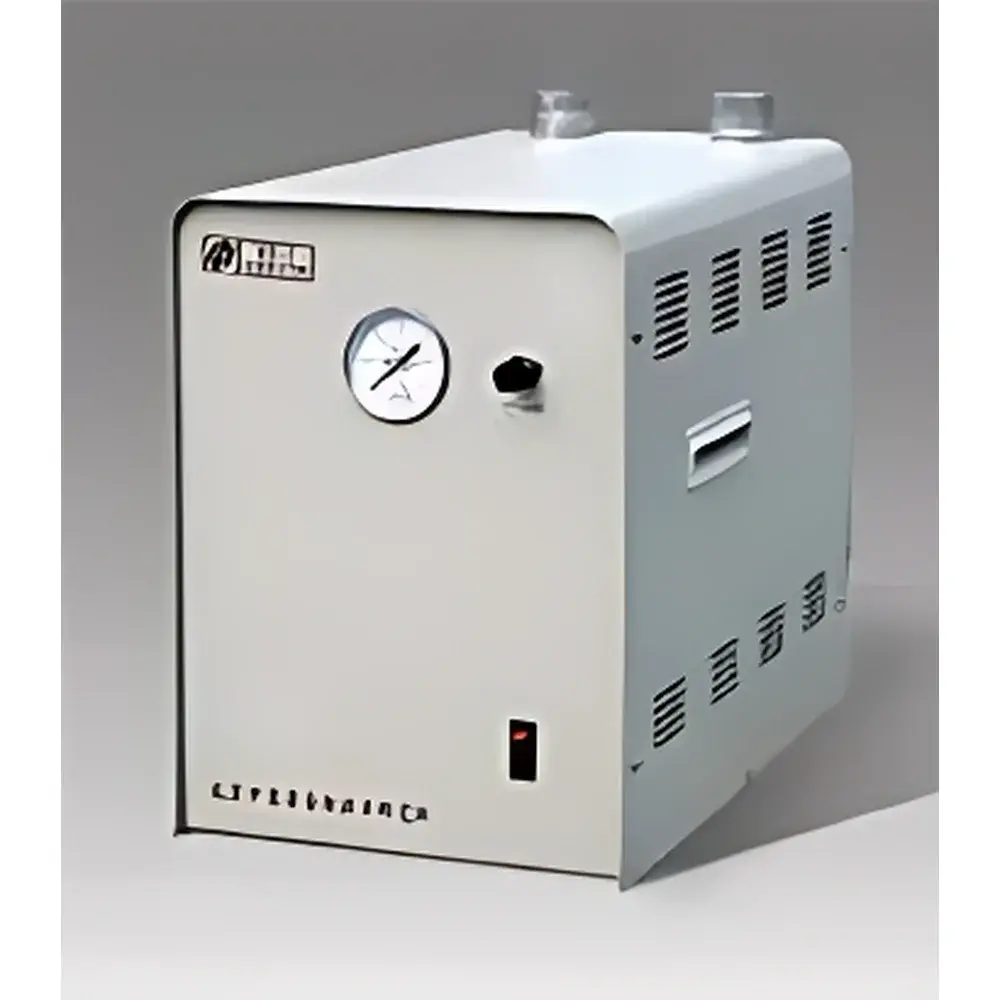
SPB-3 Fully Automatic Air Generator
| Output Flow | 0–2000 mL/min @ 0.4 MPa |
|---|---|
| Output Pressure | 0–0.4 MPa |
| Pressure Stability | < 0.003 MPa |
| Noise Level | < 35 dB(A) |
| Power Consumption | 175 W |
| Input Voltage | 220 V ±10% |
| Dimensions (W×D×H) | 420 × 260 × 350 mm |
| Net Weight | 22 kg |
| Operating Environment | 0–45 °C, RH ≤85% (non-dusty, non-corrosive atmosphere) |
| Filtration | Dual stainless steel filters + stainless steel air reservoir |
| Sealing Material | Low-sulfur silicone O-rings |
Overview
The SPB-3 Fully Automatic Air Generator is an engineered solution for laboratories requiring continuous, clean, and pressure-stable compressed air—primarily as a carrier, combustion, or auxiliary gas source for analytical instrumentation including gas chromatographs (GC), GC–MS systems, nitrogen–phosphorus detectors (NPD), flame photometric detectors (FPD), and other gas-dependent benchtop analyzers. Unlike conventional oil-lubricated compressors or high-pressure cylinder systems, the SPB-3 employs an oil-free diaphragm compression mechanism coupled with integrated dual-stage pressure regulation and automated moisture management. Its core architecture is designed to deliver consistent airflow across variable demand loads while maintaining strict pressure fidelity (< ±0.003 MPa deviation), thereby eliminating baseline drift and retention time variability in sensitive chromatographic applications.
Key Features
- Dual Independent Pressure Regulation System: Two cascaded precision pressure regulators ensure stable output pressure across the full flow range (0–2000 mL/min), minimizing pressure ripple during detector gas switching or column oven ramping.
- Intelligent Auto-Drain Functionality: An embedded microcontroller synchronizes solenoid valve actuation with condensate accumulation thresholds—enabling fully autonomous water removal without mechanical float switches or audible cycling noise (< 35 dB[A] acoustic emission).
- Low-Sulfur Gas Path Integrity: All wetted seals utilize low-sulfur silicone elastomers compliant with ASTM D1193 Type II water specifications, preventing sulfur-induced catalyst poisoning in FID and NPD systems and ensuring long-term baseline stability.
- Corrosion-Resistant Gas Storage & Filtration: A seamless 316 stainless steel air reservoir and dual-stage stainless steel particulate/moisture filters withstand exposure to ambient humidity and trace volatile organics—eliminating deformation, cracking, or permeation-related leaks common in polymer-based alternatives.
- Thermal & Electrical Robustness: Optimized heat dissipation design enables uninterrupted operation within ambient temperatures from 0 to 45 °C; power electronics include overvoltage (±10% tolerance) and thermal shutdown protection.
Sample Compatibility & Compliance
The SPB-3 is compatible with all laboratory-grade analytical instruments requiring clean, dry, oil-free air at pressures up to 0.4 MPa. It meets essential performance criteria referenced in ISO 8573-1:2010 Class 2:2:2 (solid particles, water, oil content) when used with recommended maintenance intervals. While not certified to UL/CE as a standalone appliance, its electrical subsystem conforms to IEC 61010-1 safety requirements for laboratory equipment. The unit supports GLP and GMP-aligned workflows through deterministic operational repeatability and absence of manual intervention points—critical for audit-trail integrity in regulated environments governed by FDA 21 CFR Part 11 and ISO/IEC 17025.
Software & Data Management
The SPB-3 operates as a stand-alone hardware platform with no embedded firmware interface or digital connectivity. Its control logic resides entirely in discrete analog circuitry and electromechanical components—ensuring electromagnetic compatibility (EMC) immunity and eliminating cybersecurity surface area. All operational states (pressure, flow, drain cycle status) are indicated via front-panel LED indicators. For integration into centralized lab infrastructure, optional external pressure transducers and data loggers may be deployed upstream to record runtime parameters compliant with electronic record retention policies.
Applications
- Carrier gas supply for capillary GC systems requiring constant linear velocity control
- Combustion air source for flame ionization (FID), thermal conductivity (TCD), and electron capture (ECD) detectors
- Auxiliary air for pneumatic sample introduction modules (e.g., autosampler purge, septum purge)
- Zero-air generation when paired with catalytic hydrocarbon scrubbers (not included)
- Instrument air for pressure-driven fluid handling in HPLC degassers and fraction collectors
FAQ
What is the maximum continuous operating time for the SPB-3?
The unit is rated for unattended 24/7 operation under specified ambient conditions (0–45 °C, RH ≤85%), provided routine filter replacement is performed every 6 months or per manufacturer-recommended service intervals.
Does the SPB-3 require external cooling or ventilation?
No dedicated cooling is required; however, minimum clearance of 10 cm on all sides is advised to ensure adequate natural convection and prevent thermal buildup in enclosed cabinets.
Can the SPB-3 be used with oxygen-sensitive detectors?
Yes—the air stream contains atmospheric oxygen concentration (~21% v/v); for oxygen-sensitive applications (e.g., certain mass spectrometer ion sources), supplemental deoxygenation modules must be installed downstream.
Is the output air suitable for breathing or medical use?
No. The SPB-3 is strictly intended for instrument-grade laboratory gas supply and does not meet ISO 8573-1 Class 1 or medical air standards (ISO 8573-7, ISO 7396-1).
How often should the stainless steel filters be replaced?
Under typical lab conditions, both inlet and final-stage stainless steel filters require cleaning every 3 months and replacement every 12 months—or sooner if pressure drop exceeds 0.05 MPa across the filter housing.



