
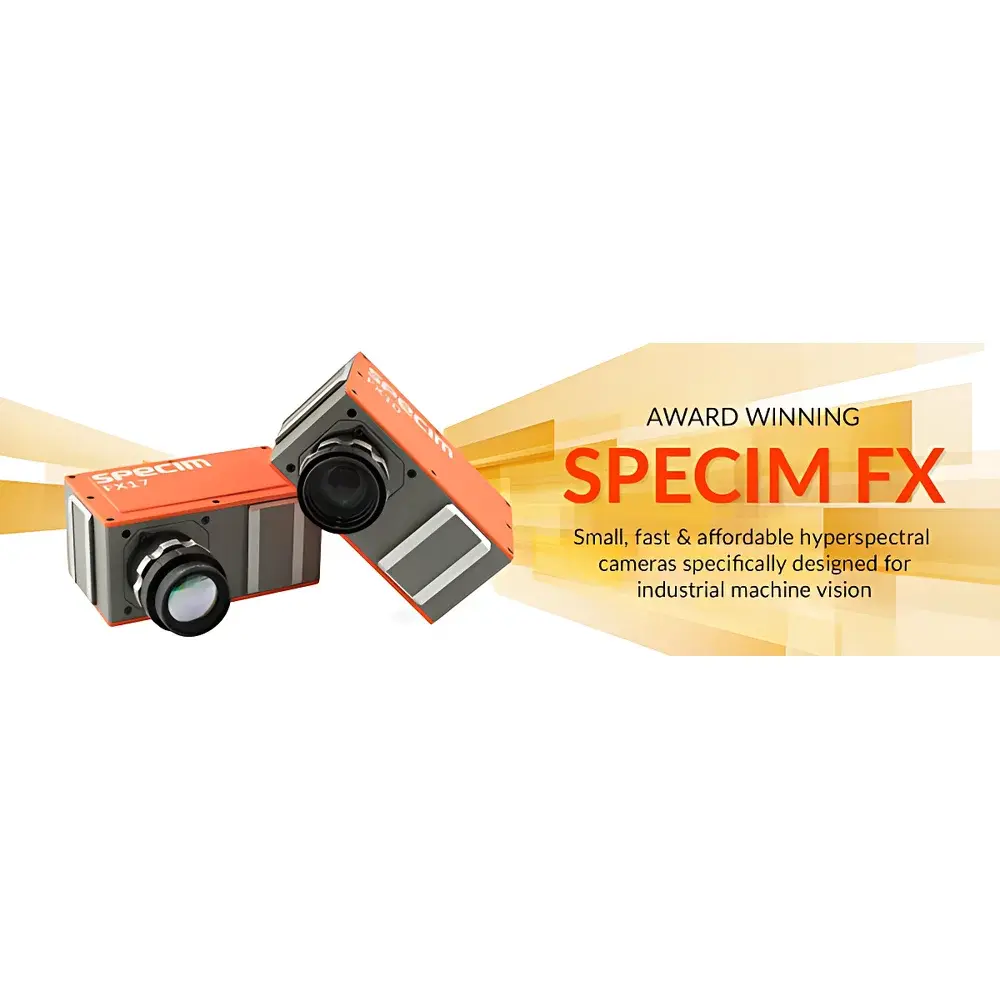
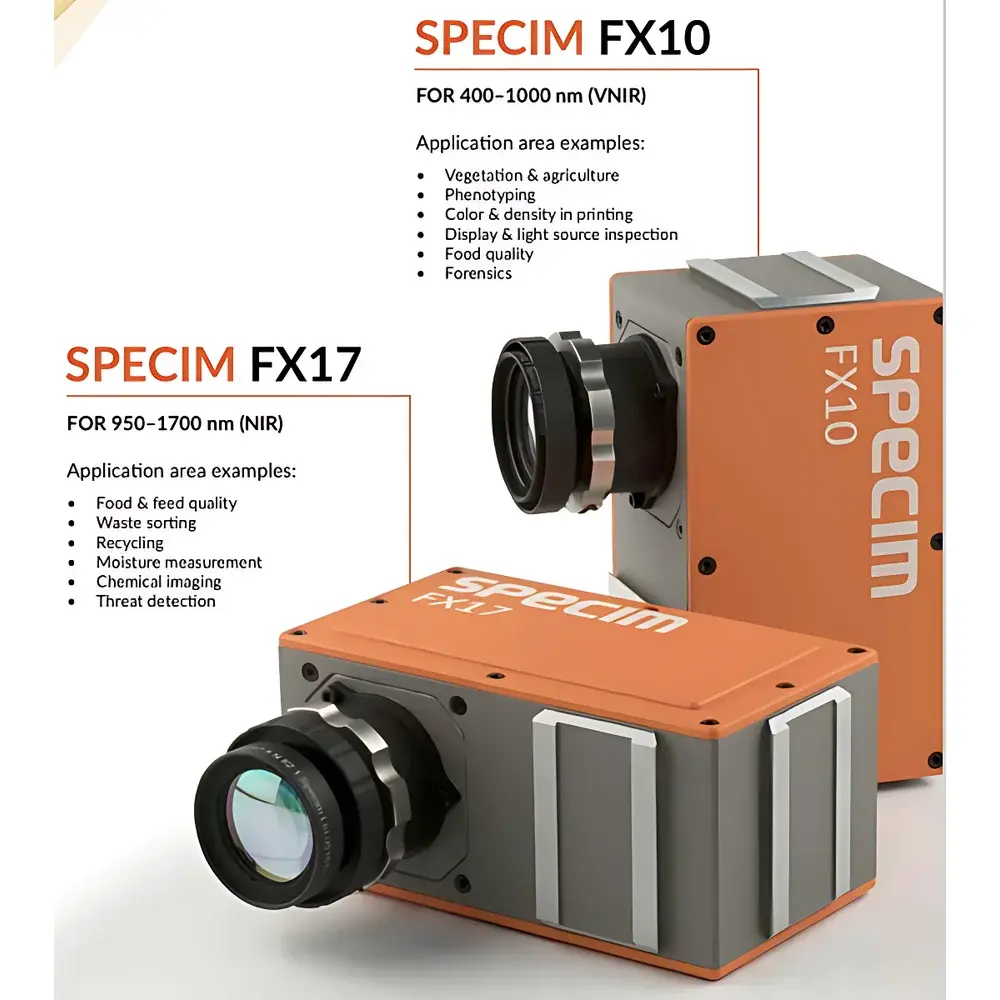
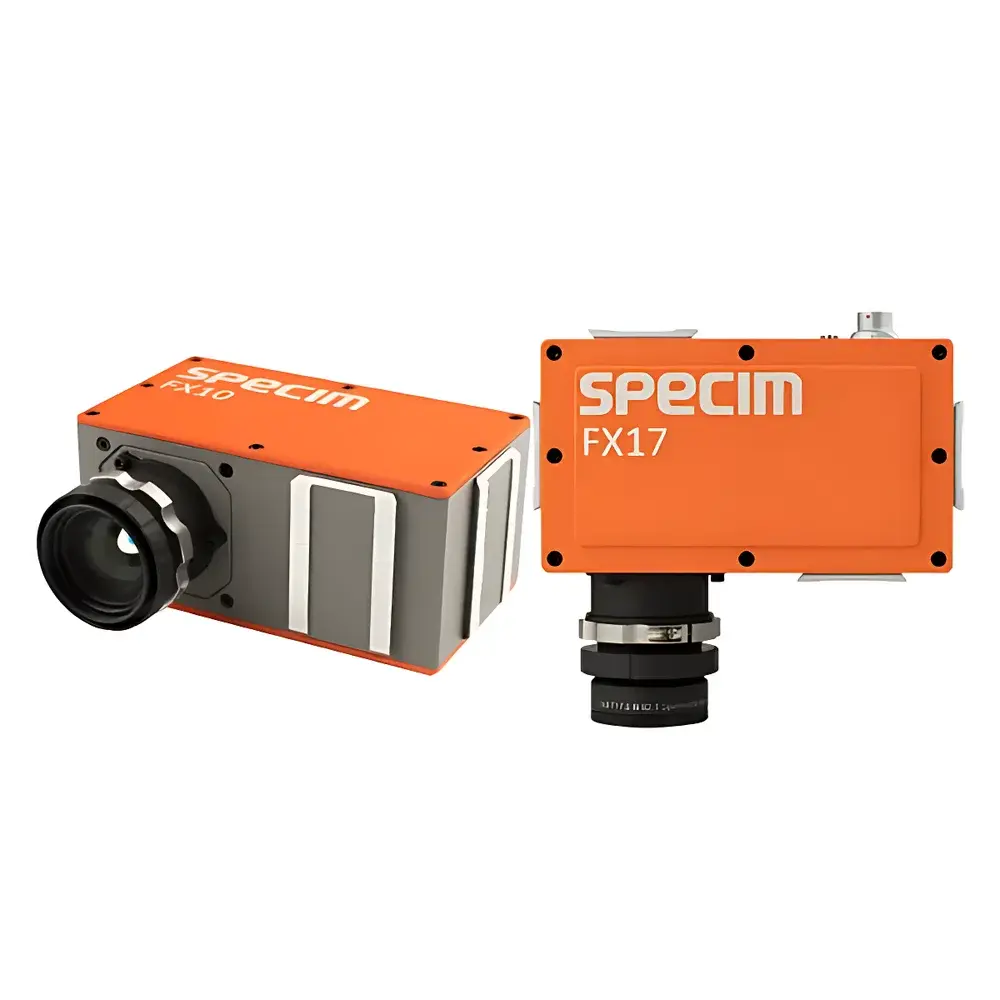
Specim FX10/FX17 Visible-Near Infrared Hyperspectral Imaging Camera
| Brand | Specim |
|---|---|
| Origin | Finland |
| Model | FX10/FX17 |
| Operating Principle | Push-broom |
| Imaging Optics | Binary optical element |
| Deployment Mode | Ground-based & airborne compatible |
| Spectral Range | 400–1000 nm (FX10), 950–1700 nm (FX17) |
| Spectral Resolution | 5.5 nm (FX10), 8 nm (FX17) |
| Spatial Resolution | 1024 × 1024 pixels (FX10), 640 × 1024 pixels (FX17) |
| Field of View (TFOV) | 38° |
| Instantaneous Field of View (IFOV) | 640 px / 1024 px (FX17 / FX10) |
| Frame Rate | 330 fps (FX10 GigE), 670 fps (FX17 CameraLink) |
Overview
The Specim FX10 and FX17 are push-broom hyperspectral imaging cameras engineered for precision spectral data acquisition across the visible and near-infrared (VNIR) domains. Designed for laboratory validation, industrial inline inspection, and field-deployable remote sensing applications, these instruments operate on the principle of spatial-spectral scanning—where a linear sensor array captures one spatial line per integration time while motion (mechanical or platform-based) provides the second spatial dimension. This architecture enables high-fidelity, calibrated spectral cubes (x, y, λ) without moving parts in the optical path. The FX10 covers 400–1000 nm with 5.5 nm spectral resolution and 1024-pixel spatial sampling, optimized for color-critical tasks including pigment identification, vegetation index derivation (e.g., NDVI, PRI), and surface reflectance mapping. The FX17 extends coverage to 950–1700 nm at 8 nm resolution, targeting molecular absorption features associated with C–H, O–H, and N–H bonds—enabling quantitative analysis of moisture, starch, sugar, lignin, and polymer composition. Both models feature thermally stabilized optics, factory-calibrated radiometric response, and intrinsic spectral uniformity across the full FOV.
Key Features
- Push-broom architecture with binary optical design for minimal chromatic aberration and high throughput efficiency
- Thermally compensated optical bench ensuring long-term spectral stability under ambient temperature fluctuations (±0.5°C drift compensation)
- Onboard non-uniformity correction (NUC) and dark current subtraction for pixel-level radiometric accuracy
- GigE Vision (FX10/FX17) and CameraLink (FX17 high-speed variant) interfaces compliant with GenICam standard for deterministic trigger synchronization and metadata embedding
- SpecimONE software integration enabling real-time spectral cube streaming, ROI-based spectral averaging, and export to ENVI, HDF5, or TIFF formats with embedded wavelength calibration vectors
- Modular mounting interface (M42 × 0.75 thread) compatible with telecentric lenses, collimators, and UAV gimbals; IP52-rated housing for controlled indoor and outdoor deployment
Sample Compatibility & Compliance
The FX10/FX17 systems support diverse sample geometries—from static petri dishes and conveyor-belt specimens to dynamic aerial survey strips—without requiring contact or sample preparation. Reflectance, transmittance, and fluorescence modes are accessible via external illumination control (e.g., halogen, LED, or pulsed xenon sources synchronized via TTL). Radiometric calibration traceability follows NIST-traceable standards using certified reflectance panels (e.g., Labsphere Spectralon®) and blackbody references. Data acquisition workflows comply with ISO 17025 requirements for measurement uncertainty reporting and support audit-ready documentation per GLP and FDA 21 CFR Part 11 when deployed with SpecimONE’s secure user authentication and electronic signature modules. All spectral libraries generated are compatible with ASTM E1777 (Standard Guide for Hyperspectral Imaging Data Acquisition) and ISO 18587 (Imaging spectroscopy — Vocabulary and terminology).
Software & Data Management
SpecimONE serves as the unified application environment for configuration, acquisition, preprocessing, and basic analysis. It supports real-time frame buffering (up to 16 GB RAM allocation), hardware-triggered burst capture, and automatic geotagging when integrated with GNSS/IMU modules. Raw data undergoes pixel-wise dark-frame subtraction, flat-field correction, and wavelength registration prior to export. For advanced analytics, exported hyperspectral cubes integrate natively with Python (via scikit-image, spectral, and PySpTools), MATLAB Hyperspectral Toolbox, and commercial platforms such as ENVI and ERDAS IMAGINE. Batch processing pipelines—including PCA, MNF transformation, spectral angle mapper (SAM), and partial least squares regression (PLSR)—can be scripted and version-controlled. Audit logs record operator ID, timestamp, exposure settings, and calibration file hash—ensuring full traceability for regulated environments.
Applications
- Agricultural phenotyping: Quantitative assessment of chlorophyll content, water stress indices (NDWI, MSI), and early disease detection in cereal crops and horticultural species
- Food quality assurance: Non-destructive measurement of soluble solids content (Brix) in fruits, moisture distribution in baked goods, and adulterant detection in powdered dairy products
- Recycling & waste sorting: Discrimination of polyethylene (PE), polypropylene (PP), polyethylene terephthalate (PET), and acrylonitrile butadiene styrene (ABS) based on spectral fingerprinting in the 1100–1650 nm range
- Pharmaceutical tablet coating uniformity: Mapping of active pharmaceutical ingredient (API) distribution and excipient homogeneity using NIR spectral unmixing
- Art conservation & forensic document analysis: Detection of faded inks, pigment layer stratigraphy, and erased annotations through spectral contrast enhancement
FAQ
What spectral calibration standards are applied during factory calibration?
Each FX10/FX17 unit undergoes wavelength calibration using mercury-argon emission lamps and radiometric calibration against NIST-traceable integrating sphere sources. Calibration coefficients are stored in camera firmware and embedded in every acquired frame header.
Can the FX10 and FX17 be operated simultaneously on the same platform?
Yes—dual-camera synchronization is supported via hardware trigger daisy-chaining and GenICam-compatible timestamp alignment, enabling co-registered VNIR + SWIR spectral fusion for extended chemical characterization.
Is real-time onboard spectral processing available?
No onboard GPU or FPGA-based spectral analysis is implemented; however, real-time streaming to host systems enables low-latency (<50 ms) spectral indexing and threshold-based event triggering via SpecimONE’s API.
What is the typical radiometric accuracy over operating temperature range?
Radiometric uncertainty remains within ±3% (k=2) across 10–40°C ambient conditions when used with recommended stabilization warm-up time (≥15 min) and calibrated illumination.
Are OEM integration kits available for custom mechanical or electrical interfacing?
Specim provides mechanical drawings, electrical pinouts, SDK documentation (C/C++, Python, .NET), and reference designs for embedded integration—including power management, thermal dissipation, and shock/vibration mitigation per MIL-STD-810G.






