
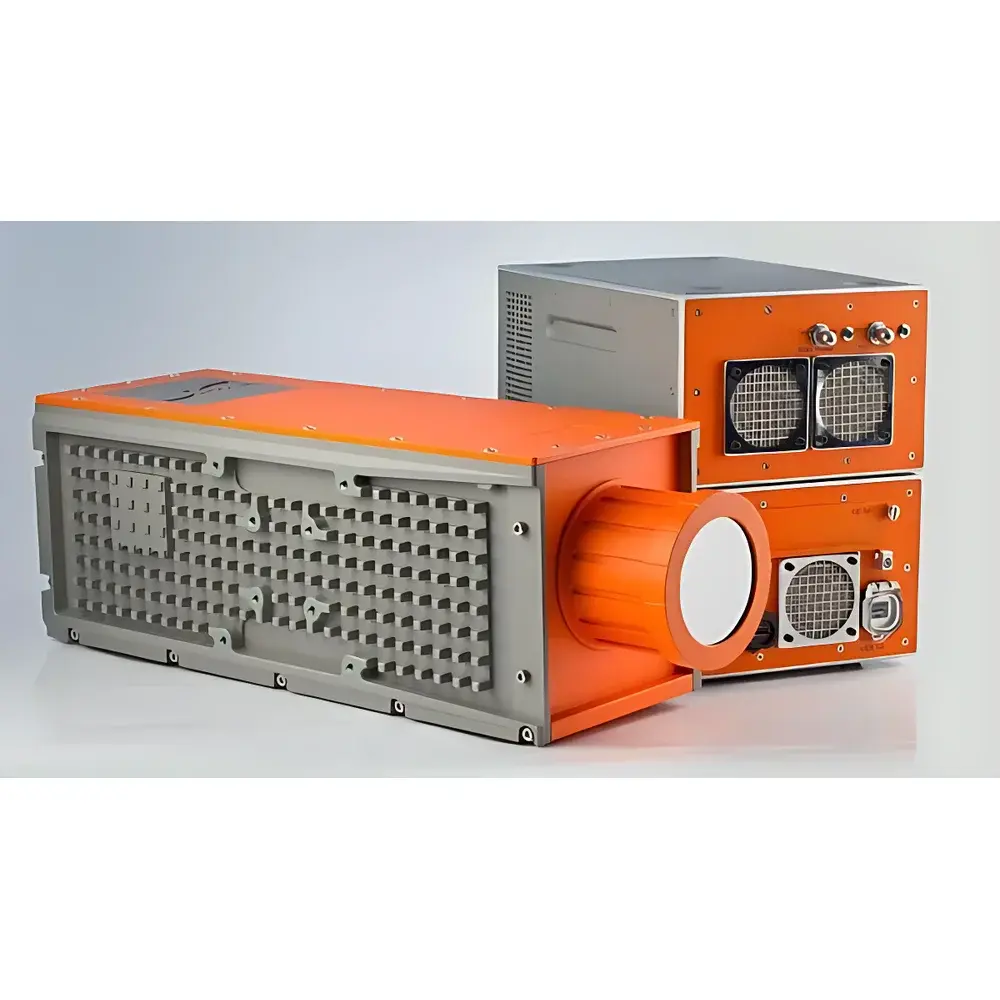
Specim SWIR Short-Wave Infrared Hyperspectral Imaging System
| Brand | Specim |
|---|---|
| Origin | Czech Republic |
| Model | Specim SWIR |
| Spectral Range | 1000–2500 nm |
| Spectral Resolution (FWHM) | 12 nm (30 µm slit) |
| Spatial Pixels | 384 |
| Spectral Bands | 288 |
| Pixel Size | 24 × 24 µm |
| Detector | Stirling-cooled MCT |
| Frame Rate | up to 450 fps (full frame) |
| Exposure Time | 0.1–20 ms |
| SNR | 1050:1 (at max signal level) |
| Interface | CameraLink (16-bit), USB/RS232 control |
| Power Consumption | <50 W |
| Operating Temperature | +5 to +40 °C (non-condensing) |
| Storage Temperature | −20 to +50 °C |
| IP Rating | IP54 |
| Optical f-number | f/2.0 |
| Slit Width Options | 30 µm (standard), 50 µm or 80 µm optional |
| Effective Slit Length | 9.2 mm |
| Cooling MTTF | 25,000 h |
| Data Format | ENVI, MATLAB, R-compatible hypercube |
| Software | LUMO (acquisition, scanning control, real-time visualization) |
| SDK | Available for custom application development |
Overview
The Specim SWIR Short-Wave Infrared Hyperspectral Imaging System is a high-performance, industrial-grade push-broom imager engineered for quantitative chemical imaging in the 1000–2500 nm spectral region. Based on cooled mercury cadmium telluride (MCT) detector technology and optimized optical design, it delivers high-fidelity spectral data with exceptional stability across variable environmental conditions. Its measurement principle relies on spatial-spectral scanning: light from the target scene is dispersed via a precision diffraction grating onto the 384-pixel linear MCT array, generating a 384 × 288 pixel hyperspectral data cube per scan line. The system’s temperature-stabilized optics and Stirling-cooled detector ensure minimal thermal drift—critical for long-duration field deployments, laboratory reproducibility, and process monitoring applications where spectral fidelity must remain consistent over time and ambient fluctuation.
Key Features
- Stirling-cooled MCT detector with 25,000-hour mean time to failure (MTTF), enabling stable, low-noise operation without liquid nitrogen or external chillers
- High-speed acquisition at up to 450 full-frame lines per second, supporting real-time scanning of moving samples on conveyor belts or robotic stages
- Rugged IP54-rated aluminum housing—certified for outdoor use, resistant to dust ingress and water splashing—suitable for field spectroscopy and industrial floor integration
- Optimized optical train with f/2.0 aperture and selectable slit widths (30/50/80 µm), balancing spectral resolution (FWHM = 12 nm at 30 µm) and light throughput
- Low power consumption (<50 W nominal), facilitating deployment in battery-powered mobile platforms or energy-constrained environments
- Native CameraLink interface (16-bit output) with supplementary USB/RS232 for parameter control, synchronization, and metadata embedding
- Integrated electromechanical shutter for automated dark reference acquisition—essential for radiometric calibration and drift correction
Sample Compatibility & Compliance
The Specim SWIR accommodates diverse sample geometries—from macro-scale agricultural produce and pharmaceutical tablets to micro-scale tissue sections—when paired with compatible C-mount lenses or fiber-optic coupling. Its spectral coverage (1000–2500 nm) targets key molecular absorption features including C–H, O–H, and N–H overtones and combination bands, making it suitable for moisture mapping, lipid quantification, polymer identification, and active pharmaceutical ingredient (API) distribution analysis. The system complies with ISO 17025-aligned calibration traceability protocols when used with NIST-traceable reference standards (e.g., calibrated white panels, tungsten-halogen sources). For regulated environments—including GMP-compliant pharmaceutical QC labs—it supports audit-ready data acquisition through LUMO software’s timestamped metadata logging and optional 21 CFR Part 11–compliant user access controls (via third-party integration).
Software & Data Management
LUMO software provides native control of camera parameters, motorized scanning stages, and real-time spectral cube visualization. It exports fully georeferenced, radiometrically corrected hyperspectral data cubes in ENVI header/data format—natively readable by MATLAB, Python (scikit-image, hylite), R (hyperSpec), and commercial chemometrics platforms (e.g., Unscrambler X, Pirouette). The included Software Development Kit (SDK) enables deterministic integration into custom machine vision pipelines, PLC-controlled inspection systems, or AI-driven classification frameworks. All raw and processed datasets retain embedded acquisition metadata (exposure time, integration gain, shutter state, temperature logs), ensuring full experimental provenance for GLP/GMP documentation requirements.
Applications
- Pharmaceutical Quality Assurance: Non-destructive verification of tablet coating uniformity, API concentration gradients, and counterfeit detection (e.g., differentiation of Illicium verum vs. toxic Illicium anisatum using PLS-DA models trained on SWIR spectral fingerprints)
- Food & Agriculture: Quantitative moisture mapping in grains, detection of bruising or fungal infection beneath fruit skin (e.g., avocado subepidermal spotting), and compositional grading of nuts and seeds
- Mineralogy & Geoscience: Identification of clay mineral assemblages, hydroxyl-bearing species, and carbonate content in core samples or drill cuttings
- Forensic Science: Age estimation of dried bloodstains via time-dependent hemoglobin derivative spectral shifts—validated across 0–29 day aging studies using PCA/MNF decomposition
- Recycling & Waste Sorting: Real-time polymer classification (PET, PP, PE) on high-speed sorting lines based on overtone absorption signatures
- Cultural Heritage: Pigment stratigraphy analysis and binder identification in historical paintings without physical sampling
FAQ
What spectral calibration options are available?
Factory spectral calibration is performed using Hg/Ar lamp references; users may perform field recalibration using optional NIST-traceable tungsten-halogen sources and certified reflectance standards.
Can the system operate continuously outdoors?
Yes—the IP54 enclosure and thermally stabilized optics permit unattended operation in ambient temperatures from +5 °C to +40 °C, provided condensation is avoided and direct solar irradiation on the lens is minimized.
Is radiometric calibration supported?
Yes—LUMO includes routines for dark current subtraction, flat-field correction, and absolute radiance conversion using calibrated reference panels; raw DN values are preserved for post-acquisition reprocessing.
How is synchronization achieved with external motion systems?
TTL trigger input/output ports enable hardware-synchronized line acquisition with linear stages, rotary encoders, or conveyor belt encoders—ensuring pixel-to-physical-distance fidelity in push-broom mode.
What computing resources are required for real-time processing?
Real-time visualization of 450 fps streams requires a PCIe x4 CameraLink frame grabber (e.g., NI PCIe-1427) and ≥32 GB RAM; offline chemometric modeling benefits from multi-core CPUs and GPU acceleration (CUDA/OpenCL support via SDK).




