
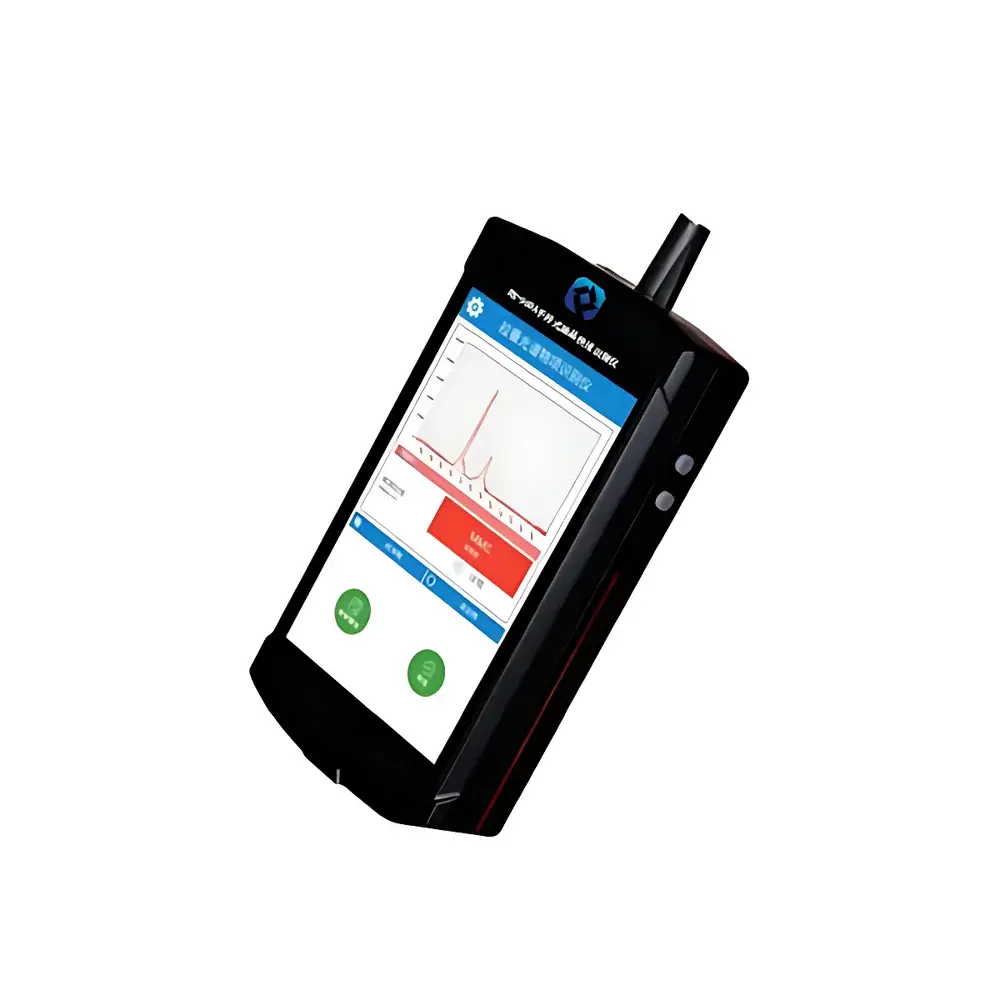
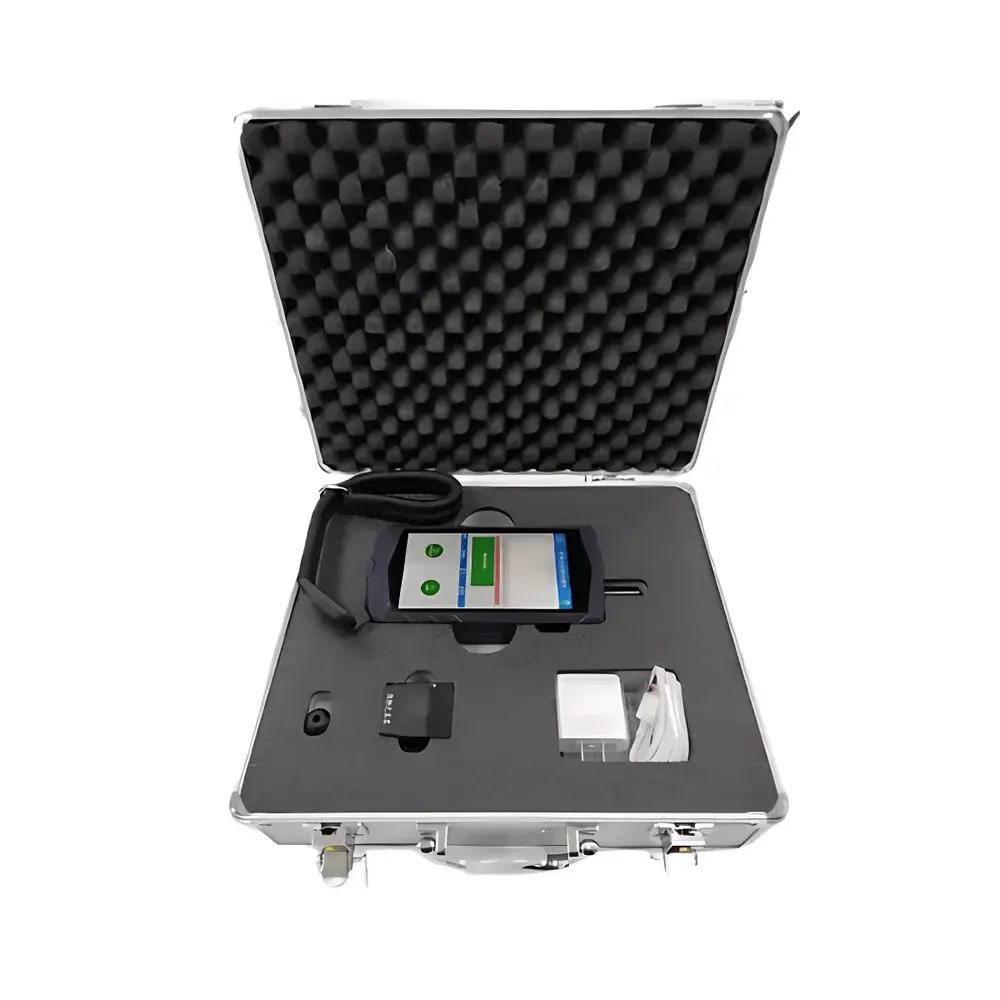
Spectra Invent HX-960A Handheld Raman Spectrometer for Petroleum Product Identification
| Brand | Spectra Invent |
|---|---|
| Origin | Beijing, China |
| Manufacturer Type | Authorized Distributor |
| Country of Origin | China |
| Model | HX-960A |
| Price | Upon Request |
| Laser Wavelength | 785 ± 0.5 nm |
| Wavenumber Range | 200–4000 cm⁻¹ |
| Spectral Resolution | 7–10 cm⁻¹ |
| Operating Temperature | −5 to 50 °C |
| Touchscreen | 5.5″ capacitive LCD (1920 × 1080) |
| Dimensions | 172 × 85 × 30 mm |
| Weight | 0.45 kg |
| IP Rating | IP67 |
| Battery Life | ≥ 4 h (Li-ion) |
| Connectivity | Wi-Fi, Bluetooth 5.0, 4G LTE, GPS, GPRS, GSM, USB-C |
| Camera | Dual-module (13 MP + 8 MP), barcode scanning capable |
| Reporting | PDF export with three-tier color-coded result classification |
| Database | Preloaded library of >3000 chemical spectra |
Overview
The Spectra Invent HX-960A Handheld Raman Spectrometer is an engineered field-deployable instrument designed for rapid, non-destructive identification of petroleum products using 785 nm excitation Raman spectroscopy. Unlike conventional chromatographic or wet-chemical methods, the HX-960A leverages vibrational fingerprinting—capturing unique molecular scattering signatures across a 200–4000 cm⁻¹ wavenumber range—to distinguish hydrocarbon composition, additive profiles, and oxidation states in real time. Its compact optical architecture integrates a thermally stabilized diode laser, high-throughput transmission grating spectrometer, and low-noise CMOS detector, enabling robust signal acquisition under variable ambient lighting and temperature conditions (−5 to 50 °C). The system operates on first-principles chemometric modeling: spectral preprocessing (baseline correction, cosmic ray removal, normalization), followed by multivariate pattern recognition—including PLS-DA and SVM classifiers—trained against reference-grade fuel samples certified to national and military standards (GB17930, GB19147, GB6537, GJB3075, GJB560A). This ensures traceable, repeatable differentiation between gasoline grades (92#, 95#, 98#), diesel variants (0#, −10#, −20#, −35#, −50#), military diesel, and jet fuels (Jet A-1, JP-5, high-flashpoint aviation kerosene), without sample preparation or consumables.
Key Features
- True handheld form factor: 0.45 kg mass and 172 × 85 × 30 mm footprint optimized for one-handed operation in confined or mobile environments (e.g., refinery manways, marine bilges, customs inspection lanes).
- IP67-rated enclosure with reinforced polycarbonate housing and sealed optical path—validated for dust ingress resistance and immersion up to 1 m for 30 min—ensuring operational continuity in offshore, desert, or arctic logistics settings.
- Integrated dual-camera system (13 MP main + 8 MP macro) supports simultaneous visual documentation, barcode/QR code capture of container labels, and spatial registration of measurement location for audit-ready traceability.
- On-device Android 11 OS with 5.5″ FHD capacitive touchscreen enables intuitive workflow navigation, offline spectral library management, and context-aware result interpretation via color-coded confidence indicators (green = match ≥98%, yellow = 95–97.9%, red = <95% or unknown).
- Multi-modal connectivity stack—including 4G LTE, GPS geotagging, Wi-Fi 5, Bluetooth 5.0, and GSM-based cloud sync—facilitates automated report generation (PDF), remote firmware updates, and secure data transmission to centralized LIMS or QMS platforms.
- Built-in rechargeable lithium-ion battery delivers ≥4 hours of continuous spectral acquisition and analysis at 25 °C, with hot-swap capability supported via external power bank interface (USB-C PD 3.0).
Sample Compatibility & Compliance
The HX-960A is validated for direct analysis of liquid hydrocarbons in their native containers—including translucent HDPE jerry cans, stainless steel drums, and glass vials—without dilution, filtration, or transfer. Its free-space optical design eliminates fiber-optic coupling losses and avoids fluorescence quenching common in UV-excited systems. All preloaded spectral models undergo cross-validation per ISO 17025:2017 requirements for analytical method verification, with documented specificity, repeatability (RSD < 2.3% across 10 replicate measurements), and limit of detection (LOD) assessment for key adulterants (e.g., benzene, xylene, biodiesel blends). Regulatory alignment includes compliance with Chinese national standards (GB series), military specifications (GJB), and international best practices for field-portable spectroscopy—supporting GLP documentation workflows and enabling integration into FDA 21 CFR Part 11–compliant environments when paired with Spectra Invent’s optional Audit Trail Module.
Software & Data Management
Embedded SpectraScan™ v3.2 software provides full spectral acquisition control, real-time peak assignment, and library-matching analytics. Users may import third-party spectral files (JCAMP-DX, ASCII), curate custom libraries via supervised training mode, and export processed data in CSV, SPC, or PDF formats with embedded metadata (operator ID, GPS coordinates, timestamp, instrument serial number). Cloud synchronization employs TLS 1.3 encryption and role-based access controls; audit logs record all spectral modifications, library edits, and report exports in immutable format. Optional enterprise deployment includes API access for integration with SAP QM, LabWare LIMS, or custom ERP systems via RESTful endpoints.
Applications
- Aerospace ground support: Verification of jet fuel flash point class (e.g., Jet A-1 vs. JP-8) prior to aircraft refueling—reducing risk of thermal instability incidents.
- Maritime customs enforcement: On-the-spot screening of bunker fuel sulfur content proxies and marine gas oil (MGO) grade conformity during port state control inspections.
- Petrochemical QC/QA: Incoming raw material verification at blending terminals—confirming base stock identity and detecting counterfeit additives or diluents.
- Military logistics: Rapid authentication of tactical diesel (GJB3075) and high-flashpoint aviation kerosene (GJB560A) in forward operating bases where lab access is unavailable.
- Environmental forensics: Field identification of hydrocarbon spill sources (e.g., distinguishing crude oil from refined product residues) using spectral similarity indexing against EPA Region 10 reference libraries.
FAQ
Does the HX-960A require calibration with NIST-traceable standards?
Yes—factory calibration is performed using NIST SRM 2241 (polystyrene) and SRM 2242 (cyclohexane); users may execute daily wavelength validation using built-in polystyrene reference stripe.
Can the device detect fuel adulteration, such as diesel blended with kerosene or vegetable oil?
Yes—its high-fidelity spectral resolution (7–10 cm⁻¹) resolves C–H stretching/bending modes characteristic of paraffinic vs. olefinic vs. ester functional groups, enabling quantitative estimation of blend ratios down to ~2% v/v.
Is spectral library expansion supported for non-petroleum materials?
Yes—the open-format library architecture accepts user-generated spectra from any Raman-compatible source; Spectra Invent provides SDK documentation and Python API wrappers for automated model retraining.
How is data integrity ensured during wireless transmission?
All GSM/4G transmissions utilize AES-256 encryption and digital certificate pinning; locally stored reports include SHA-256 hash signatures verifiable via Spectra Invent’s public key infrastructure.
What maintenance is required for long-term field reliability?
No routine optical alignment or lamp replacement is needed; recommended biannual verification of laser power stability and detector dark current drift using onboard diagnostics suite.





