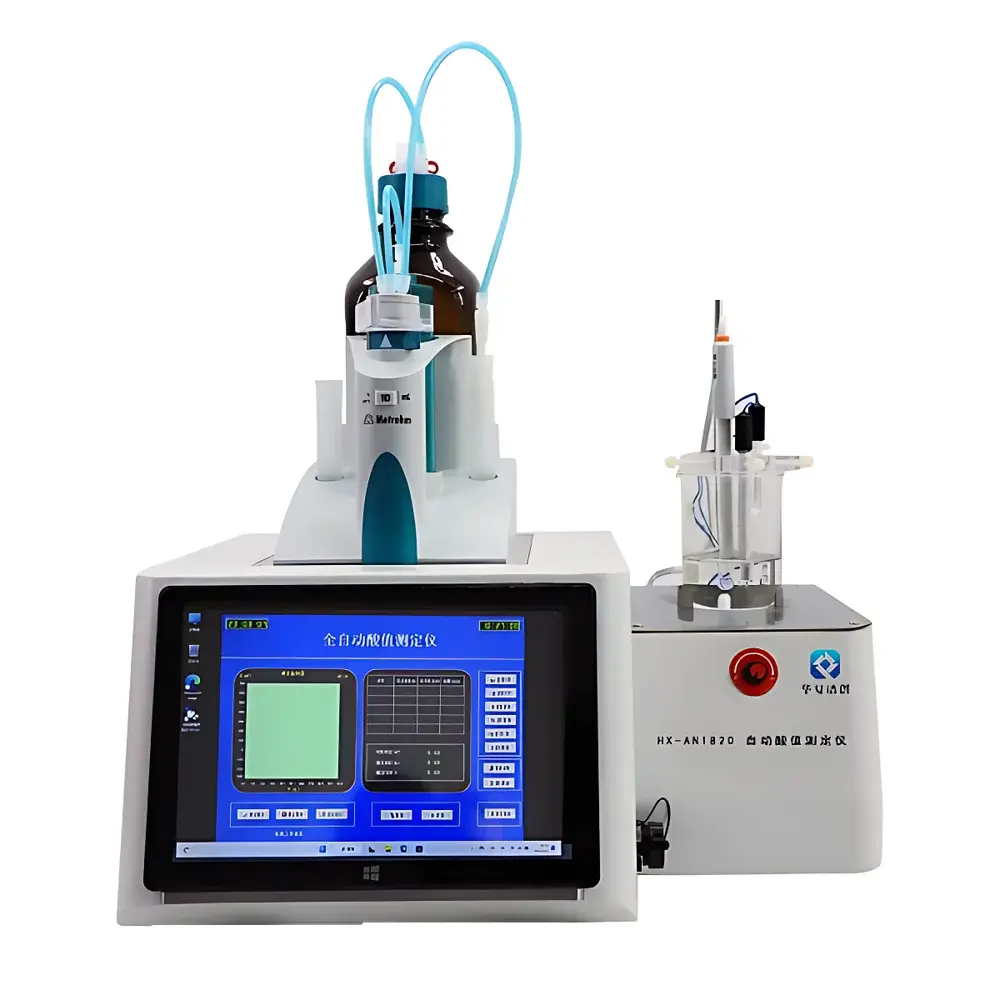
Spectra Invent HX-AN1820 Automatic Acid Number Titrator
| Brand | Spectra Invent |
|---|---|
| Origin | Beijing, China |
| Manufacturer Type | Authorized Distributor |
| Country of Origin | China |
| Model | HX-AN1820 |
| Price Range | USD 1,400 – 14,000 |
| Measurement Range | >0.01 mg KOH/g |
| Accuracy | Relative error ≤5% |
| Potentiometric Range | −200 to +700 mV |
| Basic Error | 0.1% FS ±0.5 mV |
| Burette Capacity | 10 mL |
| Minimum Dispensing Volume | 0.01 mL |
| Burette Accuracy | ±0.1% FS |
| Dimensions | 350 mm × 530 mm × 420 mm (W×D×H) |
| Weight | 13.6 kg |
| Operating System | Windows-based touchscreen interface |
| Compliance Standards | GB/T 7304, GB/T 18609, ASTM D664 |
Overview
The Spectra Invent HX-AN1820 Automatic Acid Number Titrator is a fully automated potentiometric titration system engineered for precise and reproducible determination of acid number (AN) in petroleum-based insulating oils and hydrocarbon fuels. It operates on the fundamental principle of potentiometric titration, where a standardized alcoholic potassium hydroxide (KOH) solution is incrementally delivered into the sample while continuously monitoring the potential difference between a pH-sensitive indicator electrode and a reference electrode. The instrument identifies the stoichiometric endpoint by detecting the inflection point in the first derivative of the titration curve (dE/dV), enabling quantitative calculation of acid number expressed as milligrams of KOH required to neutralize acidic components per gram of sample (mg KOH/g). Designed for routine quality control and condition monitoring in high-reliability environments, the HX-AN1820 delivers traceable, operator-independent results compliant with internationally recognized test methods.
Key Features
- Windows-based embedded operating system with 10.1-inch capacitive touchscreen interface—no external PC required; supports intuitive navigation, method setup, and real-time data visualization.
- Integrated high-precision burette module (10 mL capacity, 0.01 mL minimum dispensing increment, ±0.1% full-scale accuracy) with integrated piston-driven dosing mechanism and anti-drip valve design.
- Real-time plotting of E–V (potential vs. volume) and dE/dV curves during titration; automatic endpoint detection with configurable sensitivity thresholds and manual override capability for ambiguous or multi-step titrations.
- Automated sequence execution: solvent addition, sample dissolution, electrode conditioning, titrant delivery, endpoint recognition, post-titration rinsing, and cell purging—all programmable per method.
- Dual-electrode configuration: combination glass pH electrode with integrated Ag/AgCl reference, calibrated using NIST-traceable buffer standards; optional non-aqueous electrode variants available for low-dielectric media.
- Robust mechanical architecture with corrosion-resistant fluidic pathways, sealed reagent reservoirs, and modular maintenance access—designed for unattended operation over extended shifts.
Sample Compatibility & Compliance
The HX-AN1820 is validated for use with mineral transformer oils, synthetic ester-based dielectric fluids, turbine oils, aviation kerosene, diesel fuel, gasoline, and other non-aqueous petroleum distillates exhibiting acid numbers within the range of 0.01–10.0 mg KOH/g. Sample preparation follows ASTM D664 Annex A1 (manual pretreatment) or Annex A2 (automated extraction), depending on matrix complexity and oxidation state. Instrument compliance includes full alignment with GB/T 7304–2014 (“Petroleum Products — Determination of Acid Number by Potentiometric Titration”), GB/T 18609–2001 (“Acid Number of Crude Oil”), and ASTM D664–22 (“Standard Test Method for Acid Number of Petroleum Products by Potentiometric Titration”). Data integrity meets GLP and ISO/IEC 17025 requirements through audit-trail-enabled software logging of all user actions, calibration events, and raw titration datasets.
Software & Data Management
The onboard SpectraTitrate™ software provides comprehensive method development, validation, and reporting tools. Each method stores electrode calibration history, titrant concentration stability logs, blank correction parameters, and temperature compensation coefficients. All raw potential and volume data are stored in .CSV and proprietary binary formats with time-stamped metadata. Export options include PDF analytical reports (with embedded curves and statistical summaries), Excel-compatible spreadsheets, and LIMS-ready XML output. Software supports 21 CFR Part 11-compliant user authentication (role-based access control), electronic signatures, and immutable audit trails—enabling deployment in regulated environments subject to FDA, ISO 9001, or IEC 61000-4-30 compliance audits.
Applications
- Condition monitoring of in-service transformer oil in power generation and transmission substations to assess oxidative degradation and sludge formation risk.
- Quality release testing of new lubricants and base oils in refinery QC laboratories prior to shipment.
- Research-grade acid number profiling of biofuels and alternative jet fuels undergoing thermal stability evaluation.
- Regulatory compliance testing for sulfuric acid ester content in biodiesel blends per EN 14214 Annex B.
- Root-cause analysis of corrosion failures in steam turbine systems linked to organic acid accumulation in lube oil circuits.
FAQ
Does the HX-AN1820 support ASTM D974 (color-indicator titration)?
No—the instrument implements potentiometric detection only and does not accommodate visual endpoint methods. ASTM D974 is not supported.
Can the system be integrated into an existing LIMS via API or OPC UA?
Yes—SpectraTitrate™ includes a documented RESTful API and optional OPC UA server module for bidirectional data exchange with laboratory information management systems.
What electrode maintenance is required for long-term accuracy?
Electrodes require daily storage in 3 mol/L KCl solution, weekly cleaning with ethanol and mild detergent, and quarterly verification against certified reference materials (CRM) traceable to NIST SRM 3601a.
Is the instrument suitable for testing highly viscous samples such as heavy fuel oil?
Not without pre-dilution—samples exceeding 100 cSt at 40 °C must be diluted with xylene or toluene per ASTM D664 Section 7.3 before analysis.
How is traceability maintained for titrant standardization?
The software enforces mandatory gravimetric or volumetric standardization workflows with digital balance integration; all standardization records—including mass, purity, and expiry—are digitally signed and archived.