
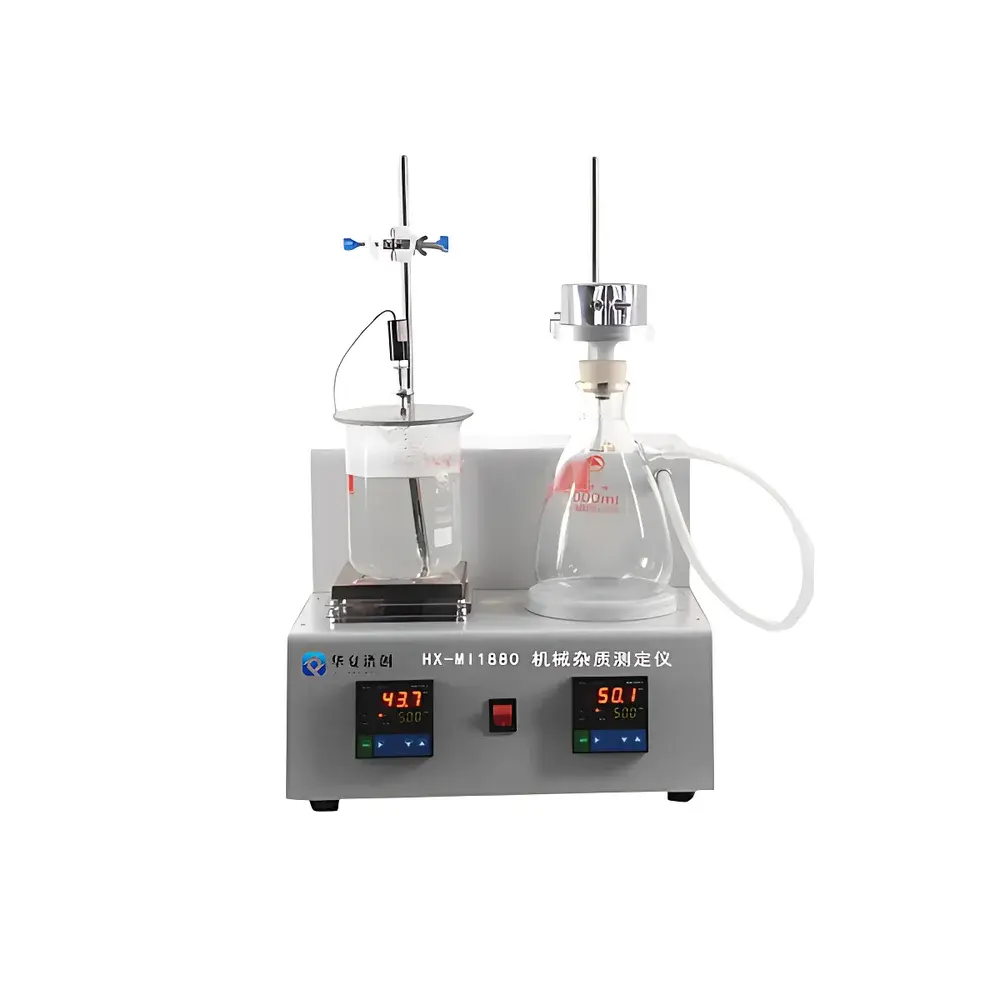
Spectra Invent HX-MI1880 Mechanical Impurities Tester
| Brand | Spectra Invent |
|---|---|
| Origin | Beijing, China |
| Manufacturer Type | Authorized Distributor |
| Country of Manufacture | China |
| Model | HX-MI1880 |
| Price Range | USD 140–14,000 |
| Bath Temperature Control Range | Room Temp–90 °C |
| Bath Temperature Display | LED Digital |
| Bath Temperature Accuracy | ±1 °C |
| Funnel Temperature Control Range | Room Temp–90 °C |
| Funnel Temperature Display | LED Digital |
| Funnel Temperature Accuracy | ±2 °C |
| Ambient Operating Temperature | 5–40 °C |
| Relative Humidity | ≤85% |
| Total Power Consumption | ≤1200 W |
| Power Supply | AC 220 V ±10%, 50 Hz |
| Heating Element Power | 1000 W |
| Dimensions (W×D×H) | 370 × 380 × 600 mm |
| Net Weight | 12.8 kg |
Overview
The Spectra Invent HX-MI1880 Mechanical Impurities Tester is a dedicated laboratory instrument engineered for the quantitative determination of insoluble particulate matter—commonly referred to as mechanical impurities—in petroleum products. It operates in strict accordance with the gravimetric filtration methodology defined in GB/T 511–2010, the Chinese national standard equivalent to ASTM D4294 and ISO 8217 Annex B for solid contaminant assessment in liquid hydrocarbons. The system employs controlled-temperature vacuum filtration through standardized filter media (typically ashless quantitative filter paper or membrane filters), followed by precise mass difference measurement before and after drying. This principle ensures high reproducibility across sample types—including light distillates (e.g., gasoline, kerosene), heavy fuel oils, lubricating base stocks, and additive packages—where particulate contamination may affect combustion efficiency, catalyst life, or equipment wear.
Key Features
- Independent dual-zone temperature control: separate PID-regulated heating systems for the water bath and filtration funnel, each with LED digital display and setpoint resolution of 0.1 °C
- Compliant thermal ramp profile generation to meet GB/T 511’s specified heating rate (e.g., gradual warming to 80 °C for residual fuel oils)
- Integrated vacuum filtration manifold with adjustable vacuum pressure regulation (via built-in vacuum pump) to maintain consistent flow rates across varying sample viscosities
- Robust stainless-steel and borosilicate glass construction for chemical resistance and long-term dimensional stability during repeated thermal cycling
- Front-accessible chamber design facilitating rapid filter exchange, solvent rinsing, and residue recovery without disassembly
- Low thermal inertia heating elements (1000 W electric furnace) enabling stable bath temperature maintenance within ±1 °C over extended test durations (up to 8 hours)
Sample Compatibility & Compliance
The HX-MI1880 accommodates a broad range of petroleum-based matrices per GB/T 511 scope: diesel fuels, marine bunker fuels (RMG/RME), turbine oils, hydraulic fluids, transformer oils, and engine oil formulations containing dispersants or detergents. Sample volumes are configurable between 50 mL and 100 mL depending on expected impurity load. All wetted components—including funnel assemblies, glass funnels, and bath vessels—meet Class A volumetric tolerance requirements per ISO 4787. The instrument supports traceability workflows compliant with GLP and internal QA/QC protocols; while not inherently 21 CFR Part 11–certified, its manual data recording architecture aligns with audit-ready documentation practices when paired with laboratory notebooks and calibrated analytical balances (e.g., METTLER TOLEDO XP series).
Software & Data Management
The HX-MI1880 is a hardware-only platform with no embedded microprocessor or digital interface. Temperature setpoints, dwell times, and vacuum levels are adjusted manually via front-panel controls. Consequently, all test parameters and gravimetric results must be recorded externally using laboratory information management systems (LIMS) or validated electronic lab notebooks (ELN). Users are advised to implement SOPs requiring dual-operator verification of filter tare masses, final dried residue weights, and calculated impurity percentages (% w/w). Instrument calibration intervals should follow internal metrology schedules aligned with ISO/IEC 17025 Clause 6.5, particularly for the digital temperature sensors (traceable to NIM-certified references) and vacuum gauge (if installed as optional accessory).
Applications
- Quality assurance testing of refinery off-gas condensates prior to pipeline injection
- Monitoring filterability degradation in stored biodiesel blends (B5–B20) per EN 14214
- Assessing sludge formation tendency in used turbine oils during condition monitoring programs
- Verifying mechanical cleanliness of insulating oils in power transformer maintenance (IEC 60429 compliance support)
- Research-level evaluation of additive-induced precipitation in multigrade lubricants under accelerated aging
- Third-party inspection of imported crude oil cargoes for sediment content prior to customs clearance
FAQ
Does the HX-MI1880 comply with international standards beyond GB/T 511?
Yes—it implements the same gravimetric filtration principle as ASTM D4294, IP 392, and ISO 8217 Annex B. While calibration certificates reference NIM (National Institute of Metrology, China), users may validate performance against SRMs such as NIST Standard Reference Material 2720a.
Can the instrument be used for non-petroleum samples, such as biofuels or solvents?
It is validated for hydrocarbon-based liquids only. Polar solvents (e.g., methanol, acetone) may degrade seal materials or distort filter paper porosity; method adaptation requires full revalidation per ISO 17025 Annex A.
Is vacuum level monitoring included in the base configuration?
No—the standard unit provides fixed-vacuum operation via integrated pump. Optional analog vacuum gauges (0–100 kPa range) are available as field-installable accessories.
What maintenance intervals are recommended for the heating elements and pump?
Electric furnace elements require annual visual inspection for oxidation; vacuum pump oil must be replaced every 500 operational hours or quarterly—whichever occurs first.
How is temperature uniformity verified across the bath volume?
Users should perform a 3-point mapping (center, front-left, rear-right) using a NIST-traceable RTD probe at 60 °C and 80 °C, per ASTM E220. Deviation >±0.5 °C warrants recalibration of the bath controller.
Related Products




