
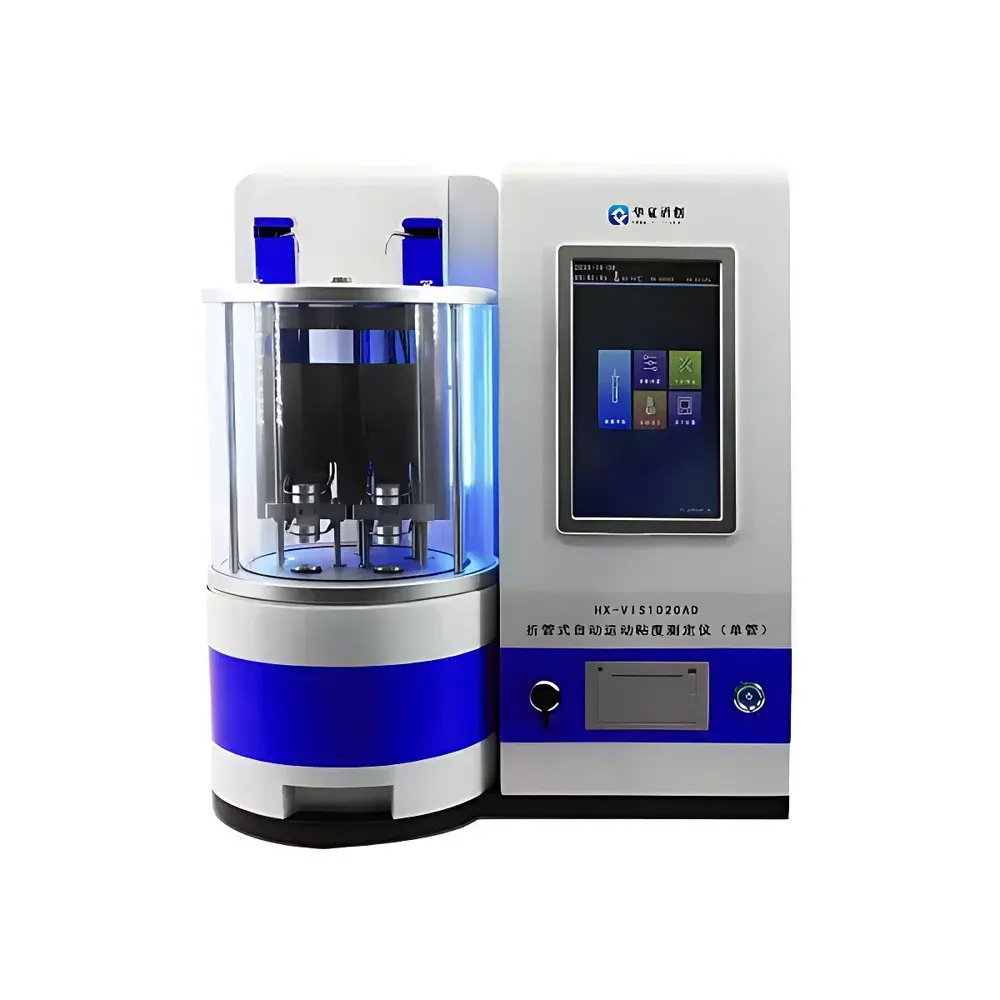
Spectra Invent HX-VIS1020AD Capillary Bend-Tube Automatic Kinematic Viscosity Tester (Single-Tube Configuration)
| Brand | Spectra Invent |
|---|---|
| Origin | Beijing, China |
| Manufacturer Type | Authorized Distributor |
| Country of Origin | China |
| Model | HX-VIS1020AD |
| Price Range | USD 1,400 – 14,000 |
Overview
The Spectra Invent HX-VIS1020AD is a fully automated capillary bend-tube kinematic viscosity tester designed for precise, unattended measurement of kinematic viscosity in petroleum-based and bio-derived liquid fuels and lubricants. It operates on the principle of gravity-driven capillary flow—complying with standardized capillary viscometry as defined in ASTM D7279 (Standard Test Method for Kinematic Viscosity of Transparent and Opaque Liquids by Automated Capillary Viscometers) and NB/SH/T 0956 (Chinese national standard for automatic kinematic viscosity determination in petroleum products). The instrument employs a U-shaped or L-bend capillary geometry to enable stable fluid column formation and accurate timing of efflux duration under controlled thermal conditions. Unlike conventional suspended-level viscometers, the bend-tube design minimizes bubble entrapment and improves repeatability for opaque or volatile samples—including used engine oils, biodiesel blends (B5–B100), diesel fuel, base stocks, and formulated lubricants. Its dual-test-position architecture supports asynchronous analysis of two independent samples without cross-contamination, while maintaining strict ISO 4287 / ASTM D445-equivalent thermal stability and timing resolution.
Key Features
- Fully automated workflow: temperature stabilization, efflux timing, solvent rinse, hot-air drying, liquid level detection, waste reservoir monitoring, data logging, result calculation, and optional reporting—all executed without operator intervention after sample loading.
- High-stability thermal control system: integrated PLC-based controller with industrial-grade AD temperature regulation module and calibrated PT100 platinum resistance thermometers ensuring ±0.1 °C accuracy across 20–120 °C operating range.
- Dual independent test positions: enables sequential or staggered analysis of two samples using identical or different capillary viscometer types—ideal for comparative testing or method validation workflows.
- Human-machine interface: 7-inch industrial touch-screen HMI with localized Chinese GUI (configurable firmware supports English-language UI upon request); real-time display of temperature, elapsed time, viscosity value, status flags, and system diagnostics.
- Data integrity architecture: onboard non-volatile memory stores >1,000 test records with timestamp, ambient conditions, capillary ID, calibration constants, raw efflux times, and calculated kinematic viscosity (mm²/s or cSt).
- Energy-efficient operation: 800 W maximum power draw; compliant with IEC 61000-3-2 harmonic emission standards for laboratory equipment.
Sample Compatibility & Compliance
The HX-VIS1020AD accommodates transparent and opaque Newtonian and near-Newtonian liquids within the kinematic viscosity range of 3–3000 mm²/s (cSt), including but not limited to: mineral base oils (Group I–III), synthetic esters, polyalphaolefins (PAO), diesel fuel (EN 590, ASTM D975), biodiesel (FAME per EN 14214), biodiesel blends (B5, B20), hydraulic fluids, transformer oils, and in-service lubricants contaminated with oxidation byproducts or soot. Capillary selection (e.g., Cannon-Fenske, Ubbelohde, or reverse-flow types) is user-replaceable to match viscosity class requirements. The system conforms to regulatory and quality assurance frameworks including ASTM D7279, NB/SH/T 0956, and DB34/T 4147. While not pre-certified for FDA 21 CFR Part 11, its audit-trail-capable data storage and user-access-controlled firmware support GLP/GMP-aligned validation protocols when deployed in QC laboratories subject to ISO/IEC 17025 accreditation.
Software & Data Management
Data acquisition and processing are handled internally via embedded firmware with deterministic real-time scheduling. All measurements include automatic application of calibration constants (K-factor), temperature correction (via ASTM D341 interpolation), and unit conversion (cSt ↔ mm²/s). Export options include USB-host file transfer (CSV or TXT format), RS-232 serial output for SCADA integration, and optional Ethernet connectivity for LAN-based lab network synchronization. Timestamps incorporate battery-backed RTC (real-time clock) retaining date/time during power loss. No proprietary desktop software is required; raw data files are human-readable and compatible with third-party statistical process control (SPC) or LIMS platforms.
Applications
This instrument serves routine and reference-grade viscosity testing across multiple sectors: power generation (turbine oil monitoring per ASTM D4378), upstream/downstream petroleum refining (crude assay, distillate specification), chemical manufacturing (solvent purity verification), environmental compliance labs (biofuel certification), and academic research on alternative fuel rheology. Its automation capability reduces labor cost per test by >70% compared to manual capillary methods and eliminates operator-induced timing variance—a critical factor in ISO 5715-compliant lubricant life-cycle assessment.
FAQ
What capillary viscometers are compatible with the HX-VIS1020AD?
Standard Ubbelohde-type and reverse-flow capillaries with nominal viscometer constants between 0.002 and 10.000 mm²/s² are supported. Users must manually install and register each capillary’s K-factor into the system prior to use.
Does the instrument support ASTM D445 mode?
No—it implements ASTM D7279 methodology exclusively, which specifies automated timing, temperature control, and cleaning cycles distinct from manual D445 procedures.
Can test results be exported directly to an LIMS?
Yes, via ASCII-formatted CSV files transferred over USB or transmitted in real time via RS-232 serial interface with configurable delimiter and header settings.
Is calibration traceability provided with the system?
The instrument ships with factory calibration certificate for temperature sensors (traceable to NIM, China) and timing circuitry; users are responsible for periodic verification using certified reference oils (e.g., NIST SRM 2786 series).
What maintenance is required for long-term reliability?
Monthly cleaning of capillary pathways with approved solvents (e.g., xylene, toluene), quarterly inspection of air-drying nozzles and waste tubing, and annual recalibration of PT100 sensors by authorized service centers.




