
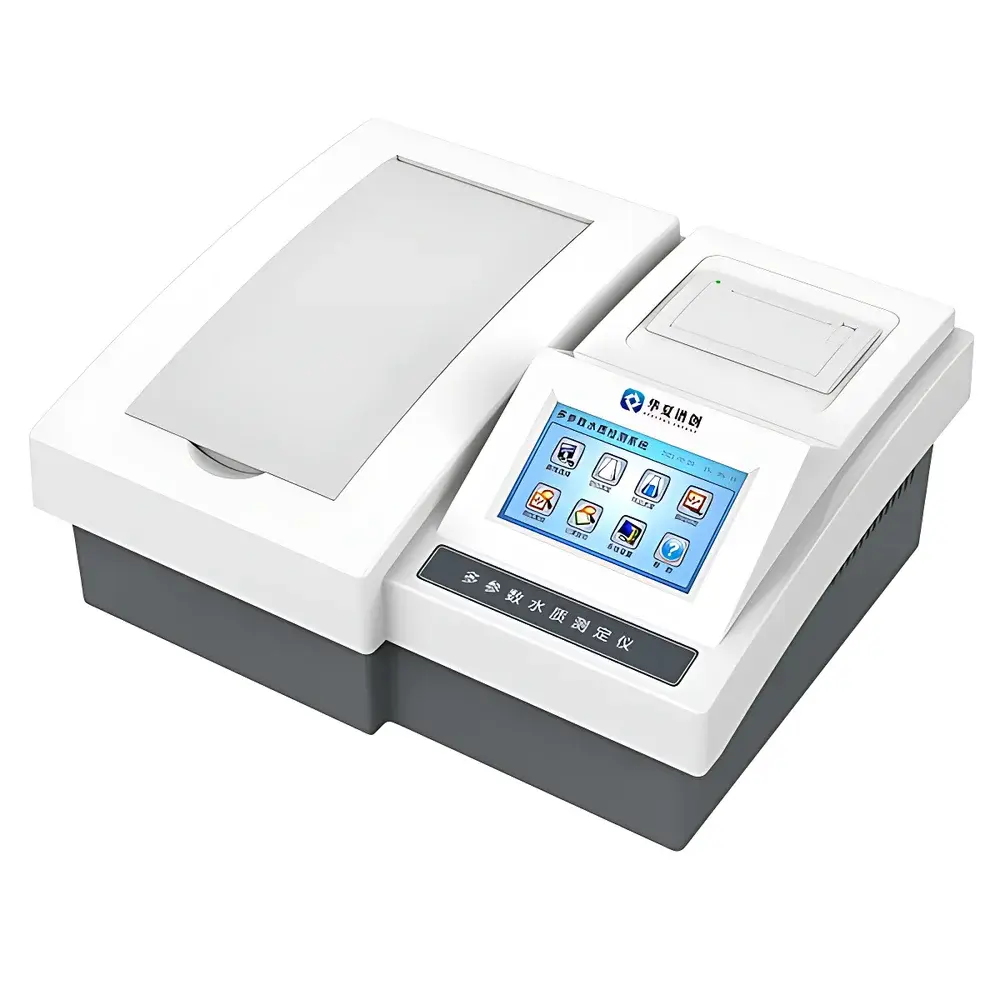
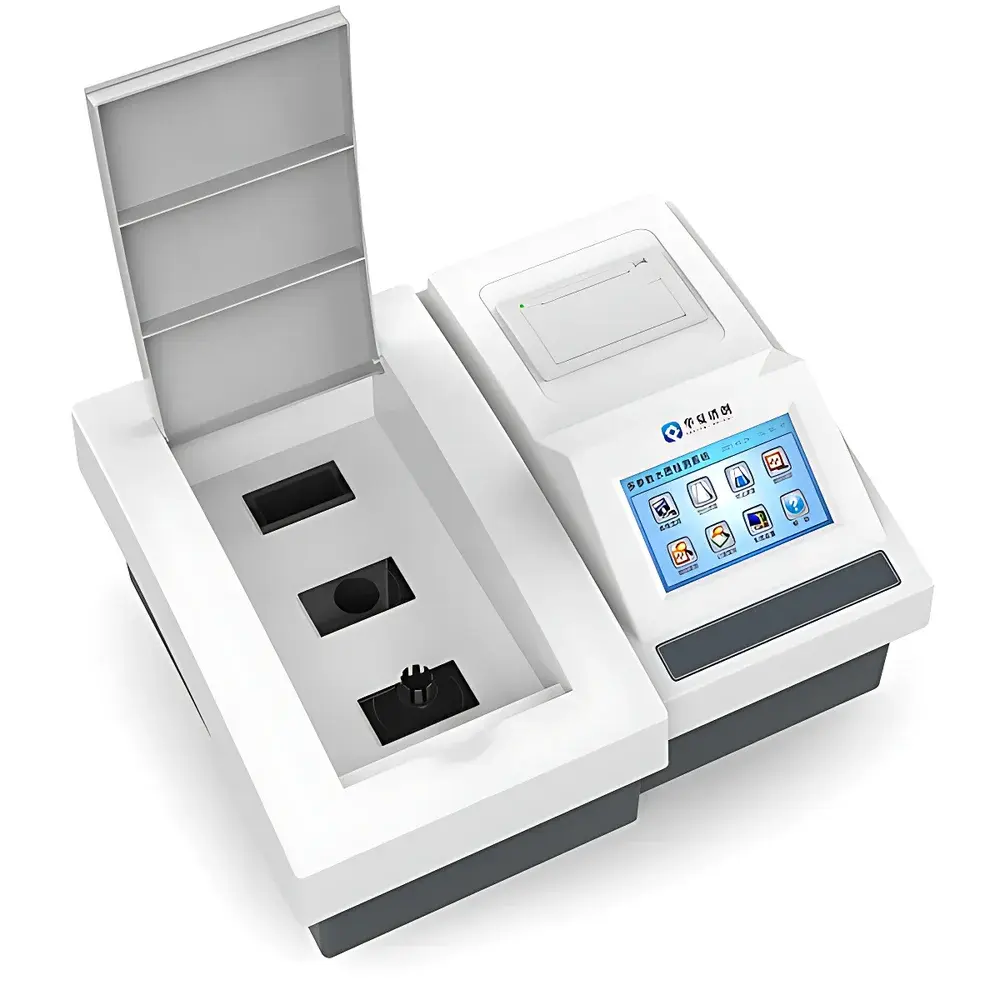
Spectra Invent HXHMP-1600 Multi-Parameter Water Quality Analyzer
| Brand | Spectra Invent |
|---|---|
| Origin | Zhejiang, China |
| Model | HXHMP-1600 |
| Instrument Type | Laboratory Water Quality Analyzer |
| Optical Channels | 4 / 8 / 12 / 16 (customizable from 1–16) |
| Wavelength Options | 340, 420, 470, 520, 540, 560, 610, 660, 680, 700 nm |
| Wavelength Accuracy | ±1 nm |
| Photometric Linearity | ±0.002 A (0–1 A) |
| Absorbance Range | –2.000 to +2.000 A |
| Photometric Accuracy | ±0.005 A per 1 A |
| Light Source | Imported High-Performance LED |
| Detector | Silicon Photodiode Sensor |
| Display | 5-inch Color Touchscreen (Bilingual: English/Chinese) |
| Power Supply | AC 220 V (165–240 V), 30 W |
| Dimensions | 400 × 310 × 158 mm |
| Weight | 5 kg |
| Operating Environment | 5–40 °C, ≤85% RH |
| Storage Environment | –40–60 °C, ≤85% RH |
| Calibration | Built-in Auto-Calibration Function |
| Curve Storage Capacity | 3,500 curves |
| Data Log Capacity | 100,000 records |
| Light Intensity Adjustment | 16-level programmable |
Overview
The Spectra Invent HXHMP-1600 Multi-Parameter Water Quality Analyzer is a laboratory-grade photometric instrument engineered for precise, reproducible quantification of waterborne analytes using single-wavelength absorbance measurement based on the Lambert-Beer law. It operates by directing monochromatic light—selected from a calibrated set of discrete wavelengths (340–700 nm)—through a cuvette containing a chemically reacted sample. The transmitted light intensity is captured by a silicon photodiode detector, and the resulting absorbance value is converted into concentration via preloaded or user-defined calibration functions. Designed for routine compliance testing and method development in municipal, industrial, academic, and regulatory laboratories, the HXHMP-1600 supports standardized protocols aligned with common water quality methods referenced in ISO 7027, ASTM D1253, APHA Standard Methods 4500, and EPA 40 CFR Part 136. Its modular optical architecture enables flexible configuration across 1–16 independent measurement channels, making it suitable for both high-throughput batch analysis and targeted parameter screening.
Key Features
- Modular optical design supporting 4, 8, 12, or 16 fixed-channel configurations—with full customization available for 1–16 channels to match specific analytical workflows.
- High-stability imported LED light sources with ±1 nm wavelength accuracy and 16-step programmable light intensity control to optimize signal-to-noise ratio across low- and high-absorbance ranges.
- 5-inch color touchscreen interface with bilingual (English/Chinese) operation, intuitive icon-driven navigation, and context-sensitive soft keys for rapid method selection and data review.
- User-configurable calibration options including linear and multi-point segmented (piecewise linear) curve fitting—critical for non-linear reactions such as nitrate interference in chloride assays or turbidity-corrected phosphorus determinations.
- Built-in auto-calibration function that performs real-time reference zeroing and dark-current compensation, minimizing long-term drift and reducing manual maintenance frequency.
- Comprehensive data integrity safeguards: password-protected system access, audit-trail-capable user ID tagging (up to 99 operator codes), and timestamped calibration logs—including standard concentrations, measured absorbances, calibration date/time, and operator ID.
- Dual-layer data protection: automatic backup of user-defined curves and measurement records to internal flash memory; one-click factory reset with optional retention of user data archives.
Sample Compatibility & Compliance
The HXHMP-1600 accommodates standard 10 mm square or round glass/plastic cuvettes (10–50 mm pathlength compatible with optional adapters). It supports all common colorimetric water quality methods requiring spectrophotometric detection—including but not limited to ammonia nitrogen (Nesslerization), total phosphorus (ascorbic acid/molybdate), COD (dichromate digestion), nitrate/nitrite (cadmium reduction/Griess), fluoride (SPADNS), and heavy metals (e.g., lead, copper via complexometric reagents). All onboard calibration curves adhere to GLP principles: each stored curve retains traceable metadata (calibration standards used, lot numbers, expiration dates where applicable). The instrument meets electromagnetic compatibility requirements per IEC 61326-1 and environmental operating specifications per IEC 60068-2 for laboratory use. While not FDA 21 CFR Part 11 certified out-of-the-box, its data export structure (CSV/Excel-compatible) and user-access logging support integration into validated LIMS environments under GxP-aligned SOPs.
Software & Data Management
Data generated by the HXHMP-1600 is stored internally in non-volatile memory—supporting up to 3,500 calibration curves and 100,000 measurement records with full metadata (sample ID, parameter name, absorbance, concentration, operator ID, timestamp, and instrument serial number). Export is performed via USB 2.0 port to external storage devices in plain-text CSV format, ensuring compatibility with Excel, LabArchives, and third-party statistical packages (e.g., JMP, Minitab). The instrument’s firmware includes built-in report generation tools: users may select individual entries or date-range batches for on-device printing (via optional thermal printer interface) or screen-based PDF preview. All curve edits, deletions, and calibrations are logged chronologically with immutable timestamps and operator authentication—enabling retrospective verification during internal audits or regulatory inspections.
Applications
- Drinking water treatment facilities performing daily compliance checks for residual chlorine, iron, manganese, and hardness ions.
- Wastewater laboratories conducting BOD/COD correlation studies and nutrient load monitoring (TN, TP) under NPDES permit requirements.
- Environmental consulting firms executing field-deployed lab validation of portable sensor data using standardized benchtop reference measurements.
- University teaching labs demonstrating fundamental photometric principles, calibration theory, and method validation exercises per APHA 23rd Edition pedagogical guidelines.
- Industrial process water monitoring in pharmaceutical, semiconductor, and food & beverage manufacturing where conductivity, silica, and TOC surrogate parameters require periodic verification.
FAQ
Can the HXHMP-1600 be used for EPA-approved methods?
Yes—when configured with appropriate reagent kits and validated calibration standards, it supports numerous EPA-referenced colorimetric procedures (e.g., Method 365.4 for phosphate, Method 350.1 for ammonia). Full method validation remains the responsibility of the end-user laboratory per 40 CFR Part 136.
Is remote software update supported?
Firmware updates are performed locally via USB drive; no cloud connectivity or over-the-air functionality is implemented to maintain data sovereignty and network security compliance.
What is the warranty coverage?
Spectra Invent provides a 24-month limited warranty covering parts and labor for defects in materials and workmanship under normal laboratory use conditions.
Does the instrument support external barcode scanning for sample ID entry?
No native barcode interface is included, but alphanumeric sample IDs up to 20 characters may be entered manually or imported via CSV batch upload.
Are calibration standards supplied with the instrument?
No certified reference materials are bundled. Users must procure NIST-traceable or equivalent standards appropriate for their target analytes and concentration ranges.







