
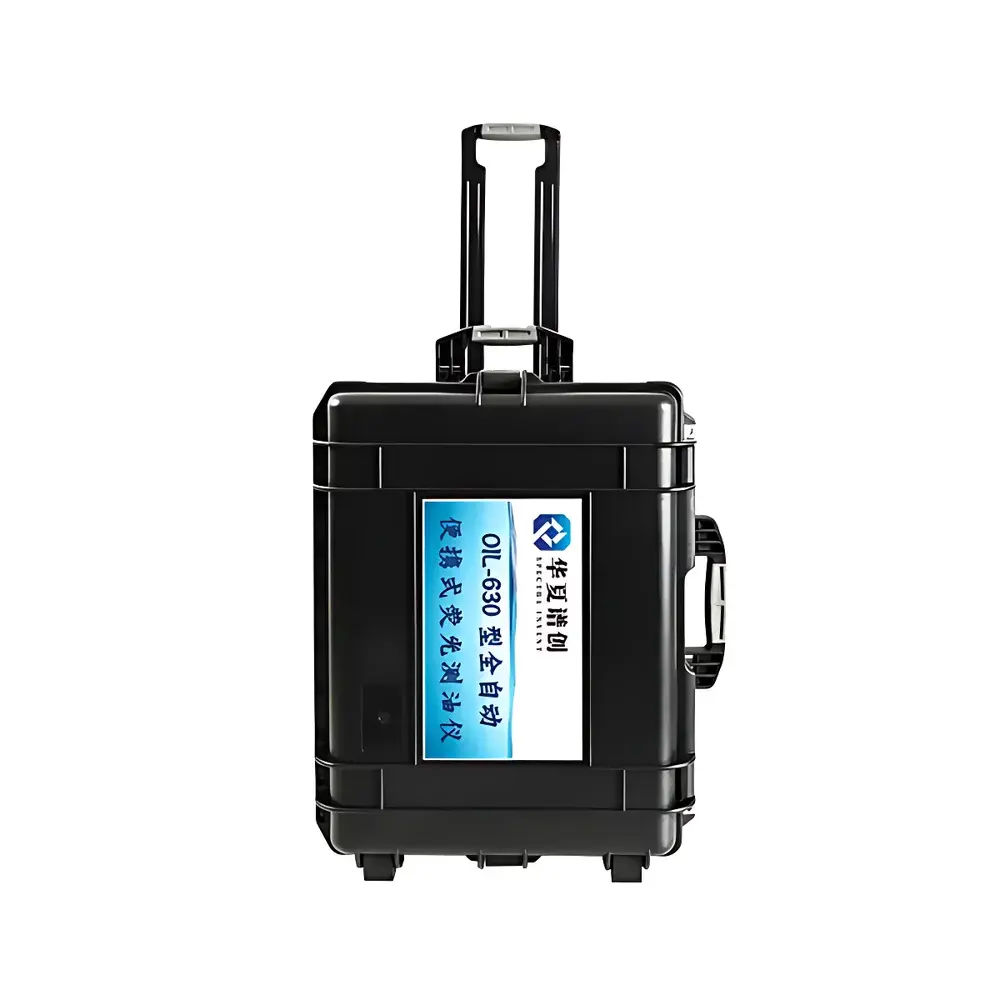
SPECTRA INVENT OIL-630 Portable Fully Automated Fluorescence Oil-in-Water Analyzer
| Brand | SPECTRA INVENT (Chinainvent) |
|---|---|
| Origin | Beijing, China |
| Model | OIL-630 |
| Principle | Fluorescence Spectrophotometry |
| Measurement Range | 0–5 mg/L (auto-dilution beyond range) |
| Detection Limit | 0.005 mg/L (instrumental), 0.001 mg/L (method) |
| Accuracy | ≤2.0% error |
| Resolution | 0.001 mg/L |
| Excitation Wavelength | 310 nm ±1 nm |
| Emission Wavelength | 360 nm |
| Optical Path | 1 cm quartz fluorescence cuvette |
| Linearity | r > 0.999 |
| Repeatability | RSD ≤2.0% |
| Sample Volume | 0–600 mL |
| Analysis Time | 8 min per sample |
| IP Rating | IP67 |
| Dimensions | 650 × 500 × 330 mm |
| Power | 220 V, 50 Hz, 50 W |
| Operating Temp/Humidity | –5 to 45 °C / 20–85 % RH |
| Battery Life | Up to 8 h continuous operation |
Overview
The SPECTRA INVENT OIL-630 is a portable, fully automated fluorescence-based oil-in-water analyzer engineered for regulatory-compliant field and laboratory quantification of hydrocarbon contaminants in aqueous matrices. It operates on the principle of molecular fluorescence spectroscopy: polycyclic aromatic hydrocarbons (PAHs) and aliphatic hydrocarbons—when extracted into non-polar solvents such as n-hexane or petroleum ether—exhibit characteristic fluorescence emission upon excitation at 310 nm. The instrument measures emitted intensity at 360 nm using a high-stability LED cold light source coupled with a Czerny-Turner monochromator, enabling selective, interference-resistant detection. Designed to meet Chinese national standard HJ 637–2018 (Determination of Petroleum Hydrocarbons in Water by Fluorescence Spectrophotometry), the OIL-630 integrates extraction, phase separation, calibration, and quantification into a single workflow—eliminating manual transfer steps that introduce variability and contamination risk. Its compact, ruggedized architecture supports deployment in remote monitoring stations, wastewater treatment plants, environmental emergency response units, and mobile labs where power stability and operator training are constrained.
Key Features
- Fully automated solvent extraction: integrated ultrasonic-assisted volume measurement, rotational stirring, and oil–water separation via hydrophobic membrane filtration
- Self-calibrating system with pre-loaded standard curve generation and automatic standard solution preparation (including serial dilution)
- Intelligent auto-dilution module for samples exceeding 5 mg/L—ensures linear response without manual intervention
- Onboard reagent level monitoring and waste liquid segregation with dedicated reservoirs to prevent cross-contamination
- IP67-rated enclosure with shock-absorbing chassis, enabling reliable operation under rain, dust, vibration, and temperature fluctuations (–5 to 45 °C)
- Integrated 8-hour lithium-ion battery backup with real-time power management; compatible with 220 V AC input for lab use
- Optical path stability maintained by fixed 1 cm quartz fluorescence cuvette and thermally stabilized LED source (±0.2 °C drift over 8 h)
- Automated cleaning cycle between analyses using solvent flush and air purge—reducing carryover to <0.3% (verified with n-hexane blank)
Sample Compatibility & Compliance
The OIL-630 accepts raw water, surface water, groundwater, wastewater effluent, and seawater (with salinity compensation). Sample introduction uses calibrated, traceable sampling vials with molded volume markings (0–600 mL), minimizing volumetric error. Extraction efficiency is validated per HJ 637–2018 using certified reference materials (e.g., NIST SRM 2781). The instrument’s performance metrics—including method detection limit (MDL = 0.001 mg/L), instrument detection limit (IDL 0.999 across 0.01–5 mg/L)—support compliance with ISO 17025 quality requirements. Data integrity safeguards include timestamped audit trails, user-access controls, and electronic signature support aligned with GLP and EPA Method 1664B documentation expectations.
Software & Data Management
The embedded firmware (v3.2+) provides touchscreen-driven workflow control, real-time spectral preview, and QC flagging (e.g., signal saturation, low signal-to-noise, reagent depletion). Raw fluorescence intensities, calibration parameters, and metadata (operator ID, GPS coordinates, ambient conditions) are stored in encrypted SQLite databases compliant with FDA 21 CFR Part 11 requirements for electronic records. Export options include CSV, PDF analytical reports (with embedded chromatogram-style intensity plots), and direct USB/Bluetooth transmission to LIMS platforms. Firmware updates are delivered via signed OTA packages with SHA-256 verification.
Applications
- Regulatory monitoring of petroleum hydrocarbons in discharge permits (e.g., municipal WWTP outfalls, industrial effluents)
- Rapid assessment during oil spill incidents—field-deployable within 90 seconds of power-on
- Groundwater plume delineation at legacy refinery or storage tank sites
- QA/QC of oil–water separators and API skimmers in offshore platforms
- Research-grade quantification of biodegradation kinetics in microcosm studies
- Validation of membrane filtration or activated carbon treatment efficacy
FAQ
What extraction solvents are compatible with the OIL-630?
n-Hexane and petroleum ether are validated per HJ 637–2018; other low-fluorescence hydrocarbons may be used subject to method validation.
Does the instrument require external gas supply or vacuum pumps?
No—all fluid handling (extraction, separation, washing) is driven by precision peristaltic and syringe pumps integrated into the chassis.
Can the OIL-630 be operated without internet connectivity?
Yes—full functionality, including calibration, analysis, and report generation, is available offline; cloud sync occurs only upon optional Wi-Fi reconnection.
How is instrument performance verified between calibrations?
Built-in check standards (pre-loaded quinine sulfate vial) enable daily system suitability testing with pass/fail criteria logged automatically.
Is third-party software integration supported?
Yes—RESTful API access (HTTPS/TLS 1.2) allows bidirectional data exchange with enterprise LIMS, SCADA, or environmental data management systems.
Related Products







