
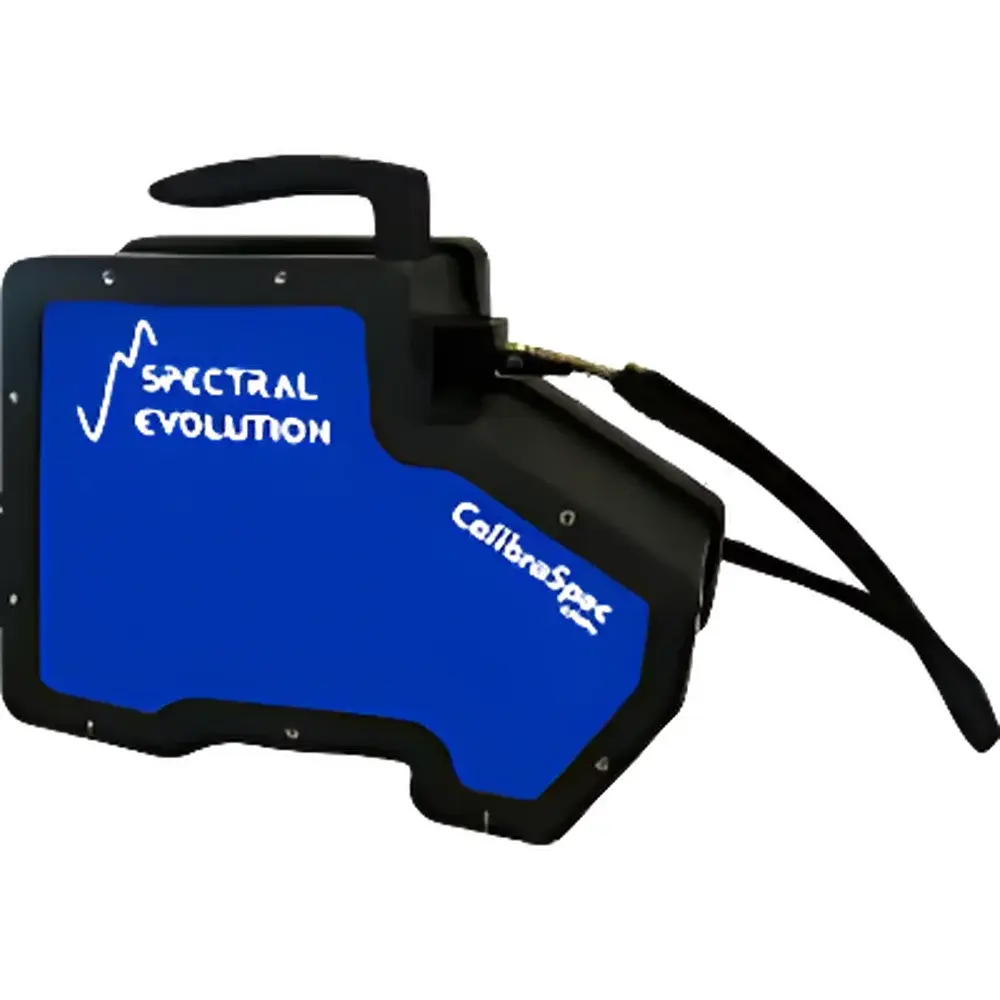
Spectral Evolution CalibraSpec 6500A High-Resolution Field Spectroradiometer
| Brand | Spectral Evolution |
|---|---|
| Origin | USA |
| Model | SR-6500A |
| Spectral Range | 350–2500 nm |
| Resolution | 1.5 nm @ 700 nm |
| Detector Cooling | Triple-stage thermoelectrically cooled Si + InGaAs arrays |
| Spectral Stability (Drift) | ≤0.4% |
| Noise Equivalent Radiance (NER) | 0.8×10⁻⁹ W/cm²/nm/sr @ 400 nm |
| Weight | 5.73 kg |
| Battery Life | 3 h (rechargeable Li-ion, <0.9 kg) |
Overview
The Spectral Evolution CalibraSpec 6500A is a high-precision, field-deployable spectroradiometer engineered for quantitative remote sensing calibration, spectral reflectance and radiance characterization, and hyperspectral ground-truth validation. Operating across the full solar-reflective spectral domain—from 350 nm in the ultraviolet through visible and near-infrared to 2500 nm in the shortwave infrared—the instrument employs a triple-detector architecture with thermoelectrically cooled silicon (Si) and indium gallium arsenide (InGaAs) focal plane arrays. Its optical design integrates holographic diffraction gratings and fixed-optics configuration—eliminating moving parts—to ensure mechanical robustness and long-term measurement repeatability under variable environmental conditions. The CalibraSpec 6500A is not a scanning or dispersive monochromator-based system; rather, it utilizes simultaneous full-spectrum acquisition via optimized detector segmentation, enabling high-fidelity spectral sampling at native resolution without time-dependent artifacts. This architecture supports traceable radiometric performance compliant with ASTM E275, ISO 9001 calibration protocols, and NASA-endorsed field spectrometer validation standards.
Key Features
- Triple-stage thermoelectric cooling applied independently to Si (UV-VIS-NIR) and dual InGaAs (SWIR-I/SWIR-II) detector arrays, maintaining stable operating temperatures ±0.1°C to suppress dark current drift and thermal noise
- Spectral resolution of 1.5 nm at 700 nm, 3.0 nm at 1500 nm, and 3.8 nm at 2100 nm—optimized for resolving narrow absorption features in vegetation pigments, mineral OH/H₂O bands, and atmospheric gas signatures
- Bidirectional thermal control system (patented) actively regulates detector housing temperature during ambient fluctuations from −10°C to +45°C, achieving radiometric stability ≤0.4% over 60-minute continuous operation
- Fixed-grating, all-reflective optical path with no motorized filters or shutters—ensuring >10⁶ cycle operational reliability and immunity to vibration-induced misalignment
- Integrated Android-based tablet interface with Bluetooth 5.0 and Wi-Fi 6 connectivity, supporting fully autonomous measurement sequences including auto-exposure, auto-integration, and real-time spectral preview
- Onboard GPS/GLONASS receiver synchronized to spectral acquisition timestamps, enabling georeferenced data capture compatible with GIS workflows and UAV-based survey integration
Sample Compatibility & Compliance
The CalibraSpec 6500A is designed for non-contact, in situ spectral measurement of natural and engineered surfaces—including soils, vegetation canopies, rock outcrops, water bodies, painted panels, and photovoltaic materials—without sample preparation. Its cosine-corrected fore-optic (25° field-of-view) conforms to ISO 13406-2 and ASTM E308 spectral irradiance measurement geometry requirements. Radiometric calibration is NIST-traceable and delivered with individual certificate of calibration (per ISO/IEC 17025), including spectral responsivity curves, linearity verification, and stray-light correction matrices. The instrument meets MIL-STD-810G environmental durability specifications for shock, humidity, and thermal cycling. Data output formats comply with CEOS/ISO 19115 metadata standards and are interoperable with ENVI, ArcGIS Pro, and NASA’s ASF HyP3 processing pipeline.
Software & Data Management
The bundled SpectraSuite Pro software (v5.2+) runs natively on Windows and Android platforms and provides full remote instrument control, spectral preprocessing, and analytical extension modules. Core capabilities include automatic atmospheric correction (using MODTRAN-derived coefficients), CIE 1931/1964 color space conversion (XYZ, L*a*b*, u’v’), and calculation of >15 vegetation indices (NDVI, EVI, GRVI, SR, NDWI, PRI, etc.) with user-defined bandpass definitions. Integrated USGS spectral library (v7.0) enables spectral angle mapper (SAM) and spectral feature fitting (SFF) analysis for mineral identification. Optional EZ-ID mineral identification module includes proprietary spectral matching algorithms trained on >12,000 reference spectra and supports batch processing of field-collected datasets. All raw and processed spectra are stored in HDF5 format with embedded audit trails, timestamping, and operator ID tagging—fully compliant with FDA 21 CFR Part 11 electronic record requirements when deployed in GLP/GMP-regulated environmental monitoring programs.
Applications
- Pre-launch and post-launch vicarious calibration of airborne and spaceborne sensors (e.g., AVIRIS-NG, PRISMA, EnMAP, Sentinel-2/3)
- Mineralogical mapping and lithological discrimination in exploration geology using diagnostic SWIR absorption features (e.g., Al-OH, Mg-OH, CO₃, SO₄)
- Phenological monitoring and precision agriculture applications requiring sub-5 nm resolution to detect early-stage stress indicators (chlorophyll a/b ratio shifts, anthocyanin accumulation)
- Ocean color validation campaigns supporting NASA’s PACE mission and ESA’s Sentinel-3 OLCI radiometric consistency checks
- Material reflectance certification for solar absorptance/emissivity testing per ASTM E903 and ISO 9050
- Forensic pigment analysis and cultural heritage documentation where UV-VIS-NIR-SWIR continuity is essential for binder/media differentiation
FAQ
Is the CalibraSpec 6500A suitable for laboratory-based spectral measurements?
Yes—it is routinely deployed in controlled environments for reference material characterization, but its ruggedized chassis, integrated battery, and field-optimized optics prioritize outdoor operational integrity without compromising laboratory-grade accuracy.
Does the system support external triggering or synchronization with UAVs or other sensors?
Yes—via TTL trigger input and programmable GPIO pins, enabling hardware-synchronized acquisition with multispectral cameras, LiDAR units, or inertial measurement units (IMUs).
How often does the instrument require recalibration?
NIST-traceable factory calibration is valid for 12 months under normal use; annual recalibration is recommended, with optional on-site verification services available through Spectral Evolution’s global service network.
Can spectral data be exported directly into ENVI or QGIS?
Yes—export formats include BIL/BIP/BSQ ENVI headers, GeoTIFF with embedded spectral metadata, and CSV with wavelength-aligned columns compatible with Python (NumPy/Pandas) and R spectral analysis workflows.
What is the maximum integration time supported?
Up to 65 seconds per scan, adjustable in 1-ms increments; dynamic range is maintained across exposure settings via on-chip gain control and dual-gain InGaAs readout architecture.






