
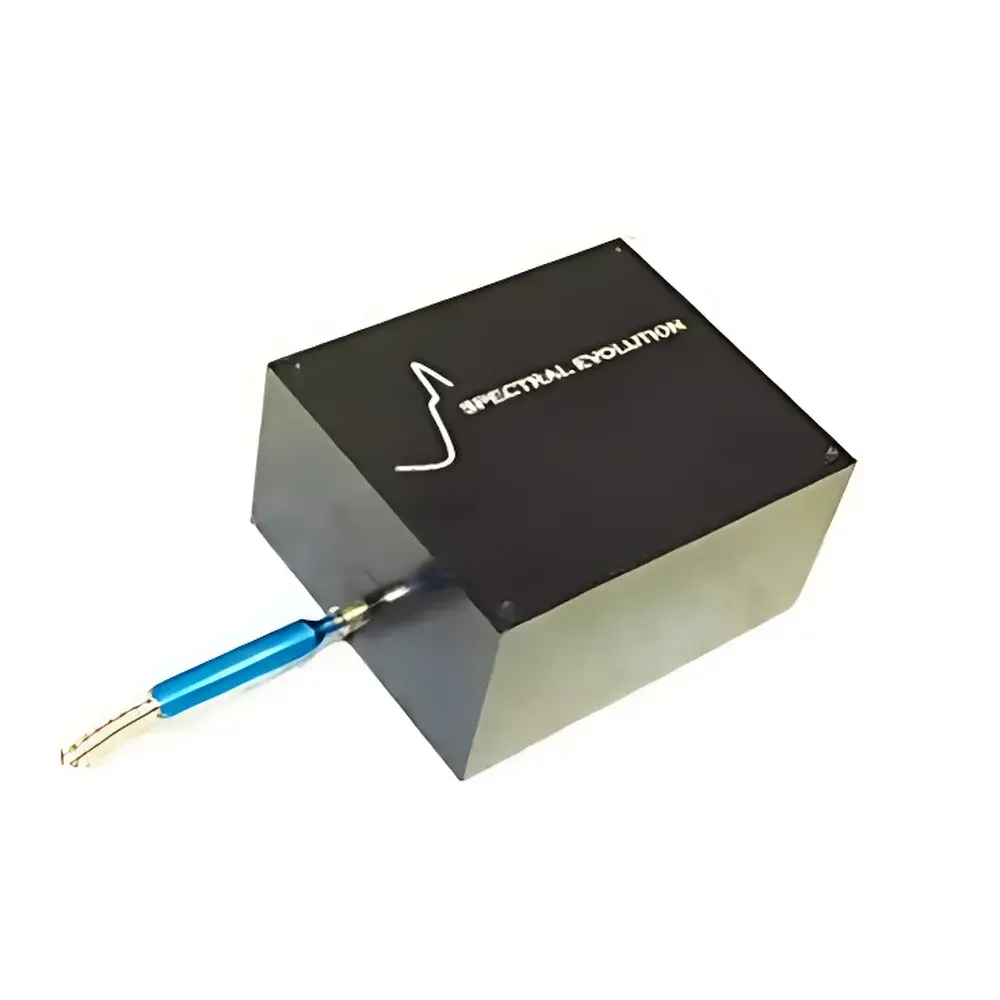
Spectral Evolution LF780/500 Portable Visible-Near Infrared Spectroradiometer
| Brand | Spectral Evolution |
|---|---|
| Model | LF780/500 |
| Origin | USA |
| Instrument Type | Portable Field Spectroradiometer |
| Optical Design | Fixed Holographic Grating + Linear Array Detector (Non-scanning) |
| Wavelength Range | 350–2500 nm (simultaneous coverage across UV-Vis-NIR) |
| Spectral Sampling Interval | ≤1.5 nm (VIS-NIR), ≤3.0 nm (SWIR) |
| Spectral Resolution (FWHM) | ≤3 nm (350–1000 nm), ≤10 nm (1000–2500 nm) |
| Integration Time | 8 ms to 2000 ms (programmable) |
| Measurement Mode | Diffuse Reflectance, Irradiance, Radiance |
| Calibration Traceability | NIST-traceable, factory-calibrated with spectralon-based standards |
| Data Acquisition Software | DARWin SP v5.x (Windows OS compatible) |
| Communication | Bluetooth 5.0 + USB-C |
| Power | Removable Li-ion battery (≥8 h field operation) |
| Housing | Anodized aluminum alloy (IP54-rated, thermal-stabilized chassis) |
| Built-in Features | Motorized shutter, drift-compensated auto-calibration, laser targeting module (635 nm, <1 mW), internal reference lamp |
Overview
The Spectral Evolution LF780/500 is a high-performance, portable field spectroradiometer engineered for precise, rapid, and repeatable spectral measurements across the ultraviolet–visible–near-infrared (UV-Vis-NIR) range—from 350 nm to 2500 nm. Unlike scanning monochromator-based systems, the LF780/500 employs a fixed holographic grating and a thermoelectrically stabilized linear array detector architecture, eliminating moving optical components and ensuring long-term radiometric stability and calibration integrity. This non-scanning design enables full-spectrum acquisition in as little as 8 milliseconds—with sustained data capture rates up to 10 Hz—making it suitable for dynamic field deployments where environmental variability, instrument portability, and measurement reproducibility are critical. The system is factory calibrated against NIST-traceable reflectance and irradiance standards, with spectral response characterized at ≤1.5 nm sampling intervals in the visible and near-infrared regions and ≤3.0 nm in the short-wave infrared (SWIR). Its optical path includes an integrated motorized shutter and real-time drift-locking algorithms that perform automatic dark-current and reference corrections prior to each measurement sequence, minimizing operator-dependent variability.
Key Features
- Fixed-optics architecture: Holographic grating + TE-cooled silicon (350–1000 nm) and InGaAs (900–2500 nm) linear array detectors ensure zero mechanical wear and eliminate wavelength registration drift.
- NIST-traceable calibration: Delivered with dual-certified Spectralon® reference panels (99% and 50% reflectance) and irradiance calibration coefficients traceable to NIST Standard Reference Materials (SRMs).
- Real-time auto-exposure and auto-calibration: DARWin SP software controls integration time dynamically based on signal-to-noise ratio thresholds, while internal shutter and reference lamp enable automated dark/white correction without manual intervention.
- Field-optimized ergonomics: Anodized aluminum housing provides thermal mass stabilization (±0.1 °C internal temperature fluctuation over 30 min ambient shift), IP54 ingress protection, and ergonomic handgrip with integrated laser targeting (635 nm, Class II).
- Wireless and wired connectivity: Bluetooth 5.0 supports remote triggering and live spectrum streaming to Windows tablets or ruggedized PDAs; USB-C interface enables high-speed data transfer and firmware updates.
- Modular power system: Hot-swappable lithium-ion battery pack rated for ≥8 hours continuous operation (typical use case: 100 ms integration, 2 Hz sampling); optional external 12 V DC input for vehicle or solar-powered deployments.
Sample Compatibility & Compliance
The LF780/500 is designed for non-contact, non-destructive spectral characterization of heterogeneous natural and engineered surfaces under ambient illumination or controlled source conditions. It supports diffuse reflectance (e.g., soils, vegetation canopies, mineral outcrops), spectral irradiance (solar, artificial light sources), and radiance (target-emitted or scattered light) measurements. All optical components comply with ISO 9001:2015 manufacturing protocols, and calibration documentation conforms to ASTM E275, ASTM E1331, and ISO 17025 requirements for spectral measurement laboratories. For regulated environments—including USDA soil monitoring networks, NASA AEROSE campaigns, and EU Horizon-funded agro-environmental observatories—the instrument’s audit trail functionality (enabled via DARWin SP’s GLP-compliant logging mode) satisfies 21 CFR Part 11 electronic record retention criteria when used with validated configurations.
Software & Data Management
DARWin SP v5.x is a Windows-native application developed exclusively for Spectral Evolution spectroradiometers. It provides real-time spectral visualization, batch processing of reflectance/irradiance/radiance conversions, and export in ENVI, ASCII, and CSV formats compatible with MATLAB, Python (NumPy/Pandas), and R workflows. The software implements robust outlier rejection during averaging, Savitzky-Golay smoothing with configurable polynomial order/window size, and spectral index calculation (e.g., NDVI, PRI, NDWI, REIP). Raw data files include embedded metadata: GPS coordinates (when paired with external GNSS), UTC timestamps, integration time, detector temperature, shutter status, and calibration file hash. DARWin SP supports user-defined measurement protocols, automated report generation (PDF/HTML), and encrypted project archives compliant with institutional data governance policies.
Applications
- Remote sensing validation: Ground-truthing satellite and UAV-borne hyperspectral sensors (e.g., Sentinel-2, PRISMA, WorldView-3) through synchronized spectral signature acquisition.
- Agricultural phenotyping: Quantifying chlorophyll content, water stress indices, nitrogen status, and canopy structural parameters across breeding trials and precision farming zones.
- Geological and mining surveys: Discriminating clay minerals (kaolinite, smectite), iron oxides (hematite, goethite), carbonates, and hydrocarbons via diagnostic absorption features between 1400–2500 nm.
- Environmental monitoring: Assessing phytoplankton community composition in inland waters using phycoerythrin and phycocyanin peaks; tracking dissolved organic carbon (DOC) and turbidity via UV-Vis slope ratios.
- Photovoltaic materials testing: Measuring spectral responsivity, quantum efficiency, and anti-reflection coating performance across AM1.5G spectral irradiance conditions.
- Pharmaceutical raw material identification: Verifying excipient homogeneity and detecting counterfeit APIs using NIR spectral fingerprint matching against USP/NF reference libraries.
FAQ
What spectral calibration standards are included with the LF780/500?
Each unit ships with two NIST-traceable Spectralon® reflectance standards (99% and 50%) and a factory-issued calibration certificate listing wavelength accuracy (±0.5 nm), radiometric uncertainty (≤3% @ 550 nm), and linearity deviation (<1.5%).
Can the LF780/500 operate in direct sunlight without thermal drift?
Yes—the aluminum chassis provides passive thermal stabilization, and the TE-cooled detectors maintain stable gain characteristics across −10 °C to +45 °C ambient temperatures; internal drift-locking routines correct for residual thermal effects every 5 minutes or per user-defined interval.
Is DARWin SP compatible with Windows 11 and ARM-based Surface devices?
DARWin SP v5.4+ supports Windows 10/11 x64 platforms, including Microsoft Surface Pro X (via x64 emulation); native ARM64 support is scheduled for Q3 2025 release.
Does the instrument meet FDA or EPA regulatory requirements for environmental field data collection?
When operated under DARWin SP’s GLP mode—with enabled electronic signatures, audit trails, and version-controlled calibration files—the LF780/500 meets data integrity requirements outlined in EPA SW-846 Method 8000B and FDA Guidance for Industry on Analytical Procedure Development.
How often is recalibration recommended for field-deployed units?
Annual recalibration is recommended for ISO/IEC 17025 compliance; however, users performing daily dark/white reference checks and storing instruments in climate-controlled environments may extend intervals to 18 months, subject to internal verification per ASTM E275 Annex A2.






