
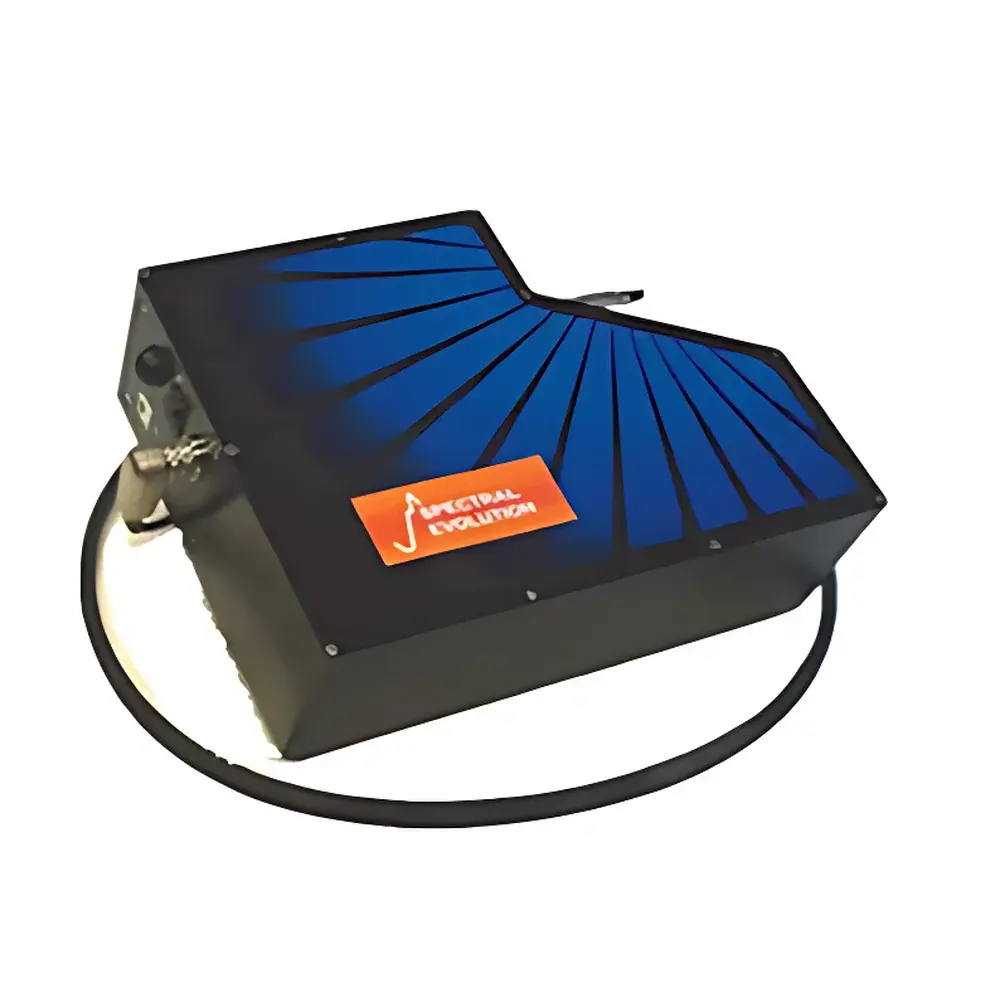
Spectral Evolution SR500 Portable Field Spectroradiometer
| Brand | Spectral Evolution |
|---|---|
| Origin | USA |
| Model | SR500 |
| Optical Design | Single-beam |
| Detector | Photodiode Array (PDA) |
| Wavelength Range | 350–2500 nm |
| Spectral Resolution | ≤3 nm (VIS-NIR), ≤10 nm (SWIR) |
| Wavelength Accuracy | ±0.5 nm |
| Stray Light | <0.05% @ 600 nm |
| Auto-wavelength Scanning | Yes |
| Built-in Shutter & Drift-Lock Auto-Calibration | Yes |
| Data Acquisition Speed | Up to 10 spectra/sec |
| Communication | Bluetooth 4.2 + USB 2.0 |
| Power | Rechargeable Li-ion battery (8+ hrs typical operation) |
| Housing | Anodized aluminum alloy, IP54-rated |
| Software Platform | DARWin SP v4.x (Windows 10/11 compatible) |
Overview
The Spectral Evolution SR500 Portable Field Spectroradiometer is a high-performance, field-deployable spectroradiometric instrument engineered for precision measurement of spectral radiance, reflectance, and irradiance across the ultraviolet–visible–shortwave infrared (UV-VIS-SWIR) spectrum. Operating on a fixed-grating, full-array photodiode detector architecture, the SR500 eliminates mechanical scanning components—such as moving gratings, rotating prisms, or fiber-coupled slit mechanisms—thereby ensuring long-term radiometric stability, minimal calibration drift, and high measurement reproducibility under variable environmental conditions. Its optical design adheres to fundamental principles of spectroradiometry: light enters via calibrated fore-optics (e.g., cosine corrector, fiber optic probe, or collimating lens), is dispersed by a holographic plane grating, and is simultaneously detected across the full spectral range by a thermoelectrically stabilized PDA sensor. This enables true snapshot spectral acquisition—no wavelength scanning delay—delivering up to 10 full-spectrum measurements per second with sub-100 ms integration time. The SR500 is optimized for outdoor, in situ applications where portability, thermal robustness, and traceable radiometric performance are critical.
Key Features
- Fixed holographic grating and full-array photodiode detector—no moving optical parts ensures mechanical reliability and calibration integrity over thousands of field deployments
- Integrated shutter and drift-lock auto-calibration system compensates for thermal and electronic baseline drift in real time, supporting extended unattended operation
- Bluetooth 4.2 and USB 2.0 dual-mode connectivity enables wireless control from Windows tablets or ruggedized PDAs and direct data streaming to laptops or cloud-based repositories
- Laser targeting module co-aligned with the field-of-view for precise spatial registration of measured targets—essential for vegetation canopy, soil patch, or mineral outcrop sampling
- Anodized aluminum housing with passive thermal management provides mechanical durability, EMI shielding, and stable spectral response across −10 °C to +50 °C ambient ranges
- Rechargeable lithium-ion battery pack delivers ≥8 hours of continuous operation and supports hot-swap capability in multi-day field campaigns
Sample Compatibility & Compliance
The SR500 accommodates diverse sampling geometries through interchangeable fore-optics—including cosine-corrected irradiance sensors, contact reflectance probes, fiber-coupled telescopic lenses (up to 25× magnification), and underwater housings rated to 30 m depth. It complies with ASTM E275, ISO 9050, and ISO 13406-2 for optical measurement traceability and geometric field-of-view characterization. All factory calibrations are NIST-traceable, with certificate documentation including spectral responsivity, linearity, and stray light verification. The instrument meets IEC 61326-1 for electromagnetic compatibility and operates within GLP-compliant workflows when paired with DARWin SP’s audit-trail-enabled data acquisition logs (supporting 21 CFR Part 11–aligned metadata tagging and user authentication).
Software & Data Management
DARWin SP v4.x is a dedicated, Windows-native application designed exclusively for Spectral Evolution spectroradiometers. It provides real-time spectral visualization, automated dark/light reference capture, spectral index calculation (e.g., NDVI, PRI, NDWI), and batch processing with customizable export formats (ASCII, CSV, ENVI BIL, HDF5). Each acquired spectrum is embedded with geotagged metadata (GPS coordinates, timestamp, instrument ID, calibration file hash, operator ID), enabling FAIR (Findable, Accessible, Interoperable, Reusable) data practices. Raw data files include full spectral calibration coefficients, allowing post-acquisition radiometric reprocessing without hardware intervention. DARWin SP supports scripting via Python API for integration into automated remote sensing pipelines or machine learning training workflows.
Applications
- Earth observation validation: Cross-calibration of airborne/satellite sensors (e.g., Sentinel-2, Landsat 9, PRISMA) using ground-truth reflectance spectra
- Agricultural phenotyping: In-field quantification of chlorophyll content, water stress indices, and nitrogen status across crop canopies
- Geological surveying: Discrimination of clay mineralogy, iron oxide phases, and hydrothermal alteration signatures in exposed bedrock
- Environmental monitoring: Turbidity, CDOM, and phytoplankton pigment analysis in coastal and inland waters
- Solar energy assessment: Spectral mismatch evaluation of PV modules under natural illumination and spectral irradiance modeling
- Food quality inspection: Non-destructive detection of bruising, ripeness, and adulteration in fruits, grains, and pharmaceutical tablets
FAQ
What spectral calibration standards are used for the SR500?
The SR500 is calibrated using NIST-traceable tungsten halogen and deuterium lamps, with spectral responsivity verified against NIST Standard Reference Materials (SRMs) 2035 and 2065.
Can the SR500 operate in direct sunlight without saturation?
Yes—the instrument features programmable integration time (1 ms to 10 s), automatic gain control, and a built-in neutral density filter wheel to maintain linear response under high-irradiance conditions.
Is DARWin SP compliant with FDA 21 CFR Part 11 requirements?
DARWin SP v4.3+ supports electronic signatures, audit trails, role-based access control, and encrypted data storage—enabling compliance in regulated environments when deployed with validated IT infrastructure.
How often does the SR500 require recalibration?
Under normal field use, annual recalibration is recommended; however, the drift-lock function and onboard reference checks extend calibration stability to 12–18 months in controlled thermal environments.
Does the SR500 support external GPS synchronization?
Yes—via NMEA 0183 serial input or Bluetooth-connected GNSS receivers, enabling sub-meter positional accuracy and synchronized timestamping with inertial measurement units (IMUs) for UAV-mounted deployments.





