
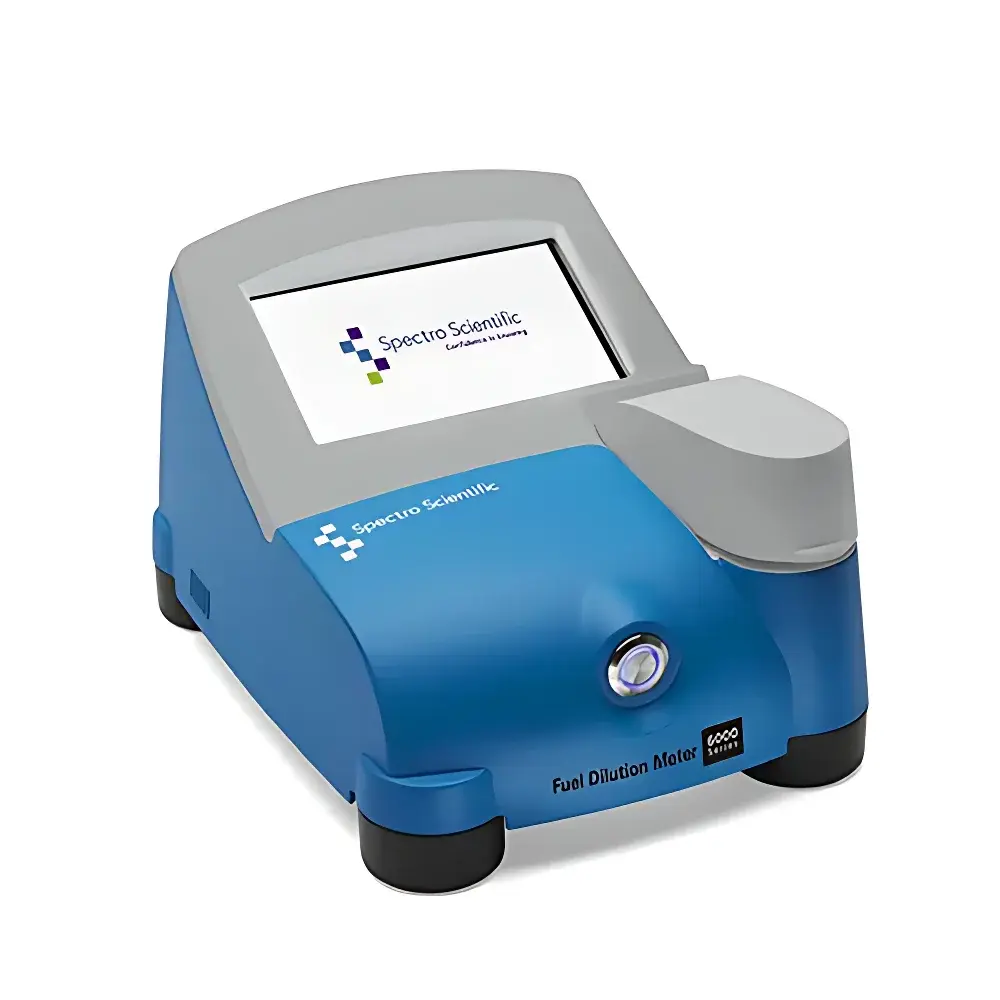
Spectro Scientific FDM 6000 Fuel Dilution Monitor
| Brand | Spectro Scientific |
|---|---|
| Origin | USA |
| Manufacturer Status | Authorized Distributor |
| Product Origin | Imported |
| Model | FDM 6000 |
| Pricing | Upon Request |
Overview
The Spectro Scientific FDM 6000 Fuel Dilution Monitor is a field-deployable, benchtop-capable analytical instrument engineered for rapid, quantitative determination of fuel contamination in used engine oils. Developed jointly by Spectro Scientific and the U.S. Navy, the FDM 6000 employs Surface Acoustic Wave (SAW) sensor technology to measure volatile hydrocarbon vapors in the headspace above an oil sample—enabling direct, solvent-free quantification of diesel or gasoline dilution without sample preparation. Unlike indirect methods such as gas chromatography (GC) or Fourier-transform infrared spectroscopy (FTIR), which require calibration against reference standards and may suffer from matrix interference, the SAW-based detection principle delivers robust response to low-molecular-weight fuel fractions with high specificity and minimal cross-sensitivity to oxidation byproducts or nitration compounds. The device operates on the physical principle that fuel volatility alters headspace vapor composition, which modulates the propagation velocity and attenuation of acoustic waves across a piezoelectric substrate—transducing changes into measurable frequency shifts proportional to fuel concentration. This physics-driven approach ensures consistent performance across diverse lubricant formulations, including conventional, synthetic, and low-SAPS engine oils.
Key Features
- Complies with ASTM D8004–21: Standard Test Method for Determination of Fuel Dilution in Used Lubricating Oils Using Surface Acoustic Wave Sensors
- “Sawtooth” sensor architecture enhances signal stability and reproducibility, achieving ≤5% relative standard deviation (RSD) across repeated measurements under controlled conditions
- Wide dynamic range: 0.2% to 15.0% fuel dilution (v/v), covering critical thresholds associated with piston ring wear, injector leakage, and cold-start degradation
- Analysis time ≤120 seconds per sample; no reagents, solvents, or consumables required
- Integrated rechargeable lithium-ion battery supports ≥8 hours of continuous operation—ideal for mobile labs, marine vessels, and remote maintenance depots
- 7-inch full-color capacitive touchscreen with intuitive icon-driven interface and multilingual audio guidance (English and Chinese)
- Onboard data storage for up to three user-defined calibration curves, each supporting linear or quadratic regression models
Sample Compatibility & Compliance
The FDM 6000 is validated for use with crankcase oils meeting API SP, CK-4, FA-4, ACEA A3/B4, and JASO DL-1 specifications. It accommodates standard 40 mL glass vials (ASTM D5185-compliant) and accepts samples at ambient temperature (15–35°C); no heating or equilibration is required. Instrument output conforms to ISO/IEC 17025 documentation requirements when operated within defined environmental tolerances (20–25°C, <70% RH). Data integrity is maintained through timestamped result logging and non-volatile memory retention. While not a GLP/GMP-certified system per se, its traceability framework—including calibration history, operator ID tagging, and audit-ready CSV export—supports compliance with internal quality protocols aligned with ISO 9001 and SAE JA1002 guidelines for oil condition monitoring.
Software & Data Management
The embedded firmware enables real-time visualization of sensor response curves and peak amplitude tracking during analysis. Results are displayed numerically (as % fuel dilution) and graphically (bar chart overlay), with configurable pass/fail thresholds based on OEM-recommended limits (e.g., Caterpillar’s 3% alert level for off-highway engines). All measurements are stored with metadata: date/time stamp, sample ID, calibration curve used, and operator code. Export options include USB mass-storage mode (CSV format) and optional Bluetooth 5.0 connectivity for integration with Spectro’s FluidScan® LubeSuite™ platform or third-party CMMS systems via RESTful API. Firmware updates are delivered via secure HTTPS download and verified using SHA-256 checksums.
Applications
The FDM 6000 serves mission-critical roles across transportation, defense, and industrial power generation sectors. It is routinely deployed for predictive maintenance of diesel generators aboard naval vessels, where rapid detection of >2% fuel dilution triggers immediate cylinder compression testing. In heavy-duty truck fleets, it supports roadside oil screening programs to identify vehicles exhibiting abnormal combustion behavior prior to catastrophic bearing failure. Power plant operators utilize it during turbine lube oil surveillance to distinguish between fuel ingress (indicative of seal failure) and glycol contamination (requiring different mitigation strategies). Its portability and speed also make it suitable for aviation ground support equipment (GSE) oil verification and rail locomotive depot diagnostics—particularly where GC infrastructure is unavailable or turnaround time exceeds operational tolerance.
FAQ
What types of fuel can the FDM 6000 detect?
It quantifies both diesel and gasoline dilution in engine oils, with equivalent sensitivity across C8–C16 hydrocarbon ranges typical of modern distillate fuels.
Does the instrument require periodic recalibration?
Yes—calibration verification is recommended before each shift or after 24 hours of continuous use. Full recalibration using certified reference standards (0%, 3%, and 10% fuel-in-oil) is required every 90 days or after sensor replacement.
Can the FDM 6000 be used with biofuels or renewable diesel blends?
Validation data exists for B5 biodiesel and HRD (hydroprocessed renewable diesel) blends up to 20%; performance with higher concentrations should be confirmed via side-by-side testing against GC-FID.
Is the touchscreen interface compatible with gloved operation?
Yes—the capacitive screen responds reliably to standard nitrile and leather work gloves when operated in “glove mode,” activated via system settings.
How does the FDM 6000 handle highly oxidized or soot-laden oils?
Oxidation products do not interfere with SAW detection, but excessive soot (>3% wt.) may attenuate vapor diffusion kinetics; centrifugation or filtration is advised for severely degraded samples.



