
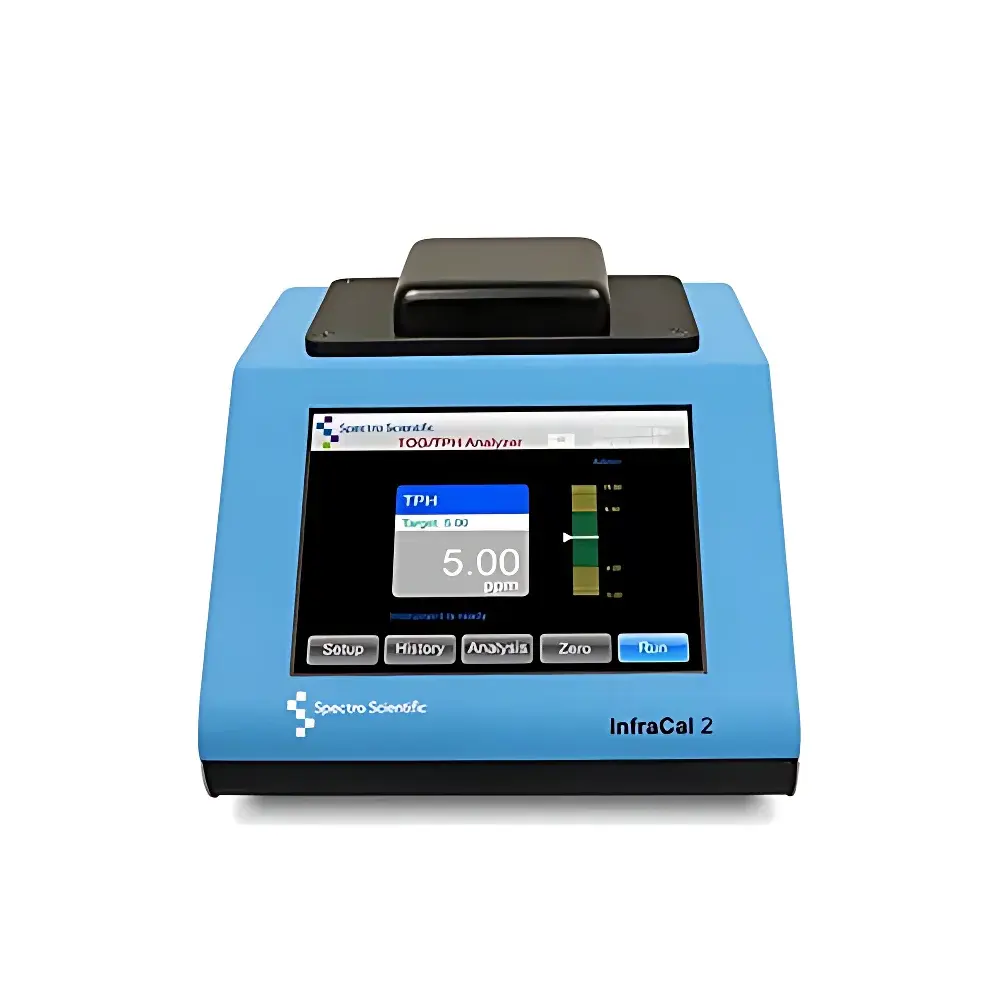
Spectro Scientific InfraCal 2 Portable Oil-in-Water and Oil-in-Soil Analyzer
| Brand | Spectro Scientific |
|---|---|
| Origin | USA |
| Model | InfraCal 2 |
| Instrument Type | Portable |
| Measurement Principle | Infrared Absorption Spectrophotometry (Fixed-Wavelength at 3.4 µm) |
| Measurement Range | 0.1–5000 ppm |
| Detection Limit | 0.1 ppm |
| Accuracy | < ±1% |
| Resolution | 0.1 ppm |
| Optical Bandpass | 3.4 µm filter with ±10 cm⁻¹ wavenumber tolerance |
| Dimensions | 17 × 19.8 × 13.2 cm |
| Weight | 2.6 kg (net), 3.2 kg (with Li-ion battery) |
| Display | 640 × 480 color touchscreen |
| Power Supply | AC/DC adapter (110–220 V, 50–60 Hz) or 18 V DC / 3.3 Ah rechargeable Li-ion battery (≥16 h operation) |
| Operating Environment | 5–40 °C, <90% RH (non-condensing) |
| Connectivity | USB, RS232 |
| Compliance | ASTM D7066 (transmission mode), EPA Method 1664 (reflectance mode) |
Overview
The Spectro Scientific InfraCal 2 Portable Oil-in-Water and Oil-in-Soil Analyzer is an engineered field-deployable instrument designed for rapid, on-site quantification of hydrocarbon contamination in aqueous and solid-phase environmental matrices. It operates on the principle of infrared absorption spectrophotometry at a fixed wavelength of 3.4 µm — corresponding to the C–H stretching vibration band characteristic of aliphatic hydrocarbons — enabling selective detection of total oil and grease (TOG), fats, oils, and greases (FOG), and total petroleum hydrocarbons (TPH). Unlike broad-spectrum IR instruments requiring complex spectral deconvolution, the InfraCal 2 employs a robust, single-wavelength optical architecture optimized for regulatory compliance and field reproducibility. Its design targets applications where immediate decision-making is critical: discharge monitoring, remediation verification, process water screening, and soil triage prior to laboratory submission. The analyzer meets the instrumental performance criteria outlined in ASTM D7066 for transmission-mode analysis and delivers results traceable to EPA Method 1664 for reflectance-based quantification — ensuring data acceptability in U.S. federal and state environmental reporting frameworks.
Key Features
- Field-ready portability: Compact footprint (17 × 19.8 × 13.2 cm) and lightweight construction (2.6 kg net) enable deployment in remote locations, offshore platforms, and mobile labs without external support infrastructure.
- Sub-ppm sensitivity: Achieves a method detection limit of 0.1 ppm with resolution to 0.1 ppm across the full 0.1–5000 ppm dynamic range — suitable for both low-level compliance checks and high-concentration waste stream characterization.
- Dual-mode measurement capability: Supports both transmission (ASTM D7066) and reflectance (EPA 1664) configurations via interchangeable sample holders and calibration protocols — eliminating need for separate instruments for water vs. soil/sludge analysis.
- Integrated data handling: Onboard memory stores up to 1,000 test records with timestamp, operator ID, and calibration version metadata; data export via USB or RS232 to LIMS or spreadsheet-compatible formats (CSV).
- Multi-curve calibration management: Stores up to eight user-defined calibration curves, each with unique slope, intercept, and linear range parameters — essential for matrix-matched calibrations across diverse sample types (e.g., saline produced water, clay-rich soils, solvent extracts).
- Ruggedized industrial interface: 640 × 480 color touchscreen with glove-compatible responsiveness, sealed keypad, and IP54-rated enclosure — validated for continuous operation in ambient temperatures from 5 to 40 °C and relative humidity up to 90% non-condensing.
Sample Compatibility & Compliance
The InfraCal 2 accommodates liquid samples (water, wastewater, solvent extracts) and solid-phase matrices (soils, drill cuttings, sludges, metal swabs) following standardized extraction procedures (e.g., EPA 3550C, ASTM D7678). For aqueous analysis, samples are measured directly in disposable quartz or glass cuvettes (transmission) or on reflective substrates (reflectance). Soil and solid samples require prior extraction using approved solvents (e.g., Freon-113 substitute, hexane, or isopropanol), with extract volumes normalized to ensure consistent pathlength or surface loading. All measurements comply with quality assurance requirements under EPA Contract Laboratory Program (CLP) guidelines and support GLP/GMP audit trails when paired with Spectro’s optional calibration logbook and electronic signature module. Instrument validation documentation satisfies ISO/IEC 17025 clause 5.5.2 for field instrumentation used in accredited environmental testing laboratories.
Software & Data Management
No proprietary software installation is required for basic operation; however, Spectro provides the free InfraCal Data Manager desktop application for advanced curve development, batch report generation, and audit-log review. The application supports 21 CFR Part 11-compliant user authentication, electronic signatures, and immutable audit trails for all calibration updates, result modifications, and firmware revisions. Raw absorbance values, calculated concentrations, and diagnostic flags (e.g., saturation warning, baseline drift alert) are embedded in exported files. Firmware updates preserve historical calibration integrity and maintain backward compatibility with legacy curve libraries. Remote diagnostics via USB serial emulation allow technical support teams to verify optical alignment and detector response without physical instrument access.
Applications
- Real-time monitoring of produced water from offshore and onshore oil & gas operations against discharge permit limits (e.g., BSEE 250.490, OSPAR COM(2000)5).
- Verification of effluent compliance at refinery wastewater treatment plants prior to release to municipal systems or receiving waters.
- FOG source tracking in food processing facilities and municipal sewer collection systems per local pretreatment ordinances.
- Performance assessment of oil-water separators, coalescers, and API tanks during commissioning and routine maintenance.
- Quantitative screening of drill cuttings and pit sludge for landfarm eligibility or hazardous waste classification (40 CFR 261.24).
- Residual hydrocarbon verification on cleaned metal parts in aerospace, automotive, and power generation maintenance workflows.
- Purity assessment of recovered solvents in closed-loop cleaning systems to prevent cross-contamination in precision manufacturing.
- Field-tier soil screening at brownfield sites to prioritize laboratory analysis and reduce analytical cost burden by >60%.
FAQ
What extraction solvents are validated for use with the InfraCal 2?
Spectro validates n-hexane, isopropanol, and Freon-113 substitutes (e.g., Vertrel XF) per EPA 3550C and ASTM D7678. Solvent choice must be documented in the QA/QC plan and matched to the calibration curve.
Can the InfraCal 2 distinguish between biogenic and petrogenic hydrocarbons?
No — it measures total C–H absorbance and cannot speciate hydrocarbon classes. For source identification, GC-FID or GC-MS analysis is required post-screening.
Is routine optical alignment required?
The fixed-wavelength optical path is factory-aligned and sealed; no user-accessible alignment mechanisms exist. Annual verification using NIST-traceable reference standards is recommended.
How is method accuracy verified in the field?
Accuracy is confirmed through daily analysis of certified reference materials (CRMs) such as AccuStandard TOG-1 or OSHA 29 CFR 1910.1200-compliant spiked blanks, with acceptance criteria of ±1% recovery.
Does the instrument meet EPA SW-846 compliance requirements?
While not a SW-846-listed method itself, the InfraCal 2 serves as a validated field screening tool supporting SW-846 Methods 418.1 (IR) and 9071B (TPH), provided extraction and calibration follow documented SOPs aligned with those methods.







