
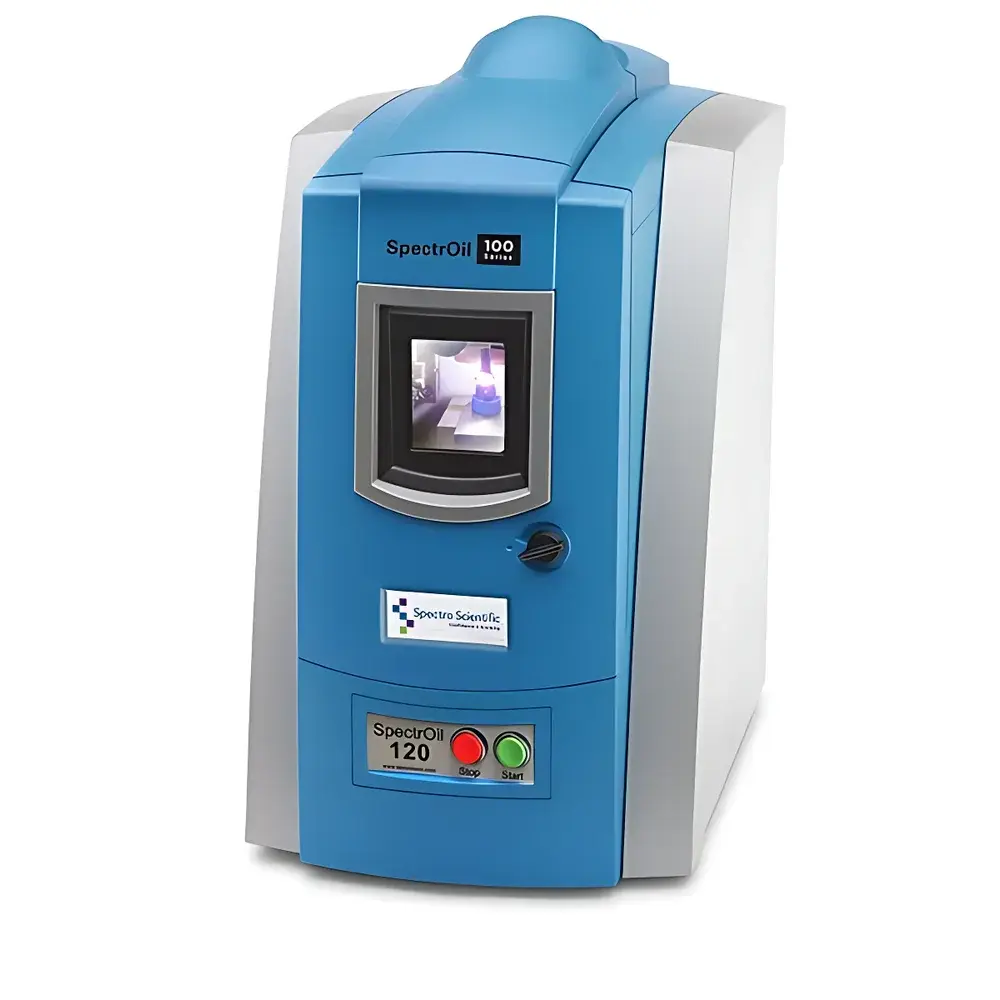
Spectro Scientific SpectrOil 120C Rotating Disc Electrode Atomic Emission Spectrometer
| Brand | Spectro Scientific |
|---|---|
| Origin | USA |
| Model | 120C |
| Application | Elemental Analysis of Lubricating Oils, Fuels, Coolants, and Industrial Fluids |
| Compliance | ASTM D6595, ASTM D6728 |
| Sample Volume | 2 mL |
| Analysis Time | ≤30 s per sample |
| Elements Quantified | Up to 31 metals |
| Detection Limits | Sub-ppm for most elements |
| Sample Preparation | Solvent-free, no dilution required |
| Configuration | Benchtop laboratory spectrometer |
| Intended Use | Wear debris monitoring, additive package verification, contamination screening |
Overview
The Spectro Scientific SpectrOil 120C is a benchtop rotating disc electrode atomic emission spectrometer (RDE-AES) engineered for rapid, quantitative elemental analysis of used lubricating oils, hydraulic fluids, diesel and jet fuels, coolants, and industrial process waters. Based on the fundamental principles of arc/spark excitation and wavelength-dispersive optical emission spectroscopy, the instrument vaporizes and atomizes oil samples directly at the electrode gap—eliminating the need for acid digestion, organic solvent dilution, or nebulization. As the rotating disc electrode continuously transports fresh sample into the high-voltage AC discharge zone between the disc and counter electrode, transient plasma formation induces characteristic atomic line emission. These spectral lines are resolved by a fixed-grating optical system and detected via photomultiplier tube (PMT)-based readout, enabling simultaneous quantification of up to 31 metallic elements—including Fe, Cu, Al, Cr, Pb, Sn, Si, Na, Ca, Mg, Zn, P, B, and others critical to machinery health monitoring.
Key Features
- Solvent-free, dilution-free operation: Requires only 2 mL of neat oil—no acid digestion, no xylene or MIBK dilution, reducing analytical cost and hazardous waste generation.
- ASTM-compliant methodology: Fully satisfies ASTM D6595 (for in-service lubricants) and ASTM D6728 (for distillate fuels), ensuring regulatory acceptability and inter-laboratory reproducibility.
- High-speed analysis: Complete elemental quantification in ≤30 seconds per sample, supporting high-throughput condition monitoring programs.
- Sub-ppm detection capability: Achieves typical detection limits of 0.1–0.5 ppm for key wear metals (e.g., Fe, Cu, Cr) and contaminants (e.g., Si, Na), meeting ISO 4406 and SAE AS4059 particle contamination reporting requirements.
- Robust calibration architecture: Pre-installed, matrix-matched calibration curves eliminate manual curve development; users select application-specific calibrations (e.g., turbine oil, engine oil, hydraulic fluid) without software reconfiguration.
- Benchtop design with integrated safety interlocks: Complies with IEC 61010-1 for electrical safety and incorporates optical shielding, arc containment, and automatic power cutoff during chamber access.
Sample Compatibility & Compliance
The SpectrOil 120C accepts undiluted samples across multiple fluid classes: mineral- and synthetic-based engine oils (SAE 0W–60), turbine oils (ISO VG 32–100), hydraulic fluids (HL, HM, HVLP), gear oils, coolants (ethylene glycol/water blends), diesel fuel (ASTM D975), jet fuel (ASTM D1655), and industrial circulating water. All analyses adhere to traceable reference material protocols using NIST-traceable certified standards (e.g., NIST SRM 2721, Spectro Certified Reference Oils). The instrument’s measurement uncertainty profile has been validated against round-robin studies conducted under ASTM D7622 and ISO/IEC 17025-accredited laboratories. It supports GLP/GMP documentation workflows, including full audit trails, electronic signatures, and data integrity controls aligned with FDA 21 CFR Part 11 requirements.
Software & Data Management
The SpectrOil 120C operates with Spectro’s proprietary OilView™ software v5.x—a Windows-based platform compliant with ISO/IEC 17025 data management clauses. Software features include automated QC flagging (control charting per ASTM D6595 Annex A1), trend analysis across fleets or assets, customizable report templates (PDF/CSV/XLSX export), and integration-ready APIs for LIMS (e.g., Thermo Fisher SampleManager, LabVantage) and CMMS platforms (e.g., IBM Maximo, SAP PM). All raw spectral data, background correction parameters, integration windows, and calibration metadata are stored immutably with time-stamped digital signatures. Software validation packages—including IQ/OQ/PQ documentation—are available for regulated environments.
Applications
This instrument serves as a core diagnostic tool in predictive maintenance programs across aerospace (engine oil surveillance per SAE ARP5563), power generation (turbine oil health per ASTM D4378), mining and heavy equipment (gearbox and hydraulic fluid analysis per ISO 12171), marine propulsion (lube oil trending per CIMAC WG27 guidelines), and rail transport (locomotive engine oil compliance with AAR M-1003). It enables early detection of abnormal wear modes (e.g., bearing spalling via elevated Cr/Fe ratios), coolant ingress (Na/K/Si anomalies), sand/dirt contamination (Si/Al/Ti), and additive depletion (Zn/P/Ca/Mg decline), thereby extending component life and reducing unplanned downtime.
FAQ
Does the SpectrOil 120C require daily standardization or recalibration?
No—calibration stability is verified weekly using a single check standard per ASTM D6595 Section 8. Full recalibration is recommended every 6 months or after 500 analyses, whichever occurs first.
Can it analyze greases or solid particulates?
Not directly—the method is optimized for low-viscosity liquids. Greases must be dissolved in kerosene or white spirit prior to analysis; solid wear debris requires ultrasonic extraction into carrier oil.
Is operator training required for routine use?
Yes—Spectro offers certified 2-day onsite training covering safety, preventive maintenance, QC procedures, and interpretation of ASTM D6595 reporting thresholds.
What maintenance intervals apply to the electrode assembly?
The tungsten disc electrode and copper counter electrode are consumables rated for ~2,000 analyses; replacement kits include alignment fixtures and torque specifications per manufacturer’s service bulletin SB-120C-03.
How is data security ensured in multi-user laboratory environments?
OilView™ enforces role-based access control (RBAC), encrypted local database storage (AES-256), and optional LDAP/Active Directory integration for centralized user authentication and session logging.






