
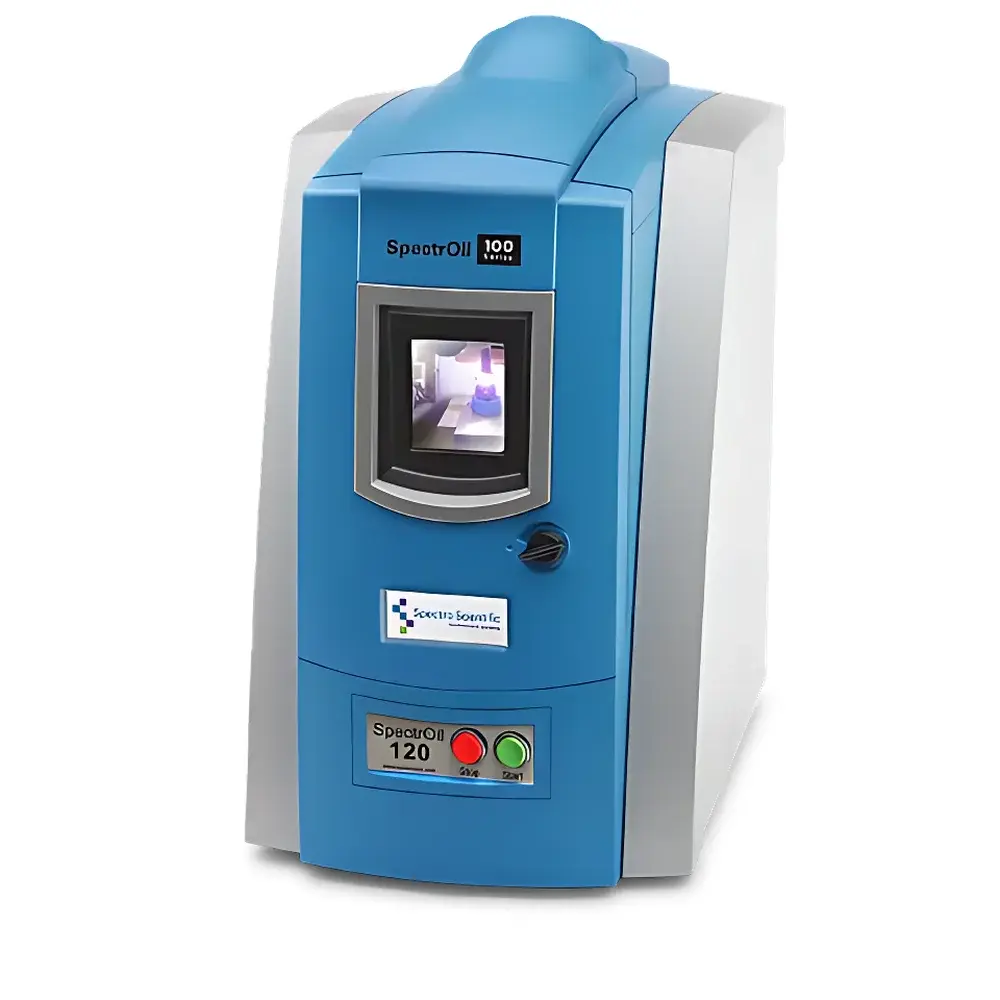
Spectro Scientific SpectrOil 120C Rotating Disc Electrode Atomic Emission Spectrometer
| Brand | Spectro Scientific |
|---|---|
| Origin | USA |
| Model | SpectrOil 120C |
| Detection Principle | Rotating Disc Electrode (RDE) Atomic Emission Spectrometry |
| Compliant Standards | ASTM D6595 (Used Lubricants), ASTM D6728 (Fuel Oils) |
| Sample Volume | 2 mL |
| Analysis Time | ≤30 seconds per sample |
| Elements Quantified | Up to 31 elements (24 standard + 7 optional) |
| Detection Limits | Sub-ppm for most metallic elements |
| Sample Preparation | None — direct oil injection |
| Gas Requirement | None |
| Application Scope | In-service lubricant wear debris, contaminant, and additive analysis |
Overview
The Spectro Scientific SpectrOil 120C is a benchtop rotating disc electrode (RDE) atomic emission spectrometer engineered specifically for routine elemental analysis of in-service lubricating oils, hydraulic fluids, and diesel fuels. Based on the well-established ASTM D6595 methodology—rotating disc electrode arc emission spectroscopy—the instrument excites a thin film of oil sample deposited on a graphite disc using a controlled DC arc, generating element-specific emission spectra. A high-resolution CCD spectrometer captures and quantifies spectral intensities across the UV–visible range (190–800 nm), enabling simultaneous multi-element detection without chemical digestion or dilution. With over seven decades of heritage in oil condition monitoring, the SpectrOil platform delivers field-proven reliability for predictive maintenance programs in power generation, mining, marine propulsion, wind turbine operations, and heavy industrial OEM service labs. Its gas-free operation, minimal consumables, and absence of hazardous solvents align with modern laboratory safety and sustainability requirements.
Key Features
- Direct oil analysis: No sample dilution, no acid digestion, no carrier gas required—only 2 mL of neat oil is introduced via syringe onto the rotating graphite electrode.
- Rapid turnaround: Full quantitative elemental report generated in ≤30 seconds per sample, supporting high-throughput lab workflows and real-time field diagnostics.
- High sensitivity: Sub-part-per-trillion (sub-ppt) to low-parts-per-trillion detection limits for key wear metals (e.g., Fe, Cu, Cr, Al), contaminants (e.g., Si, Na, B), and additives (e.g., Ca, Zn, P, Mg).
- Expandable elemental coverage: Standard configuration supports quantification of 24 elements; optional upgrade path enables on-demand activation of up to 7 additional elements (Bi, As, In, Co, Zr, W, Ce) via software license—no hardware modification required.
- Robust architecture: Designed for continuous operation in ISO/IEC 17025-accredited laboratories and mobile service units; includes temperature-stabilized optical bench and automated electrode rotation control.
- Regulatory alignment: Fully compliant with ASTM D6595 (used lubricants) and ASTM D6728 (distillate fuels); method validation documentation supports GLP/GMP audit readiness.
Sample Compatibility & Compliance
The SpectrOil 120C accepts a broad range of petroleum-based fluids—including mineral and synthetic engine oils, turbine oils, gear oils, hydraulic fluids, compressor oils, and diesel fuel—without matrix-specific calibration adjustments. It accommodates viscosity ranges from 300 cSt and handles samples with particulate loadings up to 100 ppm without clogging. All calibrations are traceable to NIST-certified reference materials (CRM 1080 series, CRM 1090 series). The system meets the analytical performance criteria outlined in ISO 17025:2017 for competence of testing and calibration laboratories. Optional firmware modules extend validated methods to antifreeze/coolant analysis (per ASTM D7152) and biodiesel blends (per ASTM D7467), maintaining full compliance without physical reconfiguration.
Software & Data Management
Operation is managed through Spectro’s proprietary OilView™ 6.x software, a Windows-based application supporting multi-user role permissions, electronic signatures, and full 21 CFR Part 11 compliance—including audit trail logging, data integrity controls, and secure user authentication. The software provides automated trend analysis, alarm thresholds based on OEM guidelines (e.g., Caterpillar S•O•S, Komatsu KOMTRAX), and customizable reporting templates compatible with LIMS integration via ASTM WK57184-compliant XML export. Raw spectral data, background correction logs, and electrode wear history are retained for forensic reprocessing and method verification. All data files are encrypted at rest and support SHA-256 hash verification for regulatory submissions.
Applications
Primary use cases include wear debris monitoring in rotating machinery (bearings, gears, pumps), contamination tracking (dirt ingress, coolant leakage, cross-contamination), and additive depletion profiling (detergents, anti-wear agents, viscosity index improvers). The instrument serves as a core tool in ISO 4406 particle count correlation studies, ASTM D7622 ferrous density analysis workflows, and MIL-STD-3007 oil health assessment protocols. It is widely deployed by third-party certification labs (e.g., SGS, Bureau Veritas, Intertek), OEM technical centers (GE Power, Siemens Energy, Rolls-Royce), and in-house reliability engineering teams managing fleets exceeding 5,000 assets.
FAQ
Does the SpectrOil 120C require argon or other shielding gases during analysis?
No—unlike ICP-OES or spark-OES systems, the RDE technique used by the SpectrOil 120C operates in ambient air and requires no external gas supply.
Can it analyze greases or highly viscous oils?
Yes, when pre-heated to 40–60 °C and homogenized, greases and viscosities up to 300 cSt can be analyzed using the optional heated sample introduction module.
Is method validation support available for ISO 17025 accreditation?
Yes—Spectro provides comprehensive validation kits including linearity studies, precision/repeatability reports, LOD/LOQ determination protocols, and CRM-based accuracy verification data.
How frequently must the graphite electrode be replaced?
Under typical lab throughput (50–100 samples/day), electrode lifetime exceeds 2,000 analyses; wear is monitored automatically and reported in each run log.
Can historical data from older SpectrOil models be migrated to OilView 6.x?
Yes—backward compatibility extends to SpectrOil M, Q, and 100-series databases; migration utilities preserve all metadata, calibration histories, and trending baselines.






