
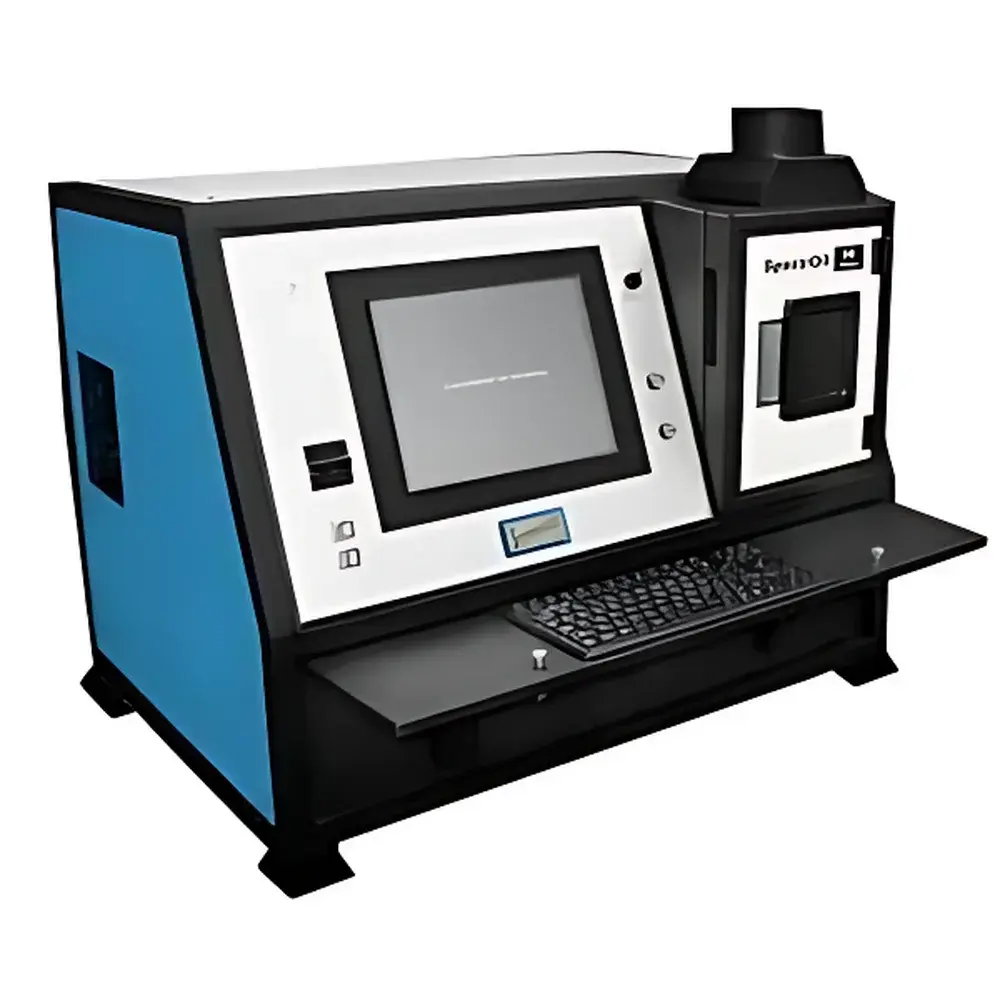
Spectro Scientific SpectrOil M Series Rotating Disc Electrode Optical Emission Spectrometer
| Brand | Spectro Scientific |
|---|---|
| Origin | USA |
| Model | SpectrOil M |
| Detection Method | Rotating Disc Electrode Atomic Emission Spectroscopy (RDE-OES) |
| Compliance | ASTM D6595, ASTM D6728 |
| Max Elements Detected | 31 |
| Analysis Time | ≤30 s per sample |
| Power Requirement | Standard AC mains |
| Sample Prep | None required |
| Operating Environment | MIL-STD-810G compliant (shock/vibration per JOAP CID-0191) |
| Integrated Computing | Industrial-grade touchscreen PC |
Overview
The Spectro Scientific SpectrOil M Series is a rugged, field-deployable rotating disc electrode optical emission spectrometer (RDE-OES) engineered for elemental analysis of lubricating oils, fuels (including diesel, jet fuel, and heavy fuel oil), coolants, and industrial process waters. As the eighth-generation RDE-OES platform, it employs high-voltage alternating current to atomize and excite analytes at the gap between a rotating graphite disc electrode and a stationary rod electrode. The resulting atomic emission spectra are resolved by a fixed-grating optical system and quantified via photomultiplier tube (PMT)-based detection. This technique delivers laboratory-grade precision and sensitivity—trace-level detection limits (e.g., 0.1 ppm for vanadium in diesel) —without sample digestion, dilution, or external gases. Its design meets JOAP CID-0191 requirements for military mobility and environmental resilience, enabling reliable operation in remote maintenance facilities, mobile test labs, or aircraft hangars where access to centralized analytical infrastructure is limited.
Key Features
- Field-ready architecture: Fully integrated industrial touchscreen PC with embedded operating system; no external computer or peripherals required
- No sample preparation: Direct analysis of neat oils, glycol-based coolants, and aqueous samples — eliminates errors from dilution or contamination
- Robust mechanical design: Shock- and vibration-resistant housing certified to MIL-STD-810G; operational across −20 °C to +50 °C ambient range
- High-throughput analysis: Full quantitative multi-element report generated in ≤30 seconds per sample
- Multi-matrix capability: Pre-calibrated, application-specific calibration curves for lubricants, fuels (light/heavy/LD), coolants, deionized water, and JOAP-spec military oils
- Trace-level sensitivity: Optimized detection limits for critical wear metals (Fe, Cu, Al, Cr), contaminants (Si, Na, K), and fuel-specific elements (V, Ni, Ca); vanadium detection limit as low as 0.1 ppm in diesel per ASTM D6728
- Gas-free operation: No argon, nitrogen, or other support gases needed — powered solely by standard 100–240 V AC supply
Sample Compatibility & Compliance
The SpectrOil M supports direct analysis of undiluted lubricants (mineral, synthetic, hydraulic), aviation turbine fuels (Jet A, JP-5, JP-8), diesel fuels (including ultra-low-sulfur and LD grades), ethylene/propylene glycol coolants, industrial boiler feedwater, condensate, and turbine wash water. All calibrations are traceable to NIST-traceable reference standards and validated per ASTM D6595 (wear metal analysis in used oils) and ASTM D6728 (elemental contaminants in fuels). Calibration sets include CS-75-500 (base oil), CS-GT15-10/100 (light/heavy fuel), CS-HP-100 (high-purity base oil), JDIW (deionized water), SIGLYCOL (glycol standard), and JOAP-specific matrices (D19-0, D12-100, D3-100) for U.S. Air Force and Army aviation oils. The instrument’s hardware platform is identical across all SpectrOil M variants (M/C-W, M/N-W, M/F, M/F-LD); differentiation resides exclusively in preloaded calibration libraries and application firmware.
Software & Data Management
The embedded software provides intuitive workflow navigation, real-time spectral visualization, automated quality control (QC) flagging, and configurable reporting. Each analysis includes full audit trail metadata: timestamp, operator ID, calibration ID, electrode usage count, and raw intensity values. Data export complies with GLP/GMP documentation requirements, supporting CSV, PDF, and XML formats. The system enforces user role-based access control (administrator, analyst, viewer) and maintains tamper-evident electronic records in accordance with FDA 21 CFR Part 11 principles. Calibration stability is monitored via daily QC checks using certified reference materials; drift correction algorithms adjust for electrode wear and plasma variability without manual intervention.
Applications
- Turbine engine oil monitoring: Early detection of bearing wear (Cr, Fe), contamination ingress (Si, Al), and additive depletion (Ca, Mg, Zn) in gas turbine and auxiliary power unit (APU) lubricants
- Fuel quality assurance: Screening for catalyst poisons (V, Na, K) and corrosion promoters (Cl, S) in aviation and marine fuels per OEM specifications (e.g., GE Energy, Rolls-Royce)
- Military logistics support: On-site verification of JOAP-specified elemental composition in F-35, C-17, and Abrams platform oils under field-deployed conditions
- Industrial predictive maintenance: Trending of wear metals in gear oils, compressor oils, and hydraulic fluids to schedule component replacement before catastrophic failure
- Coolant lifecycle management: Quantification of glycol degradation products (B, Si) and corrosion inhibitors (Na, Mo, nitrites) in closed-loop HVAC and power generation systems
- Water chemistry control: Monitoring of scaling ions (Ca, Mg), corrosion accelerants (Cl, Cu), and treatment residuals (Zn, phosphates) in steam condensate and cooling tower makeup water
FAQ
Does the SpectrOil M require argon or other shielding gases during analysis?
No. The RDE-OES plasma is stabilized in ambient air; no external gas supply is needed.
Can the same instrument be reconfigured for different sample types (e.g., from lubricant to diesel analysis)?
Yes. Calibration curves are software-selectable; switching between lubricant, fuel, coolant, or JOAP modes requires only selecting the appropriate method library — no hardware modification.
What electrode consumables are required for routine operation?
Each analysis uses one disposable graphite disc electrode (M97008), one graphite rod electrode (M97009), and a single-use sample container (e.g., P-10524 for oils, M90909 for JOAP samples); all are Spectro Scientific OEM parts.
Is the instrument suitable for ISO 17025-accredited laboratories?
Yes. Full traceability, calibration documentation, uncertainty estimation tools, and electronic audit trails support compliance with ISO/IEC 17025:2017 clause 7.7 (ensuring validity of results) and clause 8.9 (management of nonconforming work).
How is measurement reproducibility maintained across electrode wear cycles?
The software applies dynamic intensity normalization using internal reference lines and tracks electrode erosion via cumulative spark count; calibration corrections are applied automatically during data reduction.





