
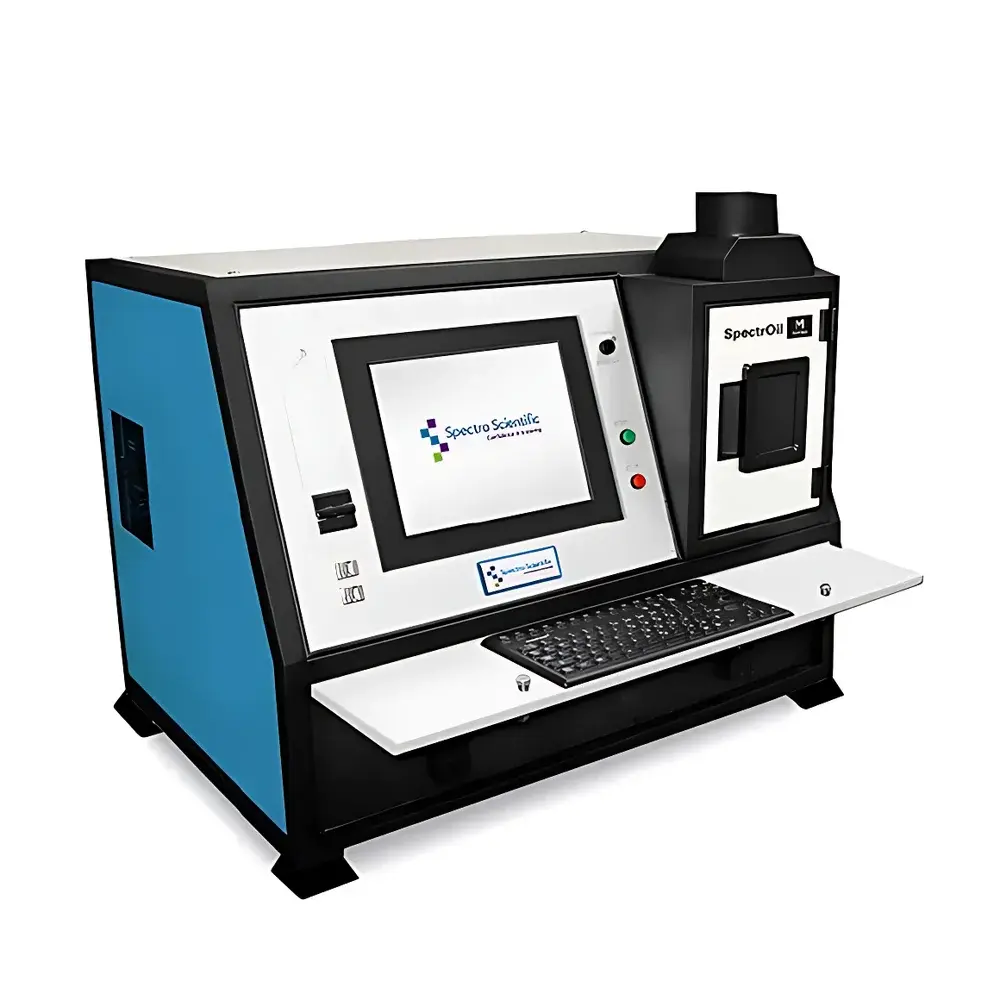
Spectro Scientific SpectrOil M Series Rotating Disc Electrode Optical Emission Spectrometer
| Brand | Spectro Scientific |
|---|---|
| Origin | USA |
| Model | SpectrOil M |
| Excitation Method | High-Temperature Arc Discharge (JOAP Standard) |
| Optical System | Paschen-Runge Polychromator with Thermally Stabilized Roland Circle Array (40°C ±1°C) |
| Spectral Range | 203 nm – 810 nm |
| Detector | CCD |
| Sample Consumption | ~2 mL per analysis |
| Analysis Time | ≤30 seconds |
| Elements Quantified Simultaneously | 31 |
| Compliance | ASTM D6595, ASTM D6728, JOAP CID-0191 |
| Software | SpectrOil V8 (Windows-based) |
| Display | 12″ Industrial Touchscreen Monitor |
| Power Requirement | 240 V / 50 Hz, 1000 W (during analysis) |
| Dimensions | 85 cm × 63.5 cm × 70 cm |
| Weight | 114 kg |
Overview
The Spectro Scientific SpectrOil M Series is a benchtop rotating disc electrode optical emission spectrometer (RDE-OES) engineered for rapid, precise elemental quantification in used and new lubricating oils—both mineral-based and synthetic formulations. Operating on the fundamental principle of atomic emission spectroscopy, the SpectrOil M employs a high-energy arc discharge between a rotating graphite disc electrode and a counter-electrode to atomize and excite metallic elements suspended or dissolved in oil samples. The resulting element-specific emission spectra are resolved by a thermally stabilized Paschen-Runge polychromator and captured by a high-sensitivity CCD detector. This architecture delivers robust analytical performance under field-deployable conditions without requiring vacuum purging, inert gas supply, or complex sample preparation—making it uniquely suited for on-site oil-in-service laboratories, mobile maintenance units, and centralized fleet diagnostic centers.
Key Features
- Field-hardened mechanical and optical design certified to JOAP CID-0191 for shock and vibration resistance—validated for repeated transport and operation in industrial environments.
- No sample dilution, digestion, or solvent addition required; direct analysis of as-received oil samples in <30 seconds per test.
- Simultaneous quantification of up to 31 wear metals, contaminants, and additive elements—including Fe, Cu, Al, Cr, Pb, Si, Na, Ca, Mg, Zn, P, and others critical to machinery health assessment.
- Integrated industrial-grade Windows-based computer with 12″ capacitive touchscreen interface—eliminates external PC dependency and simplifies operator workflow.
- Self-contained power architecture: operates exclusively on standard 240 V / 50 Hz AC mains; no compressed gas, cooling water, or auxiliary vacuum systems needed.
- Thermally regulated optical bench maintained at 40°C ±1°C ensures long-term wavelength stability and inter-day reproducibility—essential for trending wear metal accumulation over time.
Sample Compatibility & Compliance
The SpectrOil M accepts a broad range of hydrocarbon-based fluids, including engine oils, hydraulic fluids, turbine oils, gear oils, and diesel fuel—provided they meet viscosity limits compatible with capillary aspiration (<400 cSt at 40°C). It complies fully with ASTM D6595 (Standard Test Method for Determination of Wear Metals and Contaminants in Used Lubricating Oils by Rotating Disc Electrode Atomic Emission Spectrometry) and ASTM D6728 (for residual and distillate fuel oils). Its mechanical ruggedness satisfies JOAP CID-0191 requirements for airborne and ground vehicle-mounted deployment. While not intrinsically rated for hazardous locations, its sealed optical path and low-voltage control architecture support safe operation in Class I, Division 2 environments when installed per NEC Article 500 guidelines. Data integrity aligns with GLP principles, and SpectrOil V8 software supports audit-trail logging for laboratory quality management systems.
Software & Data Management
SpectrOil V8 is a purpose-built, Windows 10–compatible application that provides full instrument control, spectral acquisition, calibration management, and report generation. Calibration curves are stored as encrypted method files with versioned metadata and user-defined tolerance limits. All analyses retain raw spectral data, background-subtracted intensities, and elemental concentration outputs with associated uncertainty estimates derived from internal standardization and matrix-matched reference materials. Data export supports CSV, PDF, and XML formats compliant with LIMS integration protocols. USB ports and CD-RW drive enable offline archiving; network connectivity allows remote diagnostics and firmware updates via secure HTTPS. The software adheres to FDA 21 CFR Part 11 principles through configurable electronic signatures, role-based access control, and immutable audit trails for all critical actions—including calibration edits, result overrides, and user logins.
Applications
The SpectrOil M serves as a primary tool in predictive maintenance programs across aerospace, power generation, marine, mining, and heavy equipment sectors. Its ability to quantify trace-level wear metals enables early detection of abnormal component degradation—such as bearing fatigue (elevated Cr, Fe), piston ring scuffing (Cu, Sn), or coolant leakage (Na, K, Si). It supports additive depletion monitoring (Ca, Zn, P, Mg) to optimize oil drain intervals and verify formulation integrity. In military logistics, its portability and shock resilience make it ideal for forward-deployed oil analysis labs supporting armored vehicles and rotary-wing aircraft. Regulatory compliance testing for fuel sulfur content (per ASTM D6728) and lubricant certification (per OEM specifications such as SAE J1885 or ISO 3722) is also routinely performed using validated SpectrOil M methods.
FAQ
Does the SpectrOil M require argon or other purge gases to operate?
No. Unlike ICP-OES or spark-OES systems, the RDE-OES architecture functions reliably in ambient air due to its enclosed, pressure-stabilized discharge chamber and optimized arc geometry.
Can it analyze greases or highly viscous oils?
Greases require solvent dilution prior to analysis; oils exceeding 400 cSt at 40°C may require preheating or dilution to ensure consistent disc wetting and aerosol generation.
How often must the graphite disc electrode be replaced?
Typical electrode lifetime is 500–800 analyses under standard operating conditions; replacement is guided by real-time intensity drift monitoring within SpectrOil V8.
Is method transfer possible between different SpectrOil M units?
Yes. Calibration files and spectral libraries are portable across instruments of the same model generation, provided optical alignment verification and sensitivity normalization are performed per ASTM D6595 Annex A2.
What maintenance is required beyond electrode replacement?
Routine tasks include weekly cleaning of the sample introduction capillary and electrode holder with analytical-grade acetone, monthly inspection of high-voltage connections, and annual verification of thermal stabilization accuracy using NIST-traceable temperature references.





