
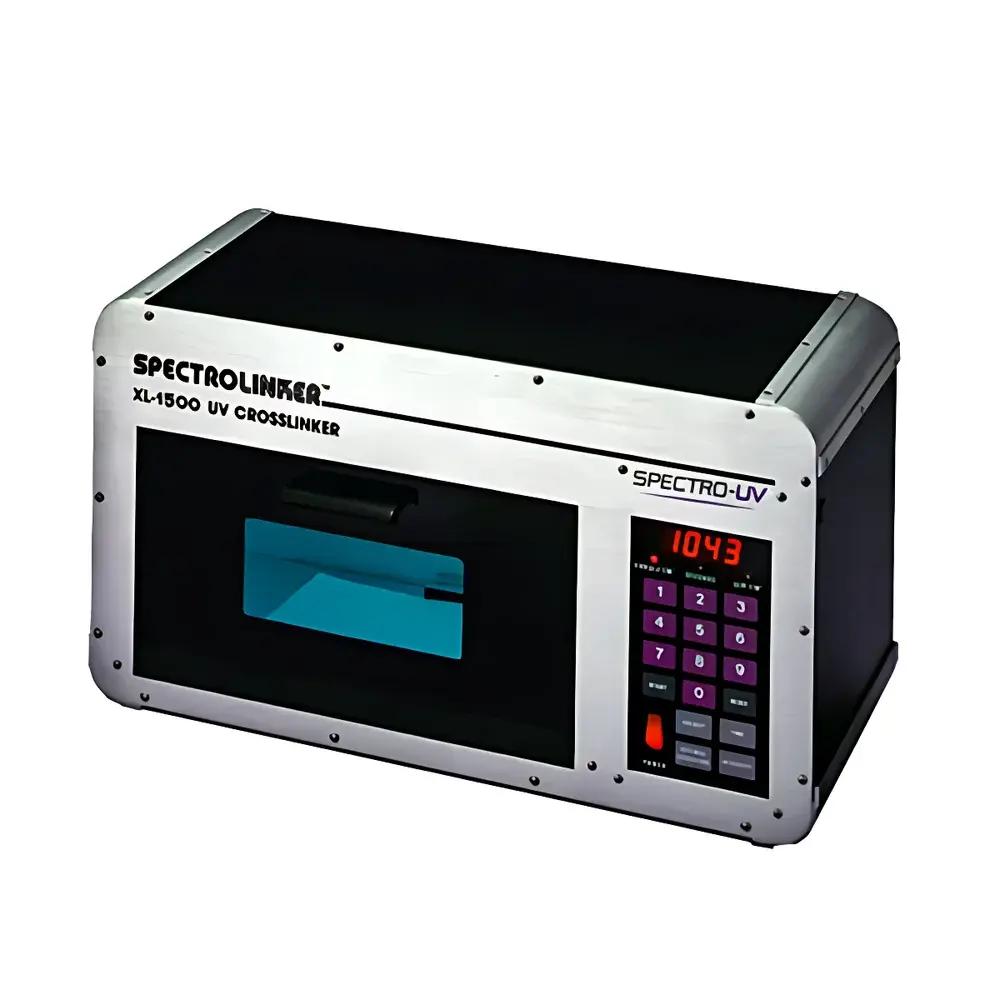
Spectro-UV XL-1000 & XL-1500 UV Crosslinker
| Brand | Spectro-UV |
|---|---|
| Origin | USA |
| Model | XL-1000, XL-1500 |
| Power Supply | 120 V / 60 Hz / 2 A (XL-1000), 120 V / 60 Hz / 3 A (XL-1500) |
| Wavelength | 254 nm |
| Lamp Type | Short-wave UV (UVC) fluorescent tubes — BLE-81254 (8 W × 5, XL-1000), BLE-11155 (15 W × 6, XL-1500) |
| Irradiation Mode | External illumination |
| Construction | Anodized aluminum housing and interior chamber |
| Chamber Dimensions (XL-1000) | 34.3 × 17.8 × 19.1 cm (W×H×D) |
| (XL-1500) | 46.4 × 15.9 × 31.8 cm |
| Net Weight | 7.9 kg (XL-1000), 11.8 kg (XL-1500) |
| Compliance | CE, RoHS, UL-listed components |
Overview
The Spectro-UV XL-1000 and XL-1500 UV Crosslinkers are engineered for precision nucleic acid immobilization, protein crosslinking, and surface decontamination in regulated laboratory environments. These instruments operate on the principle of ultraviolet-induced covalent bond formation—specifically utilizing germicidal 254 nm UVC radiation to induce thymine dimerization in DNA/RNA and promote photochemical crosslinking between biomolecules and solid supports such as nylon or nitrocellulose membranes. Unlike broadband or LED-based alternatives, the XL series employs high-output, low-ozone fluorescent lamps with tightly controlled spectral emission centered at 254 nm, ensuring reproducible irradiance profiles across the entire exposure area. Designed for integration into molecular biology workflows—including Southern/Northern blotting, EMSA, and UV-mediated immobilization of oligonucleotide arrays—the system delivers uniform, calibrated UV dose delivery without thermal overload, preserving sample integrity during extended exposure cycles.
Key Features
- Robust anodized aluminum chassis and interior chamber—resistant to corrosion, UV degradation, and repeated cleaning with ethanol or sodium hypochlorite solutions
- Dual-model platform: XL-1000 (compact footprint, 5 × 8 W lamps) and XL-1500 (expanded capacity, 6 × 15 W lamps), both optimized for consistent irradiance distribution (±8% spatial uniformity per IEC 62471)
- External illumination architecture eliminates shadowing effects and enables direct access to samples during setup—ideal for multi-well plates, blotting membranes, and custom substrates
- Integrated safety interlock system halts UV emission upon door opening, compliant with ANSI Z136.1 Class 1 laser product safety requirements for enclosed UV sources
- Multi-voltage compatibility (100–240 V AC, 50/60 Hz) with fused overcurrent protection—certified for use in GLP/GMP laboratories across North America, EU, and APAC regions
Sample Compatibility & Compliance
The XL-1000 and XL-1500 support standard molecular biology consumables including hybridization membranes (e.g., Amersham Hybond-N+, GE Healthcare), PCR plates (96- and 384-well), glass slides, and silicon wafers. Chamber geometry accommodates both rigid and flexible substrates up to 18.25″ × 6.25″ (XL-1500) without requiring repositioning. All units are manufactured under ISO 9001-certified processes and conform to IEC 61000-6-3 (EMC emissions) and IEC 61000-6-1 (immunity). Lamp specifications meet ASTM E2702-20 criteria for UVC source characterization, and irradiance output is traceable to NIST-calibrated radiometers. Documentation packages include Factory Acceptance Test (FAT) reports and lamp spectral emission certificates.
Software & Data Management
While the XL series operates via intuitive manual timer controls (0–999 seconds, ±1 s resolution), optional digital upgrade kits provide RS-232 or USB interfaces for external logging and protocol synchronization. When integrated with LIMS or ELN platforms, the system supports audit-trail generation per FDA 21 CFR Part 11 requirements—including user authentication, timestamped exposure logs, and tamper-evident data export. Firmware updates maintain alignment with evolving ICH Q5C photostability testing guidelines and USP Analytical Instrument Qualification protocols.
Applications
- Nucleic acid crosslinking for membrane-based hybridization assays (Southern, Northern, dot blots)
- Covalent immobilization of ssDNA probes on functionalized surfaces in microarray fabrication
- UV-mediated activation of photo-reactive linkers (e.g., psoralen, DSS) in protein-protein interaction studies
- Routine decontamination of laminar flow hoods, pipette tips, and reusable electrophoresis combs
- Accelerated photostability screening of biopharmaceutical formulations per ICH Q1B
FAQ
What is the effective irradiance output at 254 nm for each model?
Measured irradiance at chamber floor level is 1.2 mW/cm² (XL-1000) and 1.8 mW/cm² (XL-1500) when equipped with factory-fresh lamps, verified using a NIST-traceable UVC radiometer.
Can these units be used for UV sterilization of equipment?
Yes—both models deliver sufficient UVC fluence (>10 mJ/cm² in ≤10 s) to achieve ≥4-log reduction of common lab contaminants (e.g., E. coli, B. subtilis spores) on non-porous surfaces, provided direct line-of-sight exposure is maintained.
Are replacement lamps and calibration services available?
Spectro-UV supplies OEM-matched BLE-series lamps with spectral certification, and offers annual recalibration services with full uncertainty budgets compliant with ISO/IEC 17025.
Does the system require exhaust ventilation?
No—lamps are low-ozone emitting (<0.05 ppm O₃ at 1 m), eliminating need for dedicated ducting; however, operation in well-ventilated rooms is recommended per ACGIH TLV® guidelines for UVC exposure.
Is validation documentation provided for GxP environments?
Yes—IQ/OQ templates, risk assessments (per ISO 14971), and PQ protocol examples are included in the Regulatory Support Package, supporting qualification under Annex 11 and EU GMP Chapter 4.




