
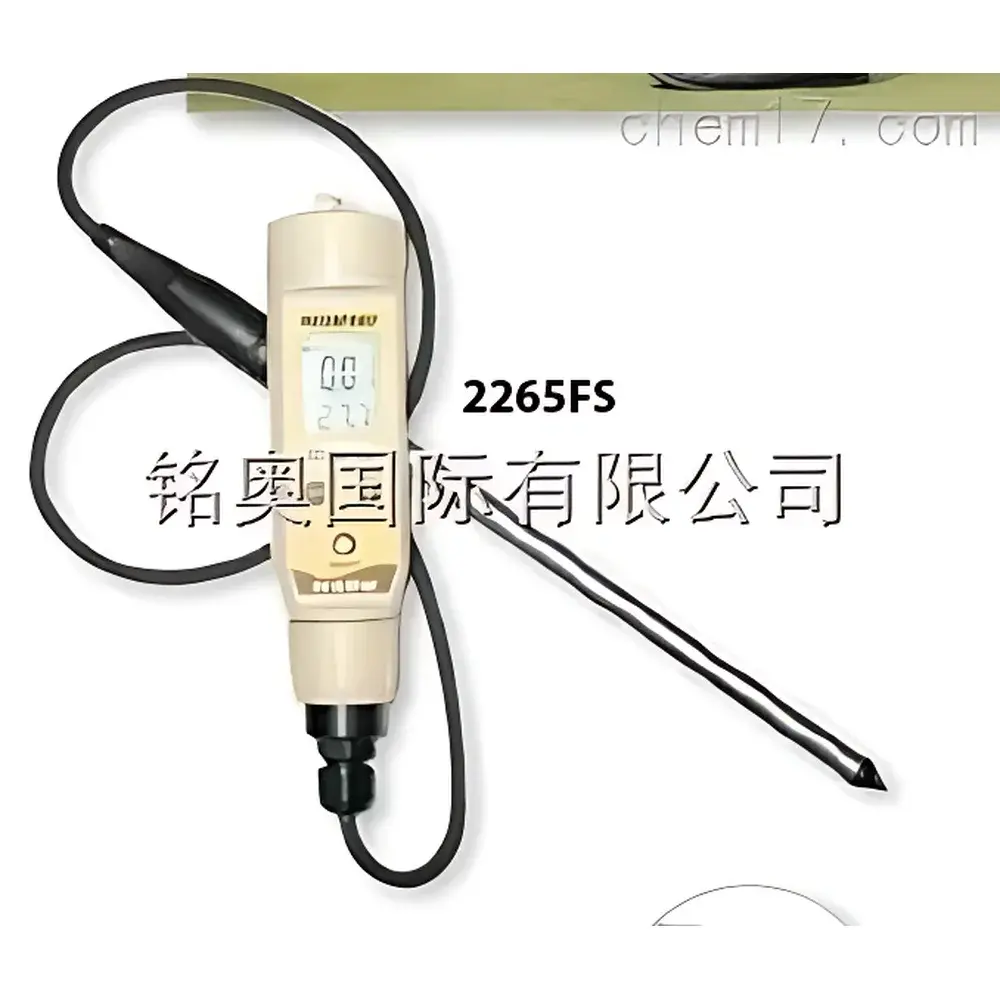
SPECTRUM 2265FS In-Situ Soil Electrical Conductivity Meter
| Origin | USA |
|---|---|
| Manufacturer Type | Authorized Distributor |
| Origin Category | Imported |
| Model | 2265FS |
| Instrument Type | Fertilizer/Nutrient Analyzer |
| Display | Large LCD |
| EC Range | 0.00–19.99 mS/cm |
| Temperature Range (Measurement) | −5–50 °C |
| Operating Ambient Temperature | 0–50 °C |
| EC Accuracy | ±2% of full scale |
| Temperature Accuracy | ±0.5 °C |
| EC Resolution | 0.01 mS/cm |
| Temperature Compensation Range | 0–50 °C |
| Calibration | Single-point at 2.76 mS/cm |
| Power Supply | Four LR44 1.5 V batteries |
| IP Rating | IP67 (Waterproof Design) |
Overview
The SPECTRUM 2265FS In-Situ Soil Electrical Conductivity Meter is a handheld, field-portable instrument engineered for rapid, direct measurement of electrical conductivity (EC) in undisturbed soil profiles, aqueous solutions, and organic liquid media. Based on two-electrode AC conductivity sensing principles, the 2265FS operates without requiring soil extraction or suspension preparation—enabling true in-situ assessment of soluble salt content, which correlates strongly with soil salinity, fertilizer residue, and ion-exchange capacity. Its compact form factor, ruggedized housing, and battery-powered operation make it suitable for routine monitoring across agricultural research plots, greenhouse management systems, reclaimed land assessments, and environmental site investigations where real-time EC data informs irrigation scheduling, nutrient management, and soil health diagnostics.
Key Features
- True in-situ capability: Stainless-steel probe electrodes penetrate directly into moist soil, minimizing disturbance and delivering representative bulk EC readings.
- Integrated automatic temperature compensation (ATC): Compensates EC values to 25 °C using an embedded thermistor, ensuring consistency across variable field conditions (0–50 °C operational range).
- High-resolution LCD display: Shows EC (mS/cm) and temperature (°C) simultaneously with 0.01 mS/cm resolution and ±2% full-scale accuracy.
- IP67-rated enclosure: Fully sealed against dust ingress and immersion up to 1 meter for 30 minutes—validated for use in humid greenhouses, rain-exposed field sites, and muddy terrain.
- Single-point calibration protocol: Simplified field calibration using a standard 2.76 mS/cm KCl solution; no multi-point curve fitting required for routine agronomic applications.
- Low-power architecture: Powered by four replaceable LR44 alkaline cells, supporting >2000 measurements per set under typical usage conditions.
Sample Compatibility & Compliance
The 2265FS is validated for direct contact measurement in mineral soils (sandy to clayey textures), hydroponic nutrient solutions, irrigation water, leachate samples, and compost extracts. It complies with ASTM D2777–20 (Standard Practice for Determination of Precision and Bias of Applicable Test Methods of Water and Wastewater) for field EC instrumentation and aligns with ISO 11265:2020 (Soil quality — Determination of electrical conductivity) for non-saturated, in-situ measurement protocols. While not a GLP-certified analytical instrument, its traceable calibration procedure and documented accuracy specifications support data integrity in farm-level nutrient audits and environmental compliance reporting under USDA-NRCS and EPA Region-specific guidance frameworks.
Software & Data Management
The 2265FS operates as a standalone field instrument with no onboard memory or Bluetooth/Wi-Fi connectivity. All measurements are recorded manually or via external logging (e.g., paired smartphone apps or field notebooks). For digital integration, users commonly pair the device with GIS-enabled platforms such as ArcGIS Field Maps or QGIS-based survey workflows, assigning geotagged EC values to spatial grids during transect-based soil mapping. Though the unit itself does not generate audit trails or electronic records, its calibration log, operator ID, and measurement timestamp can be maintained in accordance with internal QA/QC procedures compliant with ISO/IEC 17025:2017 Clause 7.7 (Ensuring validity of results).
Applications
- Agronomic salinity screening: Rapid identification of high-salt zones in orchards, vineyards, and row-crop fields prior to planting or post-irrigation.
- Fertigation monitoring: Verification of EC drift in drip-line emitters and nutrient tank solutions to prevent over- or under-fertilization.
- Soil health benchmarking: Longitudinal tracking of EC changes in conservation tillage trials, biochar amendment studies, or sodic soil reclamation projects.
- Environmental baseline surveys: Pre-construction assessment of soil conductivity in brownfield redevelopment or landfill closure monitoring programs.
- Educational field labs: Undergraduate soil science curricula requiring portable, intuitive instrumentation for hands-on EC–moisture–pH correlation exercises.
FAQ
Does the 2265FS require soil extraction or slurry preparation?
No. The instrument measures EC directly in situ using a two-electrode probe inserted into undisturbed, field-moist soil.
Can it measure EC in saturated paste extracts?
It is not designed for saturated paste analysis; for that application, laboratory-grade benchtop EC meters with standardized electrode geometry (e.g., ASTM D4292-compliant) are recommended.
Is temperature compensation adjustable or fixed?
Compensation follows a built-in linear algorithm referenced to 25 °C and is not user-configurable—optimized for typical agricultural soil thermal profiles.
What maintenance is required between field deployments?
Rinse probe electrodes with deionized water after each use; inspect O-rings for integrity before battery compartment closure; store with batteries removed in low-humidity environments.
Is the calibration certificate NIST-traceable?
Calibration uses a certified 2.76 mS/cm KCl standard (NIST SRM 3198 or equivalent); end-user documentation must retain lot-specific certificate of analysis from the distributor.







