
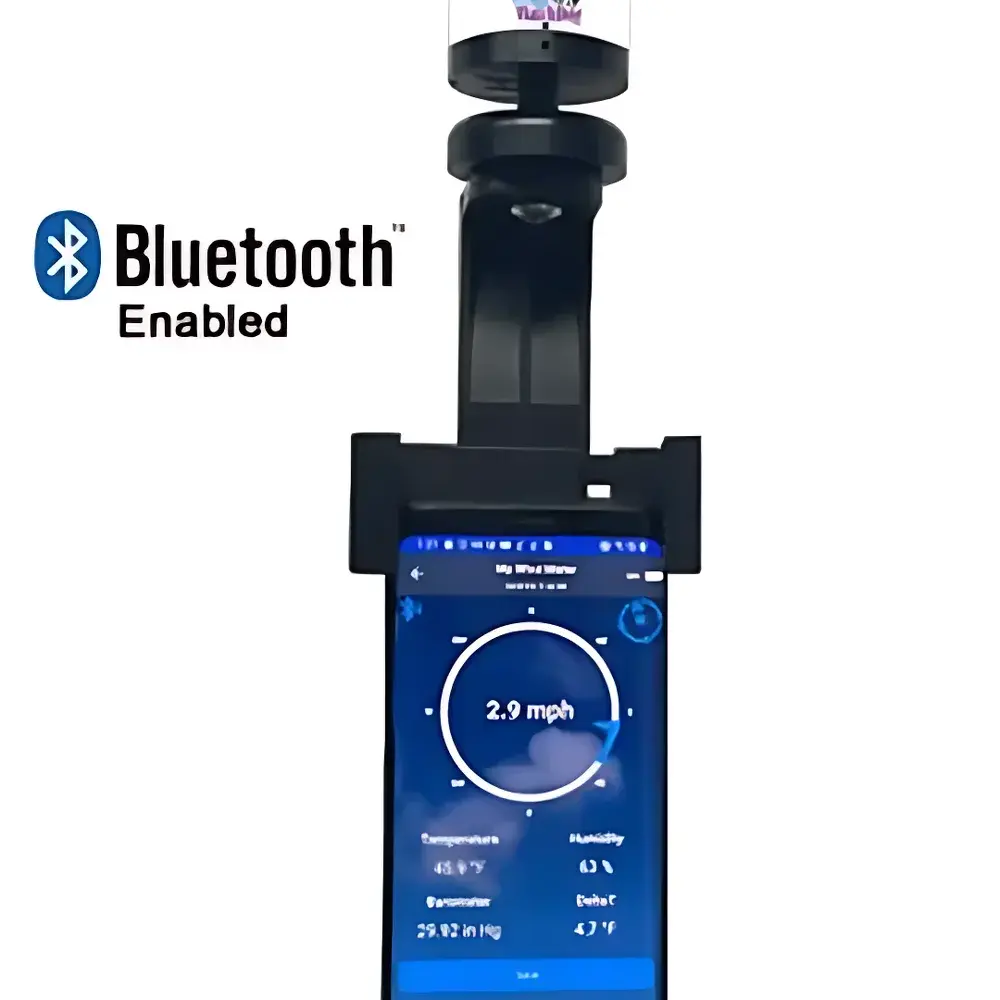
Spectrum 3348P Portable Ultrasonic Anemometer
| Brand | Spectrum |
|---|---|
| Origin | USA |
| Model | 3348P |
| Instrument Type | Ultrasonic Anemometer |
| Resolution | 0.1 m/s (wind speed), 1° (wind direction) |
| Measurement Range | Wind Speed 1–25 m/s, Wind Direction 0–359° |
| Accuracy | ±0.3 m/s @ 10 m/s (wind speed), ±1° (wind direction) |
| Operating Temperature | 0–50 °C |
| Operating Humidity | 0–60 % RH |
| Sensor Configuration | 4-channel ultrasonic transducer array |
| Dimensions (sensor unit) | 43 × 47 mm |
| Weight | 78 g |
| Battery Life | Up to 150 hours (typical usage) |
| Power | Rechargeable Li-ion battery with wireless charging support |
| Connectivity | Bluetooth 5.0 |
| Mobile Compatibility | iOS and Android (dedicated free app) |
Overview
The Spectrum 3348P Portable Ultrasonic Anemometer is a compact, handheld environmental sensor engineered for high-fidelity, real-time measurement of wind speed and wind direction under field conditions. Unlike mechanical cup-and-vane anemometers, the 3348P employs time-of-flight ultrasonic transit-time differential measurement across four precisely aligned transducer pairs. This solid-state architecture eliminates moving parts, ensuring long-term stability, minimal maintenance, and immunity to mechanical wear or inertia-induced lag. The device is calibrated per ISO 16622:2020 (Wind energy — Measurement of wind speed and direction using ultrasonic anemometers) and conforms to IEC 61000-6-3 for electromagnetic compatibility in portable instrumentation. Designed for rapid deployment in atmospheric boundary layer studies, microclimate monitoring, agricultural spray drift assessment, and industrial ventilation validation, the 3348P delivers metrologically traceable data without requiring external power sources or fixed mounting infrastructure.
Key Features
- Solid-state 4-channel ultrasonic transducer array enabling simultaneous bidirectional time-of-flight computation for both wind speed and direction
- Ultra-compact form factor (43 × 47 mm, 78 g) optimized for handheld operation, drone-mounted deployment, or integration into portable weather stations
- Bluetooth 5.0 wireless interface supporting secure, low-latency streaming to iOS and Android devices up to 30 m line-of-sight
- Onboard rechargeable lithium-ion battery providing up to 150 hours of continuous logging at 1 Hz sampling rate
- Wireless charging compatibility—no proprietary cables required; supports Qi-standard charging pads
- Integrated mounting bracket (144 × 134 mm) with universal smartphone cradle (58–105 mm width range) for hands-free field data acquisition
- IP54-rated enclosure for dust resistance and protection against water splashes during outdoor use
Sample Compatibility & Compliance
The 3348P is validated for use in non-condensing ambient environments within 0–50 °C and 0–60 % RH. It is not rated for continuous operation in rain, fog, or freezing conditions where ice accumulation may impair acoustic path integrity. The instrument complies with ASTM D5096–22 (Standard Practice for Field Calibration of Anemometers) for in-situ verification protocols and supports GLP-compliant metadata tagging (timestamp, GPS-assisted location via paired mobile device, operator ID). While not FDA-regulated, its data output format and audit trail functionality align with 21 CFR Part 11 requirements when used in environmental validation contexts under pharmaceutical or agrochemical GxP frameworks.
Software & Data Management
The Spectrum Connect mobile application (freely available on Apple App Store and Google Play) provides real-time visualization, configurable sampling intervals (0.1–10 Hz), and local CSV export. All measurements are timestamped with millisecond precision and geotagged using the host smartphone’s GNSS receiver. Raw ultrasonic transit-time values and derived wind vectors are stored onboard until synced; no cloud storage is mandatory. Exported files include header metadata compliant with CF Metadata Conventions (v1.8), facilitating direct ingestion into MATLAB, Python (Pandas/NetCDF4), or industry-standard environmental data platforms such as EPA’s AirNow or WMO’s OSCAR/Surface. Firmware updates are delivered over-the-air via the app, preserving calibration certificates and user-defined configurations.
Applications
- Micro-meteorological profiling for precision agriculture—including pesticide spray drift modeling and irrigation scheduling
- Urban heat island and street-canyon airflow characterization in environmental impact assessments
- Pre-deployment validation and post-installation verification of HVAC system air intake/exhaust performance
- Educational fieldwork in atmospheric science and environmental engineering curricula
- Temporary site monitoring for construction dust control plans and renewable energy feasibility surveys
- Calibration reference for larger fixed-site meteorological towers where portability and cross-validation are required
FAQ
Is the 3348P suitable for marine or coastal environments?
No—its IP54 rating does not protect against salt-laden mist or prolonged humidity exposure above 60 % RH. For maritime applications, consider a marine-grade ultrasonic anemometer with conformal coating and stainless-steel housing.
Can the device operate without a smartphone?
Yes—the 3348P logs data internally at user-defined intervals and retains up to 32,000 records. Smartphone connectivity is required only for configuration, real-time viewing, or data export.
Does the instrument require annual recalibration?
Per ISO 16622, ultrasonic anemometers should undergo functional verification every 12 months using a NIST-traceable wind tunnel or field reference standard. Spectrum provides a certified calibration certificate with initial shipment; optional recalibration services are available through authorized service centers in North America and EU.
What is the minimum detectable wind speed?
The specified lower limit is 1 m/s; below this threshold, signal-to-noise ratio degrades due to thermal noise in transducer electronics and ambient acoustic interference. No zero-wind offset correction is applied algorithmically.
Is GPS positioning mandatory for data collection?
No—geotagging is optional and relies solely on the paired smartphone’s GNSS capability. Location metadata can be disabled in the app settings for privacy-sensitive deployments.
Related Products







