
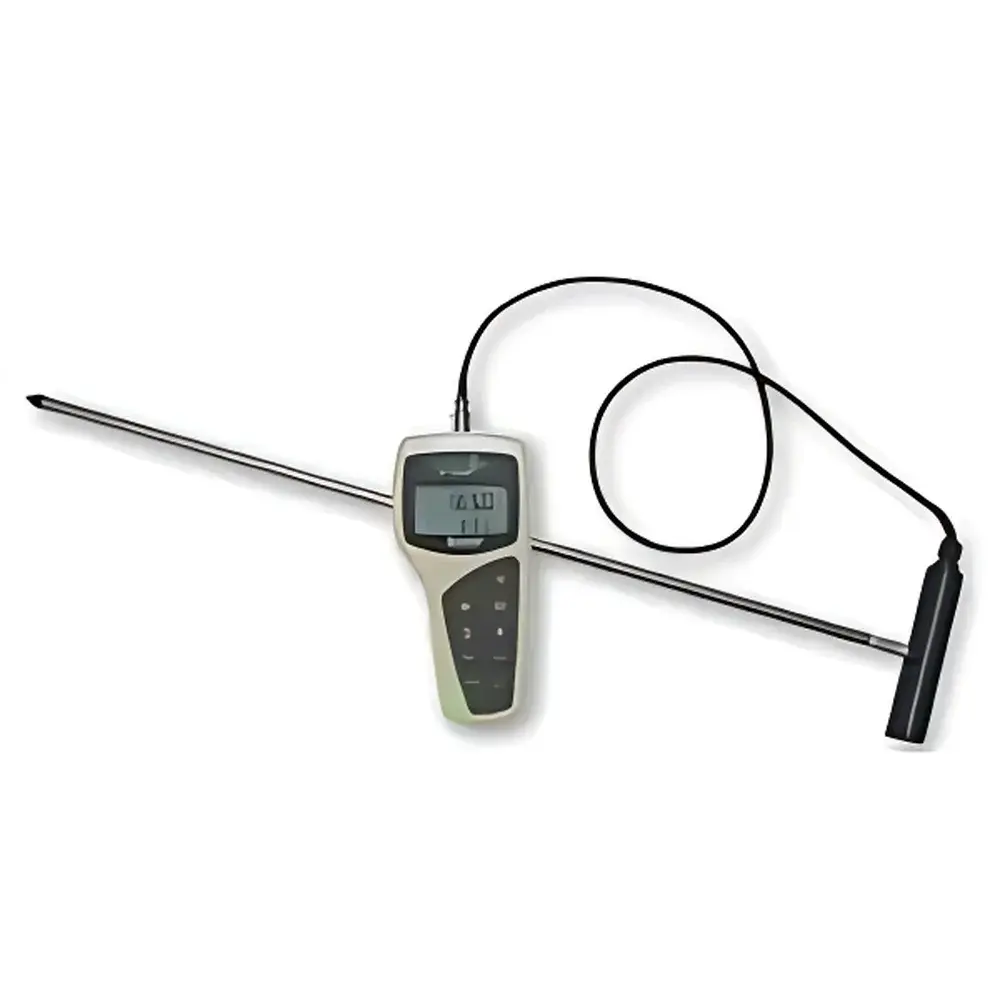
Spectrum Technologies FieldScout EC110 Soil Electrical Conductivity Meter
| Brand | Spectrum Technologies |
|---|---|
| Origin | USA |
| Model | FieldScout EC110 |
| Measurement Range | 0–199.9 mS/cm |
| Accuracy | ±2% of reading |
| Memory Capacity | 1,000 readings (GPS disabled) / 650 readings (GPS enabled) |
| Power Supply | 4 × AAA batteries (≥30 hours continuous operation) |
| Calibration Standard | 2.76 mS/cm KCl solution |
| Probe Options | FieldScout T-handle probe (2225FS, 60.96 cm), water probe (2220CC), optional GPS/DGPS cable (1950CV5) |
Overview
The Spectrum Technologies FieldScout EC110 is a handheld, field-deployable electrical conductivity (EC) meter engineered for rapid, in-situ assessment of soil and aqueous solution salinity. It operates on the principle of two-electrode conductometric measurement: an alternating current is applied across stainless-steel electrodes embedded in the probe tip, and the resulting voltage drop is converted to conductivity (mS/cm) using calibrated cell constants. Unlike laboratory benchtop EC meters requiring sample extraction and suspension preparation, the EC110 enables direct insertion into undisturbed soil profiles or immersion into surface water, irrigation channels, or nutrient solutions—providing real-time, spatially referenced EC data critical for precision agriculture, irrigation management, and environmental site characterization.
Key Features
- Direct-insertion stainless-steel probe design with ergonomic T-handle (2225FS, 60.96 cm length) optimized for consistent soil penetration and minimal disturbance of bulk density and moisture distribution.
- Integrated data logger storing up to 1,000 EC measurements without GPS tagging; memory reduces to 650 entries when GPS/DGPS positioning (via 1950CV5 cable) is enabled for georeferenced mapping.
- Onboard calibration verification using supplied 2.76 mS/cm KCl standard solution (2254), traceable to NIST-certified reference materials.
- Low-power electronics powered by four standard AAA alkaline cells, delivering ≥30 hours of continuous field operation under typical ambient conditions (15–30°C).
- Ruggedized IP65-rated housing resistant to dust ingress and water splashing, suitable for extended outdoor deployment in agricultural and ecological monitoring environments.
- USB interface compliant with USB 2.0 standards for direct connection to Windows-based PCs; no external power adapter required during data transfer.
Sample Compatibility & Compliance
The EC110 supports both solid-phase (mineral soils, potting media, compost) and liquid-phase (surface water, leachate, hydroponic reservoirs, fertilizer stock solutions) measurements. Its two-electrode configuration is optimized for EC values between 0.1 and 199.9 mS/cm—covering typical agricultural soils (0.1–10 mS/cm), saline-affected zones (10–50 mS/cm), and concentrated brines (up to 199.9 mS/cm). While not intended for high-precision metrology per ISO/IEC 17025, the instrument conforms to ASTM D512-20 (Standard Test Method for Chloride Ion in Water) and USDA-NRCS Field Handbook protocols for rapid salinity screening. Data collection workflows support GLP-aligned documentation when paired with timestamped, location-tagged records and version-controlled software exports.
Software & Data Management
Data retrieval and analysis are performed via Spectrum’s proprietary FieldScout Software (v4.2+), compatible with Windows 10/11. The application imports CSV-formatted datasets containing EC value, date/time stamp, battery status, and optional UTM or WGS84 coordinates. Users can generate spatial heatmaps, export time-series plots, apply moving-average filters for noise reduction, and cross-reference EC trends with historical soil moisture or temperature logs. All exported files include audit-trail metadata (operator ID, software version, calibration date), satisfying basic FDA 21 CFR Part 11 requirements for electronic record integrity in non-GMP field research settings.
Applications
- Variable-rate irrigation scheduling based on spatial EC heterogeneity mapped across fields.
- Salinity risk assessment in reclaimed lands, coastal zones, and arid-region agriculture.
- Monitoring nutrient leaching dynamics during fertigation events in greenhouse and open-field systems.
- Baseline characterization for environmental impact assessments (EIA) and remediation site monitoring.
- Validation of electromagnetic induction (EMI) sensor surveys through targeted point measurements.
- Teaching and extension activities in soil physics, agronomy, and environmental science curricula.
FAQ
Does the EC110 require electrode cleaning between soil measurements?
Yes—stainless-steel electrodes must be rinsed with deionized water and gently wiped dry after each insertion to prevent cross-contamination and polarization drift.
Can the EC110 measure total dissolved solids (TDS)?
No—it reports EC only. TDS estimation (e.g., mg/L) requires user-defined conversion factors (typically 0.5–0.7 × EC in mS/cm) and is not calculated onboard.
Is the 2220CC water probe compatible with the EC110 handheld unit?
Yes—the 2220CC probe connects directly to the EC110 terminal and is factory-calibrated for aqueous solutions; it is not rated for soil insertion.
What is the operating temperature range?
The device functions reliably from –10°C to +50°C; however, battery life and LCD response degrade below 0°C or above 40°C.
How is calibration verified in the field?
Using the included 2.76 mS/cm KCl standard (2254), users perform a single-point verification before and after each survey session to confirm instrument stability within ±2% tolerance.







