
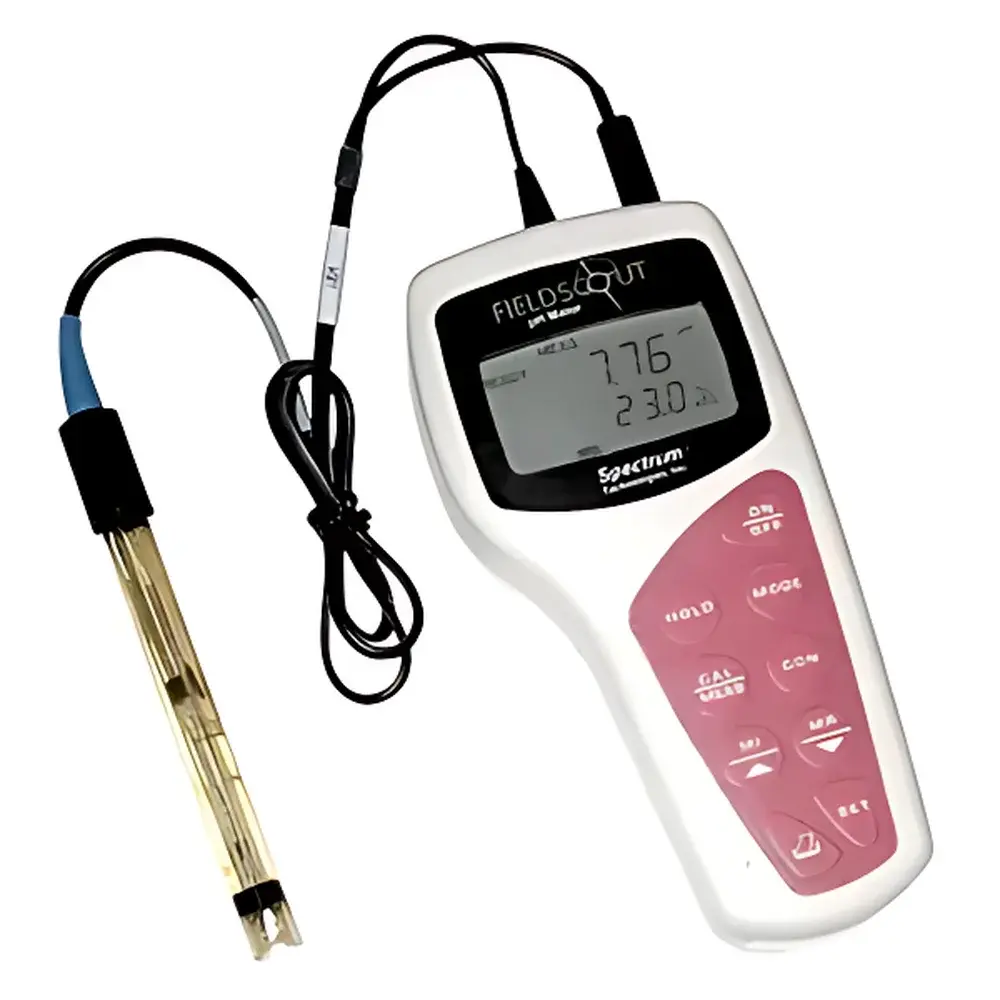
Spectrum Technologies FieldScout In-Situ Soil pH Meter
| Brand | Spectrum Technologies |
|---|---|
| Origin | USA |
| Model | FieldScout |
| pH Range | 0.00–14.00 |
| Accuracy | ±0.01 pH |
| Resolution | 0.01 pH |
| Data Storage Capacity | 4,096 readings (1,488 with GPS enabled) |
| Probe Options | Flat-surface soil probe or combined pH/temperature electrode |
| GPS Integration | RS-232 serial interface compatible with external GPS receivers |
| Software | FieldScout PC software included for configuration, data download, and export |
| Compliance | Designed for field-deployable agricultural and environmental monitoring per ASTM D2797 and ISO 10390 guidelines |
Overview
The Spectrum Technologies FieldScout In-Situ Soil pH Meter is a rugged, handheld field instrument engineered for direct, real-time measurement of soil pH without sample extraction or laboratory processing. It operates on the potentiometric principle—utilizing a glass-membrane pH electrode in direct contact with moist soil to generate a millivolt signal proportional to hydrogen ion activity. This electrochemical response is temperature-compensated via integrated or optional dual-sensor probes, ensuring measurement integrity across variable field conditions. Unlike traditional lab-based methods requiring slurry preparation and equilibrium time, the FieldScout enables immediate in-situ assessment at multiple depths and locations—critical for precision agriculture, soil health mapping, irrigation water management, and agrochemical calibration. Its design prioritizes operational robustness, low-power consumption, and traceable data acquisition under ambient outdoor conditions.
Key Features
- Two interchangeable probe configurations: a flat-surface stainless-steel probe optimized for undisturbed topsoil contact, and a combined pH/temperature electrode for simultaneous thermal compensation and deeper profile sampling;
- RS-232 serial interface supporting seamless integration with commercially available GPS receivers (e.g., Garmin GPSMAP series), embedding geospatial coordinates (latitude, longitude, elevation) into each recorded measurement;
- Onboard non-volatile memory storing up to 4,096 pH readings; capacity reduces to 1,488 entries when GPS metadata is enabled, preserving timestamped spatial fidelity;
- Built-in calibration verification using factory-supplied pH 4.01 and pH 7.00 buffer solutions—calibration status is logged with each measurement set;
- FieldScout PC software (Windows-compatible) provides device configuration, firmware updates, batch data export (CSV, TXT), and compatibility with SpecMaps—a cloud-based GIS platform for generating interpolated pH contour maps;
- Includes protective hard-shell carrying case, USB-to-serial adapter cable, four AA alkaline batteries (providing >100 hours of continuous operation), and NIST-traceable calibration standards.
Sample Compatibility & Compliance
The FieldScout is validated for use in mineral soils, loams, sandy and clay-rich substrates with moisture content ≥15% w/w. It is not intended for use in highly saline soils (>4 dS/m EC), dry powders, or organic substrates such as peat moss without prior moisture equilibration. Measurements conform to ASTM D2797 (Standard Test Method for pH of Soils) and ISO 10390:2022 (Soil quality — Determination of pH) when used according to specified field protocols—including probe insertion depth (2–5 cm), stabilization time (≥30 seconds), and surface moisture verification. The instrument’s ±0.01 pH accuracy and 0.01 resolution meet the reporting thresholds required for USDA-NRCS soil survey documentation and EPA Region IV field screening applications.
Software & Data Management
FieldScout software supports full audit trail functionality: every calibration event, measurement, GPS fix, and battery voltage reading is time-stamped and stored with device ID and operator metadata. Exported datasets include columns for date/time, pH value, temperature (°C), GPS coordinates (WGS84), HDOP, and probe type identifier—enabling compliance with GLP-aligned data handling practices. While the system does not implement FDA 21 CFR Part 11 electronic signature controls, its structured logging architecture facilitates integration into validated LIMS environments where raw field data ingestion workflows are governed by institutional SOPs.
Applications
- Site-specific lime and sulfur amendment planning based on high-resolution pH zonation;
- Verification of irrigation water pH prior to fertigation to prevent nutrient precipitation (e.g., iron chelate destabilization);
- Pre-spray tank mix evaluation to optimize pesticide hydrolysis kinetics and efficacy;
- Long-term soil acidification monitoring in no-till and perennial cropping systems;
- Regulatory field screening for brownfield remediation projects under state-level soil pH threshold mandates;
- Educational field labs in agronomy and environmental science curricula requiring portable, repeatable electrochemical instrumentation.
FAQ
How often should the pH electrode be calibrated during extended field use?
Calibration is recommended before each deployment session and after every 20–30 measurements under variable soil types. The instrument logs calibration timestamps and deviation values to support traceability.
Can the FieldScout measure pH in saturated paste extracts?
No—it is designed exclusively for in-situ solid-phase contact. For saturated paste analysis, laboratory-based benchtop meters compliant with ASTM D4972 must be used.
Is the probe resistant to corrosion in high-iron or acidic soils?
The flat probe features electropolished 316 stainless steel; the pH/temperature electrode uses a double-junction reference system with KCl gel electrolyte, providing enhanced resistance to clogging and sulfide poisoning in moderately aggressive matrices.
Does the device support Bluetooth or Wi-Fi connectivity?
No—data transfer occurs exclusively via USB-connected serial interface to ensure electromagnetic immunity in agricultural RF-noise environments.
What is the operating temperature range for reliable performance?
The instrument functions reliably from –10 °C to +50 °C; however, pH electrode response slows below 5 °C, and measurements below freezing require thermal equilibration of both probe and soil interface.







