
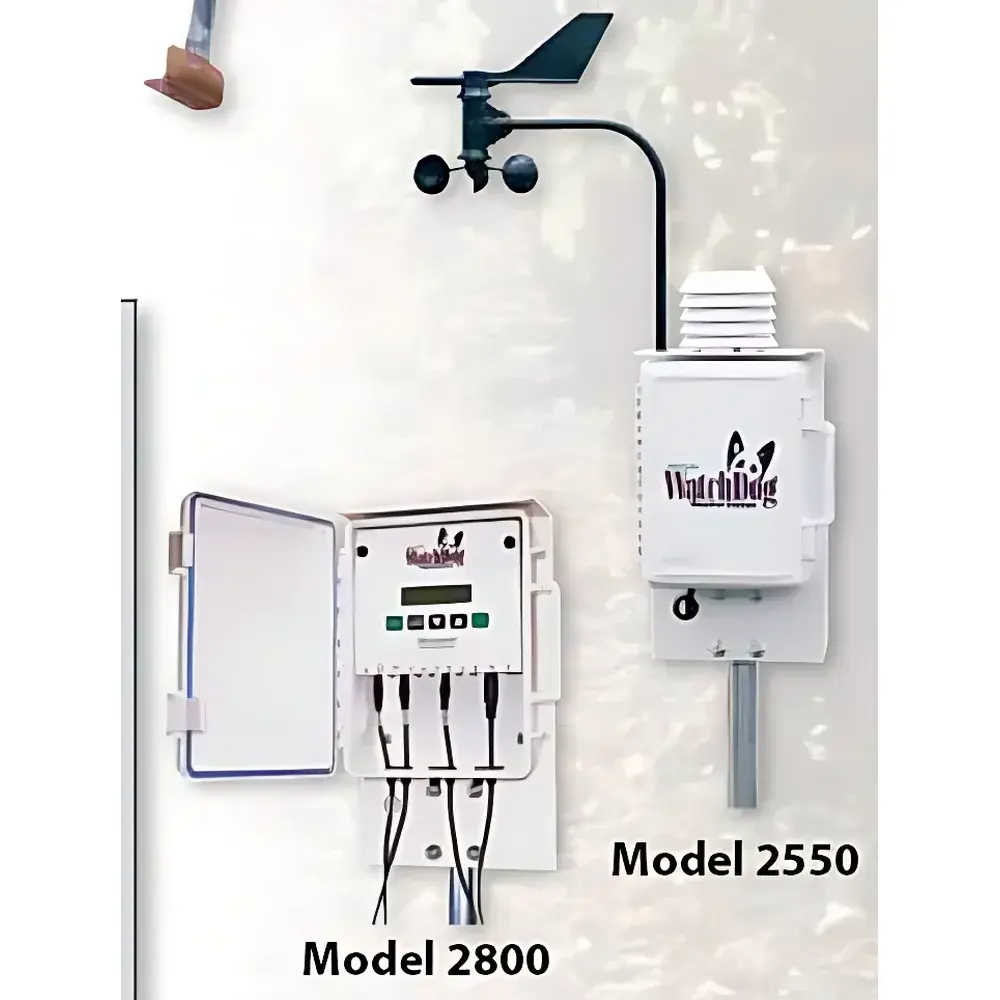
WatchDog 2550 Agricultural Weather Station by Spectrum Technologies
| Model | WD-2550 |
|---|---|
| Temperature range | −32 to 100 °C (±0.6 °C) |
| Relative humidity | 10–100% RH (±3% RH, 5–50 °C) |
| Wind speed | 0–241 km/h (±5%) |
| Wind direction resolution | 2° (±7°) |
| Solar radiation | 0–1250 W/m² (±5%) |
| Dew point | −73 to 60 °C (±2 °C) |
| Rainfall resolution | 0.25 mm (±2%) |
Overview
The WatchDog 2550 Agricultural Weather Station is a field-deployable, self-contained environmental monitoring system engineered for precision, reliability, and operational simplicity in agronomic and ecological research applications. Built on a modular architecture, it employs calibrated analog and digital transducers to measure core atmospheric parameters—including air temperature, relative humidity, wind speed and direction, solar irradiance, and precipitation—using industry-standard physical principles (e.g., capacitive humidity sensing, thermistor-based temperature detection, cup-and-vane anemometry, silicon photodiode pyranometry, and tipping-bucket rain gauge mechanics). All measurements are time-stamped and internally processed to derive secondary metrics such as dew point temperature and cumulative evapotranspiration (ET0) using the FAO Penman-Monteith reference equation when configured with appropriate sensor inputs. Designed for unattended operation across diverse climatic zones—from arid croplands to humid subtropical orchards—the system operates continuously on internal rechargeable batteries or optional solar charging, with IP67-rated enclosures ensuring resilience against dust ingress and transient water exposure.
Key Features
- Integrated six-channel data logger with real-time LCD display (backlit, 128 × 64 pixels), enabling on-site verification of current readings and configuration status without external hardware.
- Plug-and-play sensor interface architecture supporting up to six user-selectable external sensors—including soil moisture (TDR or capacitance), soil temperature (PT100 or thermistor), barometric pressure, PAR (photosynthetically active radiation), and leaf wetness modules—without firmware modification.
- Configurable sampling intervals from 1 minute to 18 hours, with internal memory capacity storing up to 10,000 measurement records (expandable via microSD card in compatible firmware versions).
- Onboard calculation engine delivering derived outputs including dew point, heat index, wind chill, and reference evapotranspiration (ET0) when paired with required sensor suites.
- Ruggedized aluminum and UV-stabilized polymer housing rated to IP67; operating temperature range extends from −32 °C to +60 °C ambient, validated per IEC 60529 and MIL-STD-810G environmental stress protocols.
- USB 2.0 interface for direct data download and configuration; optional RF433 MHz or 900 MHz wireless telemetry kits available for remote transmission up to 1 km line-of-sight (subject to local regulatory compliance).
Sample Compatibility & Compliance
The WatchDog 2550 is routinely deployed in USDA ARS field trials, NSF-funded ecosystem observatories, and ISO 17025-accredited agricultural testing laboratories. Sensor calibrations conform to NIST-traceable standards, with humidity sensors certified to ISO 9001:2015 manufacturing controls and temperature probes meeting ASTM E220-20 calibration verification requirements. The system supports GLP-compliant data integrity workflows through timestamped logging, non-erasable record storage, and audit-ready export formats (CSV, TXT). While not FDA 21 CFR Part 11-certified out-of-the-box, its data export architecture enables integration into validated LIMS environments where electronic signatures and change control are managed at the enterprise software layer.
Software & Data Management
Data retrieval and visualization are supported via Spectrum Technologies’ proprietary WatchDog Software (v4.5+), a Windows-based application providing graphical trend analysis, statistical summary reports (min/max/avg/std dev), and automated export to Excel-compatible formats. Raw binary logs include embedded metadata (sensor ID, firmware version, battery voltage, sampling interval), facilitating traceability in multi-station networks. For integration into institutional data infrastructures, the software supports ODBC connectivity and scheduled FTP/SFTP uploads. Third-party compatibility includes import support for common agro-meteorological platforms such as AgriMet, CropWx, and R-based eddy covariance post-processing pipelines.
Applications
- Irrigation scheduling and water-use efficiency optimization in row crops, vineyards, and greenhouse production systems.
- Phenological monitoring and frost-risk assessment for perennial horticultural operations.
- Boundary-layer micrometeorology studies supporting eddy covariance flux tower calibration.
- Long-term climate trend analysis in LTER (Long Term Ecological Research) sites and NEON (National Ecological Observatory Network) auxiliary nodes.
- Regulatory compliance reporting for USDA-NRCS Conservation Stewardship Program (CSP) and EPA Clean Water Act Section 319 nonpoint source monitoring initiatives.
- Validation of satellite-derived land surface temperature and albedo products under field conditions.
FAQ
What is the maximum number of external sensors the WatchDog 2550 can accommodate simultaneously?
It supports up to six external sensors via standardized RJ11-style analog/digital input ports, with automatic sensor identification and scaling applied upon connection.
Does the system support barometric pressure measurement natively?
No—barometric pressure is not included in the base configuration but is available as an optional add-on sensor (Model BP-100) that connects to one of the six expansion ports.
Can rainfall data be corrected for wind-induced undercatch?
The tipping-bucket rain gauge does not incorporate mechanical wind shielding; however, post-processing correction algorithms based on ASCE/EWRI guidelines may be applied during data analysis using exported CSV files.
Is firmware upgrade capability available in-field?
Yes—firmware updates are delivered via USB-connected WatchDog Software and require no hardware modification; version history and release notes are published on Spectrum Technologies’ technical support portal.
How is data security handled during wireless transmission?
RF telemetry modules use fixed-frequency broadcast protocols without encryption; for secure environments, data should be transmitted via wired USB or integrated into encrypted institutional networks at the server level.







