
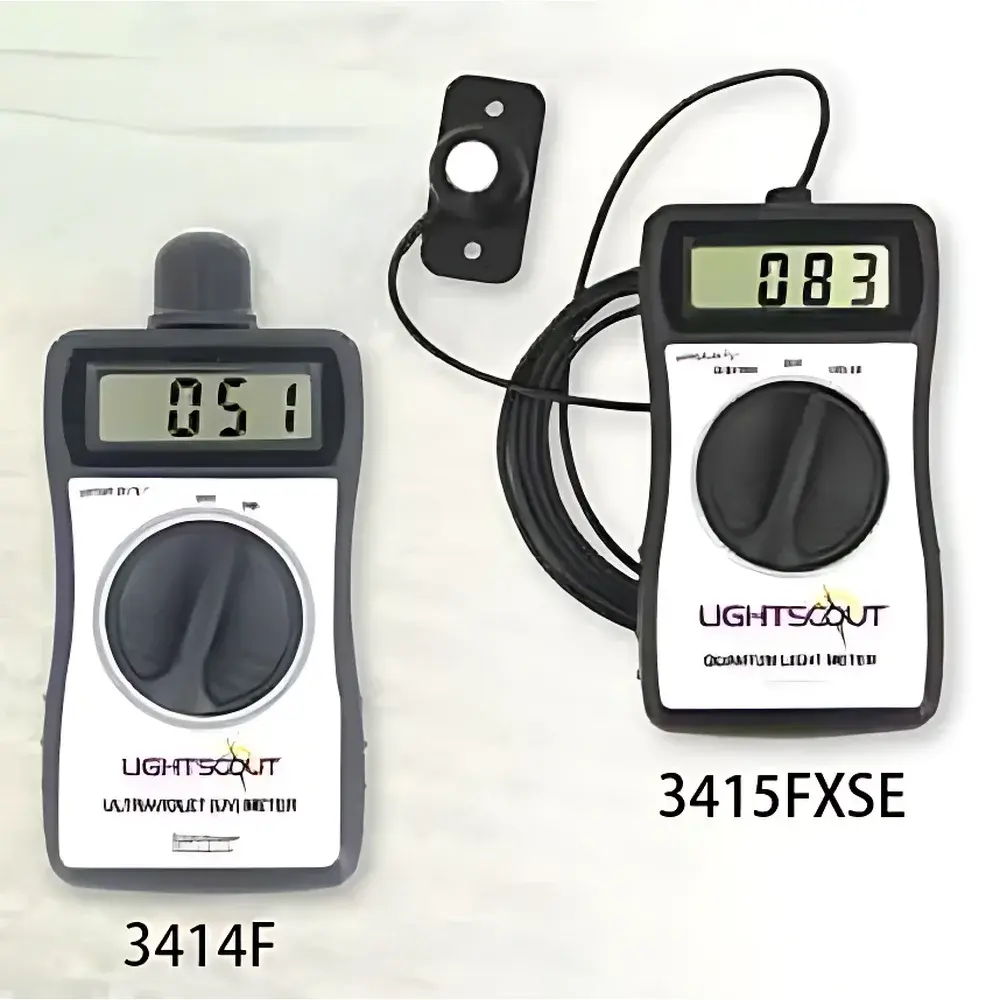
Spectrum Technologies LightScout PAR Quantum Meter
| Brand | Spectrum Technologies |
|---|---|
| Origin | USA |
| Model | LightScout |
| Measurement Range | 0–2,000 μmol·m⁻²·s⁻¹ |
| Spectral Response | 400–700 nm |
| Power Options | Solar-powered and/or external battery (model-dependent) |
| Configurations | Standalone meter (3415F), solar/electric hybrid (3415FSE), external sensor variant (3415FXSE), dual PAR & lux meter (3415FQF) |
| Carrying Case | Optional 7500 portable case |
Overview
The Spectrum Technologies LightScout PAR Quantum Meter is a precision-calibrated, field-deployable instrument engineered for the quantitative measurement of photosynthetically active radiation (PAR) in agricultural, horticultural, ecological, and controlled-environment research applications. PAR—defined as the spectral irradiance within the 400–700 nm wavelength band—is the biologically relevant portion of sunlight driving photosynthesis in higher plants, algae, and cyanobacteria. Unlike photometric units such as lux or foot-candles—which weight light by human visual sensitivity—the LightScout employs a cosine-corrected silicon photodiode sensor with spectrally optimized optical filtering to deliver quantum-based irradiance values in micromoles per square meter per second (μmol·m⁻²·s⁻¹). This metric directly correlates with photon flux density (PFD), enabling accurate assessment of light availability for photosynthetic carbon assimilation. The device operates on a robust, low-power architecture suitable for unattended logging in greenhouses, growth chambers, open-field plots, and vertical farming installations.
Key Features
- Cosine-corrected optical diffuser ensuring angular response compliance with ISO 9060:2018 Class C specifications for radiometric measurements.
- Calibration traceable to NIST-traceable standards, with documented uncertainty ≤ ±5% across the full 0–2,000 μmol·m⁻²·s⁻¹ range.
- Integrated data logging capability (up to 10,000 readings) with timestamping and configurable sampling intervals (1 sec to 24 hr).
- Multiple operational configurations: fully self-contained handheld unit (Model 3415F); solar-recharged + replaceable battery hybrid (3415FSE); external sensor head with cable extension up to 15 m (3415FXSE); and dual-channel variant supporting simultaneous PAR and illuminance (lux) measurement (3415FQF).
- IP67-rated enclosure for dust and water resistance, enabling reliable outdoor deployment under variable climatic conditions.
- USB-C interface for data export and firmware updates; compatible with Spectrum’s proprietary Loggernet software and third-party platforms via CSV export.
Sample Compatibility & Compliance
The LightScout is designed for non-contact, in-situ measurement above canopy, within canopy, or at substrate level—supporting both instantaneous spot readings and time-series monitoring. Its compact form factor and low thermal mass minimize shadowing artifacts and self-heating interference. The instrument complies with ASTM E2912-22 “Standard Practice for Measuring Photosynthetically Active Radiation (PAR) Using Quantum Sensors” and aligns with ISO 17025-accredited calibration practices when serviced through authorized Spectrum calibration centers. While not a regulated medical or pharmaceutical device, its metrological performance meets requirements for GLP-compliant environmental monitoring and supports documentation for USDA-NRCS conservation planning, USDA-ARS field trials, and academic research adhering to FAO crop modeling protocols.
Software & Data Management
Data acquisition and analysis are supported through Spectrum’s Loggernet desktop application (Windows), which enables batch download, visualization of temporal PAR profiles, statistical summaries (mean, min/max, daily integrals), and export to CSV, Excel, or MATLAB-compatible formats. All logged datasets include embedded metadata: date/time stamp, measurement unit, sensor ID, and battery status. Audit trails—including user-initiated recalibrations and configuration changes—are retained locally on-device memory. For integration into larger IoT frameworks, the LightScout supports manual synchronization with cloud-based platforms (e.g., FarmOS, Climate FieldView™) via exported time-stamped files. No remote telemetry or cellular connectivity is built-in; all communications occur via physical USB connection to preserve data integrity and security in regulated environments.
Applications
- Optimizing supplemental lighting schedules in greenhouse production based on real-time PAR accumulation versus crop-specific DLI (Daily Light Integral) thresholds.
- Evaluating light transmission efficiency of glazing materials, shade cloths, and photoselective films in protected cultivation systems.
- Validating uniformity of LED grow light distribution across multi-tier vertical farms using spatial mapping protocols.
- Supporting phenotyping studies where light environment quantification is required for genotype × environment interaction modeling.
- Long-term ecological monitoring of understory light availability in forest succession or riparian restoration projects.
- Calibration reference for imaging-based PAR estimation algorithms using multispectral UAV or satellite data.
FAQ
What is the calibration interval recommendation for the LightScout PAR meter?
Spectrum Technologies recommends annual recalibration against a NIST-traceable reference standard to maintain measurement confidence; more frequent verification is advised after mechanical shock, extended exposure to UV-intensive environments, or when used in critical GLP/GMP-aligned trials.
Can the LightScout be used underwater or in high-humidity enclosures?
The IP67 rating permits temporary submersion up to 1 m for 30 minutes, but prolonged immersion or condensation-prone sealed enclosures may compromise optical window clarity and long-term sensor stability; use of desiccant packs and periodic inspection is advised.
Does the LightScout meet FDA 21 CFR Part 11 requirements for electronic records?
No—while data export is secure and timestamped, the device lacks electronic signature capability, audit trail automation, and role-based access control required for Part 11 compliance; it is intended for research-grade measurement, not regulated pharmaceutical manufacturing or clinical trial endpoints.





