
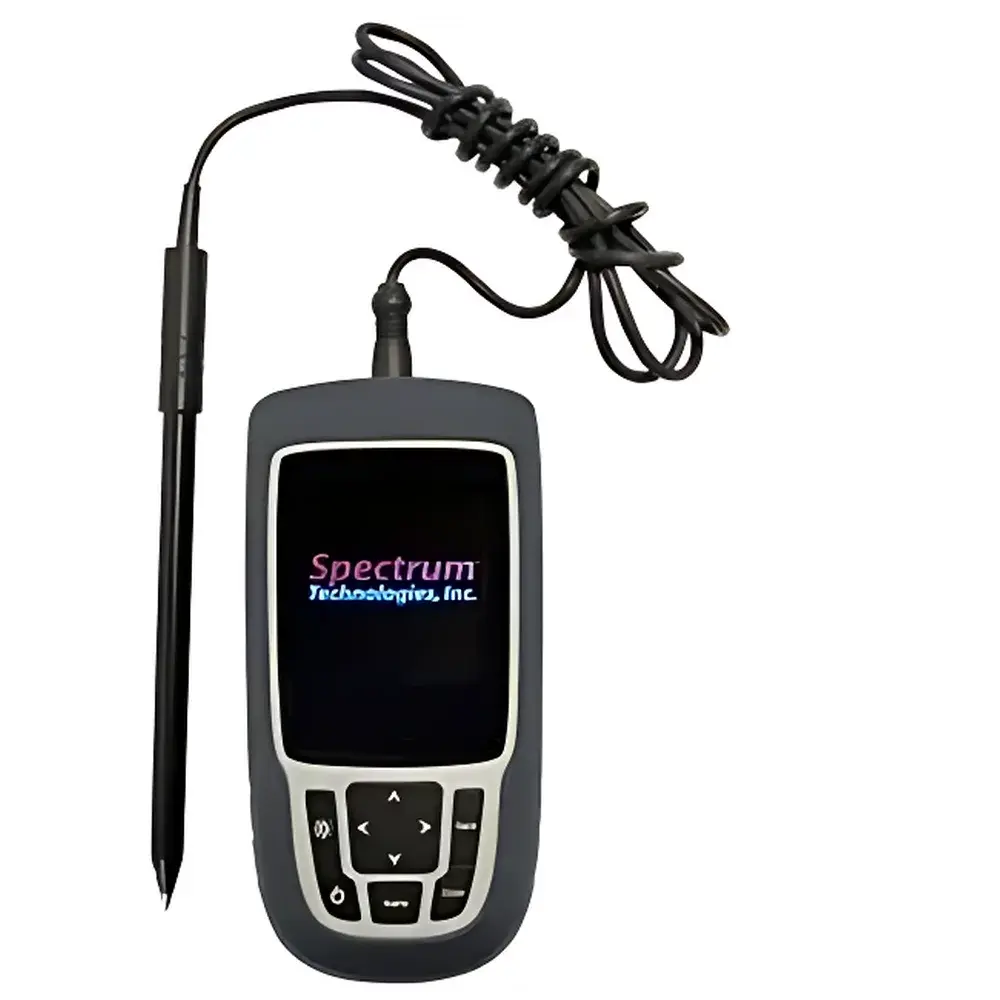
Spectrum Technologies PH-400 In-Situ Soil pH Meter
| Brand | Spectrum Technologies |
|---|---|
| Origin | USA |
| Model | PH-400 |
| pH Range | 0.00–14.00 |
| pH Accuracy | ±0.01 |
| pH Resolution | 0.01 |
| Temperature Range | −5 to 120 °C |
| Temperature Accuracy | ±0.5 °C |
| Temperature Resolution | 0.1 °C |
| Data Storage | 10 readings |
| Dimensions | 80 × 160 × 36 mm |
| Weight | 379 g |
| IP Rating | IP65 |
| Power | 3 × rechargeable AA batteries |
| Charging Time | 8 hours |
Overview
The Spectrum Technologies PH-400 In-Situ Soil pH Meter is a field-deployable, handheld electrochemical instrument engineered for direct, real-time measurement of hydrogen ion activity in heterogeneous solid and semi-solid media—including native soil, potting substrates, hydroponic solutions, and growth media in trays or nursery containers. Unlike conventional laboratory pH meters reliant on slurry extraction or filtration, the PH-400 employs a robust, non-glass solid-state pH sensing element designed to withstand mechanical stress, abrasion, and variable moisture content typical of unprocessed soil environments. Its operational principle follows the Nernst equation, where the potential difference between the reference and sensing electrodes—calibrated against standard buffer solutions—is converted into a digital pH value with traceable metrological integrity. The device integrates temperature compensation via an embedded thermistor, enabling automatic correction of pH readings across a wide thermal range (−5 to 120 °C), critical for accurate interpretation under fluctuating field conditions.
Key Features
- Non-glass, ruggedized pH probe optimized for direct insertion into undisturbed soil profiles, peat-based substrates, rockwool, coco coir, and aqueous nutrient solutions—eliminating sample preparation artifacts.
- 3.2-inch backlit color LCD display with high-contrast graphical interface, supporting intuitive navigation and simultaneous visualization of pH, temperature, calibration status, and battery level.
- Intelligent Calibration Wizard guiding users step-by-step through single-point or two-point calibration using certified pH 4.01, 7.00, and 10.01 buffers—minimizing operator error and ensuring compliance with ISO 7888 and ASTM D1293 protocols.
- IP65-rated enclosure providing dust-tight protection and resistance to low-pressure water jets—validated for extended outdoor use in rain, dew, or irrigation-saturated environments.
- Lightweight (379 g) ergonomic housing with textured grip and balanced center-of-mass, facilitating prolonged handheld operation during multi-site surveys without operator fatigue.
- Onboard memory storing up to 10 timestamped measurement records—including pH, temperature, date/time stamp, and calibration history—for preliminary data logging prior to export.
Sample Compatibility & Compliance
The PH-400 is validated for use across diverse environmental matrices encountered in agronomy, horticulture, ecological restoration, and regulatory site assessment. It meets functional equivalence requirements outlined in EPA Method 9045D (Soil pH by Direct Measurement) and aligns with the measurement principles referenced in ISO 10390:2021 (Soil quality — Determination of pH). While not a GLP-certified analytical instrument per se, its calibration traceability, documented uncertainty budget (±0.01 pH units), and stable electrode response support data defensibility in Tier 1 environmental monitoring programs. The probe’s chemical inertness ensures compatibility with organic-rich soils, saline substrates (EC ≤ 5 dS/m), and acidic/alkaline amendments without drift or poisoning. Note: For highly compacted or gravelly soils, pre-moistening and gentle probe rotation during insertion are recommended to ensure optimal electrode–matrix contact.
Software & Data Management
The PH-400 operates as a standalone field instrument without proprietary software dependencies. Measurement data are stored internally and can be manually transcribed or exported via optional USB-to-serial adapter (sold separately) compatible with generic terminal emulation tools (e.g., Tera Term, PuTTY). No cloud connectivity or mobile app integration is provided; this design prioritizes data sovereignty, electromagnetic resilience in remote locations, and avoidance of firmware update vulnerabilities common in IoT-enabled sensors. Audit trails—such as calibration dates, buffer lot numbers, and ambient temperature at time of measurement—are retained within each stored record, satisfying basic documentation requirements for QA/QC workflows under ISO/IEC 17025 Clause 7.7.
Applications
- Routine pH mapping of greenhouse growing media to optimize nutrient availability and prevent micronutrient lockout.
- Pre-plant soil screening for agricultural land reclamation projects requiring pH stratification analysis down to 15 cm depth.
- Verification of lime or sulfur amendment efficacy in turfgrass management and vineyard soil health programs.
- In-field validation of pH stability in constructed wetlands and phytoremediation plots.
- Educational use in university soil science laboratories emphasizing hands-on, in-situ methodology versus extractive techniques.
FAQ
Does the PH-400 require electrode soaking or conditioning before first use?
No—its solid-state sensor is factory-activated and ready for immediate deployment. However, a brief rinse with deionized water and blot-drying is recommended prior to initial calibration.
Can the probe be used in frozen or saturated soils?
Measurements below 0 °C are not supported due to electrolyte freezing in the reference junction; avoid use in frozen ground. For waterlogged soils, insert slowly to minimize air entrapment and allow 30–60 seconds for stabilization.
Is the device compliant with FDA 21 CFR Part 11 for regulated trials?
No—the PH-400 lacks electronic signature capability, audit trail encryption, or user access controls required for Part 11 compliance. It is intended for field screening, not GMP-regulated analytical reporting.
How often should calibration be performed during continuous field use?
Calibrate before each sampling session and recheck after every 10 measurements or upon significant ambient temperature shifts (>10 °C) to maintain accuracy within ±0.01 pH.
What maintenance is required for long-term reliability?
Rinse the probe with deionized water after each use; store upright with protective cap engaged. Replace the AA batteries every 200 hours of active use or when low-battery icon appears. Electrode lifespan exceeds 24 months under normal agricultural use conditions.







