
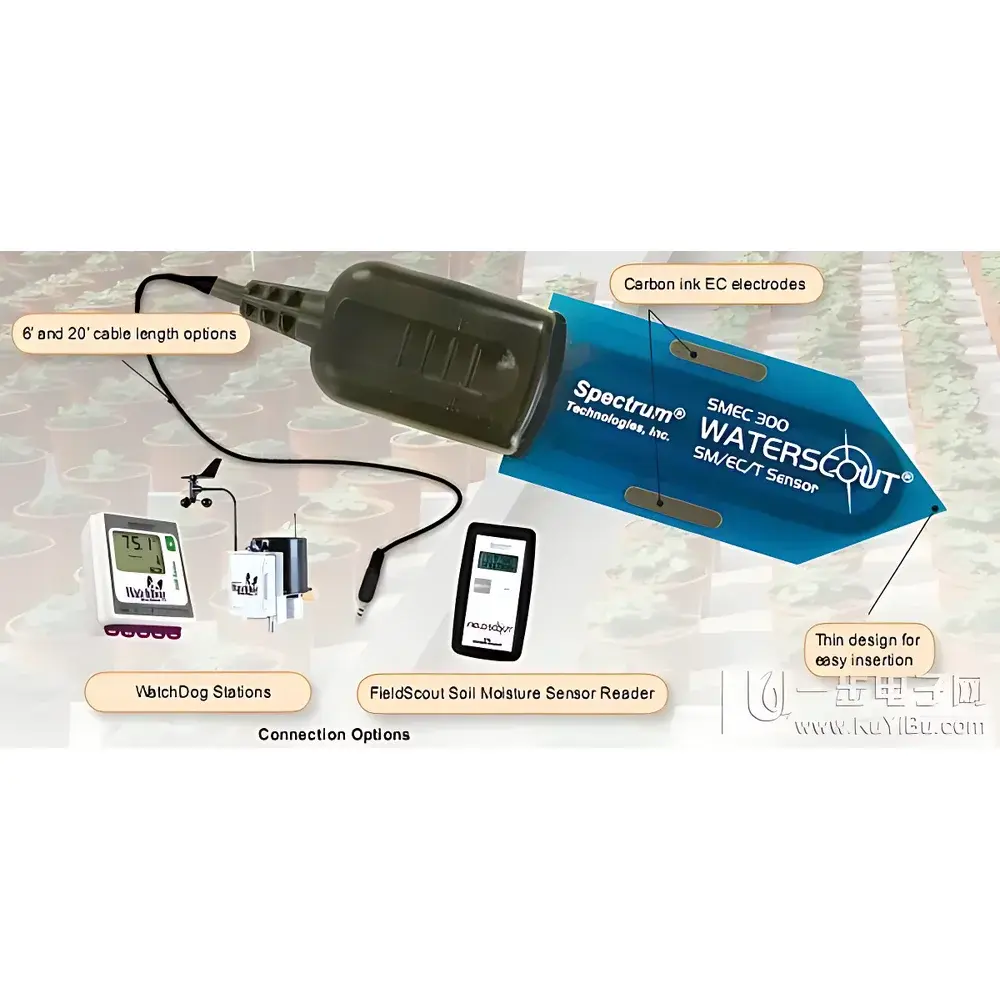
Spectrum Technologies SMEC 300 Soil Moisture, Electrical Conductivity & Temperature Sensor
| Brand | Spectrum Technologies |
|---|---|
| Origin | USA |
| Model | SMEC 300 |
| Cable Options | 1.8 m (6 ft) or 6 m (20 ft), extendable to 15 m (50 ft) |
| Volumetric Water Content Range | 0% to saturation |
| EC Range | 0–10 mS/cm |
| Temperature Range | 0.5–80 °C (33–175 °F) |
| VWC Resolution | 0.1% |
| EC Resolution | 0.01 mS/cm |
| Temp Resolution | 0.1 °C |
| VWC Accuracy | ±3% |
| EC Accuracy | ±2% |
| Temp Accuracy | ±0.6 °C |
| Output | Time-Division Multiplexed Analog Voltage |
| Power | 3 V DC, 6–10 mA |
| Connector | 2.5 mm mono plug |
| Compatible Loggers | FieldScout Soil Sensor Reader (Item 6466), WatchDog 1000/2000 Series Stations |
Overview
The Spectrum Technologies SMEC 300 Soil Moisture, Electrical Conductivity & Temperature Sensor is a field-deployable, multi-parameter probe engineered for precision monitoring of three critical soil physical properties: volumetric water content (VWC), bulk electrical conductivity (EC), and soil temperature. It operates on well-established geophysical principles: VWC is determined via high-frequency (80 MHz) capacitance measurement, where the soil matrix serves as the dielectric medium between two parallel-plate electrodes; EC is measured using a robust carbon-graphite electrode pair optimized for stable interfacial contact with soil solution; and temperature is acquired via an embedded thermistor calibrated to NIST-traceable standards. This tri-sensor architecture enables simultaneous, co-located acquisition—eliminating spatial mismatch errors common in multi-probe setups—and supports integrated interpretation of water availability, salinity stress, and thermal regime—key drivers of root-zone biogeochemical activity and crop physiological response.
Key Features
- Capacitive VWC sensing at 80 MHz ensures minimal sensitivity to soil texture, salinity, and temperature drift—critical for long-term field stability across diverse pedological conditions.
- Carbon-graphite EC electrodes provide enlarged electrochemical surface area and enhanced corrosion resistance compared to stainless-steel alternatives, improving signal reproducibility in saline or acidic soils.
- Integrated one-step EC calibration eliminates the need for external reference solutions or manual offset adjustments—reducing setup time and operator dependency.
- Time-division multiplexed analog voltage output allows all three parameters (VWC, EC, Temp) to be transmitted over a single wire pair, minimizing cabling complexity and compatibility constraints with legacy data loggers.
- Compact 2.25″ × 0.75″ sensing volume ensures representative micro-scale sampling while enabling installation in narrow access points (e.g., access tubes, lysimeters, or dense root zones).
- 2.5 mm mono plug interface ensures plug-and-play compatibility with Spectrum’s FieldScout Soil Sensor Reader (Item 6466) and WatchDog 1000/2000 Series environmental monitoring stations without adapter requirements.
Sample Compatibility & Compliance
The SMEC 300 is validated for use in mineral soils, sandy loams, clay loams, and organic-rich substrates typical of agricultural, horticultural, and ecological research applications. Its non-invasive capacitance-based VWC measurement avoids electrolytic polarization artifacts associated with time-domain reflectometry (TDR) in high-conductivity soils (>5 mS/cm). The sensor complies with ASTM D5918-21 (Standard Guide for Soil Moisture Monitoring) for field installation methodology and meets the functional requirements outlined in ISO 11274:2022 (Soil quality — Determination of water retention characteristic curves). While not certified under FDA 21 CFR Part 11, its analog output architecture supports integration into GLP/GMP-compliant data acquisition systems when paired with audit-trail-capable loggers and validated software (e.g., Specware 9.0 with configuration control logs).
Software & Data Management
Data acquisition is supported through Spectrum Technologies’ Specware 9.0 software suite, which provides real-time visualization, unit conversion (e.g., dS/m ↔ mS/cm), temperature compensation for EC readings (based on standard 2%/°C correction), and batch export to CSV or Excel formats. When connected to WatchDog stations, measurements are automatically timestamped and stored with onboard memory (up to 512 KB), supporting gap-free logging intervals from 1 minute to 24 hours. Specware 9.0 includes built-in validation checks—including out-of-range flagging for VWC > saturation threshold or EC >10 mS/cm—and generates summary statistics (mean, min/max, standard deviation) per deployment period. Raw voltage outputs are documented in the user manual with full scaling equations, enabling third-party integration with Campbell Scientific CR series, Onset HOBO, or custom Python/Matlab scripts.
Applications
- Irrigation scheduling in row crops (corn, soybean, cotton) and orchards, where VWC-EC-temperature co-variation informs deficit irrigation thresholds and leaching fraction calculations.
- Salinity management in reclaimed or coastal farmland—tracking seasonal EC dynamics to assess salt accumulation risk and evaluate gypsum amendment efficacy.
- Controlled-environment agriculture (CEA) and greenhouse substrate monitoring, where rapid detection of moisture depletion or nutrient lockout prevents yield loss.
- Ecological restoration projects assessing soil recovery metrics—e.g., VWC rebound post-disturbance or EC stabilization following phytoremediation.
- Long-term eddy covariance or flux tower networks requiring low-power, maintenance-free soil state inputs for evapotranspiration partitioning models.
FAQ
What is the recommended installation depth for optimal agronomic interpretation?
For most annual crops, install the sensor’s active zone at 15–30 cm depth to capture root-zone dynamics; for perennial systems, deploy multiple units at 15, 45, and 90 cm to resolve vertical moisture and salinity gradients.
Does the SMEC 300 require periodic recalibration in the field?
No—capacitive VWC and thermistor-based temperature elements are inherently stable; EC calibration is performed once during initial setup using the integrated procedure and remains valid unless mechanical damage occurs.
Can the sensor be used in saturated or flooded conditions?
Yes—the housing is IP68-rated for continuous submersion up to 1 m depth; however, EC measurements above 10 mS/cm will saturate, and VWC readings at full saturation reflect total porosity rather than plant-available water.
How does temperature compensation work for EC measurements?
Specware 9.0 applies automatic linear compensation (2.0%/°C) referenced to 25 °C, using the co-located thermistor reading; users may disable or adjust this coefficient if site-specific temperature coefficients are known.
Is the 15 m cable extension officially supported?
Yes—Spectrum Technologies certifies performance up to 15 m using shielded, twisted-pair extension cables (Part #EXT-SMEC); beyond this length, signal attenuation may degrade voltage resolution below 0.01 mS/cm equivalent.
Related Products







