
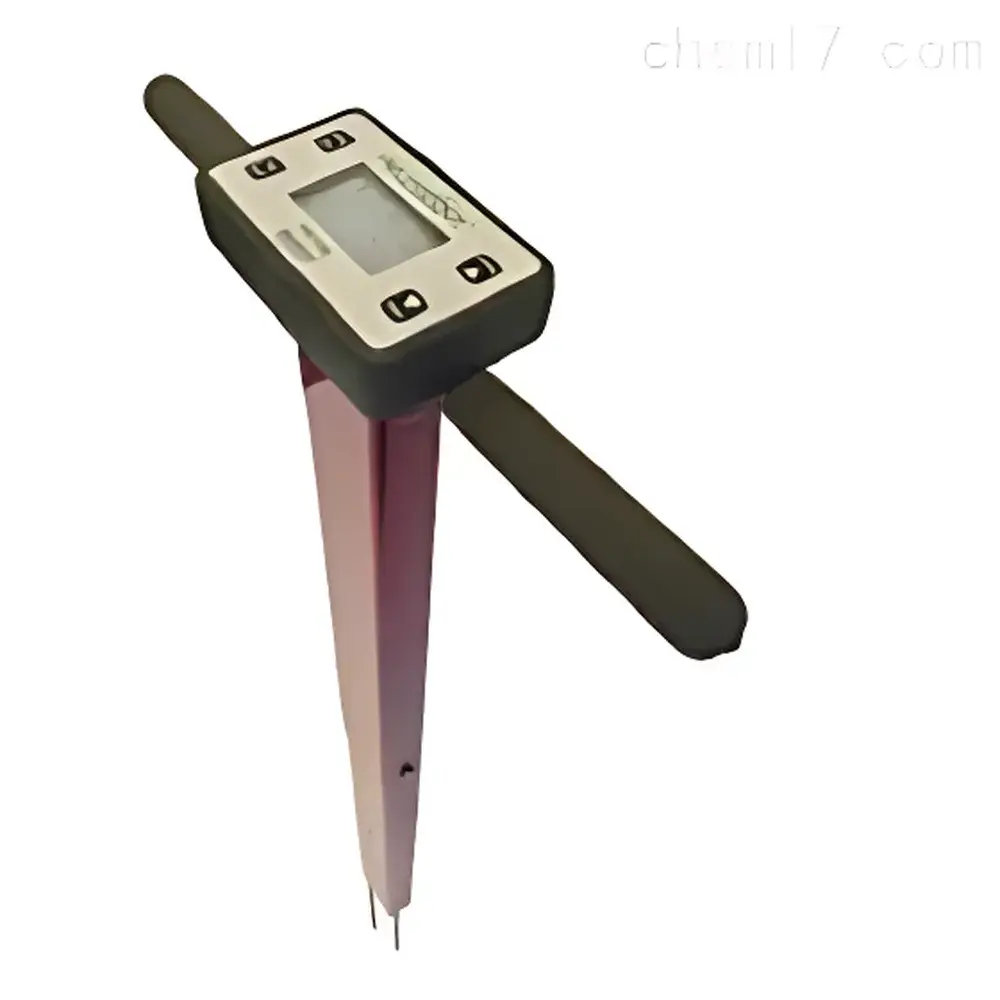
Spectrum Technologies TDR 150 Portable Soil Moisture and Electrical Conductivity Meter
| Brand | Spectrum Technologies |
|---|---|
| Origin | USA |
| Model | TDR 150 |
| Instrument Type | Multi-parameter Soil Analyzer |
| Measurement Principle | Time-Domain Reflectometry (TDR) |
| Soil Water Content Range | 0–100% volumetric water content (VWC) |
| EC Range | 0–20 dS/m |
| Temperature Range | -10°C to 50°C |
| Data Storage Capacity | >50,000 GPS-tagged measurements |
| Connectivity | Integrated Bluetooth 4.2 |
| Display | Backlit LCD |
| Probe Options | 10 cm, 20 cm, and 30 cm stainless-steel waveguide rods |
| Power | Rechargeable Li-ion battery (up to 16 hours continuous operation) |
| Compliance | ASTM D5778, ISO 11276, US EPA Method 9081A |
Overview
The Spectrum Technologies TDR 150 is a field-deployable, multi-parameter soil analyzer engineered for high-reproducibility measurement of volumetric water content (VWC) and bulk electrical conductivity (EC) in situ. It employs time-domain reflectometry (TDR), a physics-based dielectric sensing method standardized under ASTM D5778 and ISO 11276, wherein a fast-rise electromagnetic pulse is transmitted along parallel stainless-steel waveguide rods inserted into the soil. The travel time and reflection amplitude of the pulse are analyzed to calculate the soil’s dielectric permittivity—directly correlated with VWC—and signal attenuation, which enables robust estimation of bulk EC. Unlike capacitance-based sensors, TDR is minimally affected by soil texture, salinity-induced polarization, or temperature drift, making it suitable for long-term monitoring across diverse pedological conditions—from sandy loams to clay-rich profiles—and critical applications including turfgrass irrigation scheduling, precision agriculture trials, and environmental remediation site assessment.
Key Features
- True TDR architecture with calibrated 10/20/30 cm stainless-steel probe options, enabling depth-resolved profiling without sensor recalibration.
- Simultaneous dual-parameter acquisition: VWC (±0.01 m³/m³ typical accuracy) and bulk EC (±0.05 dS/m at 25°C), with real-time EC correction applied to moisture readings per US EPA Method 9081A guidelines.
- Integrated GPS receiver (WAAS-enabled, <3 m horizontal accuracy) and Bluetooth 4.2 module for georeferenced data logging and wireless synchronization with Spectrum’s proprietary FieldScout Mobile app.
- Backlit monochrome LCD display with intuitive icon-driven interface—operable under direct sunlight and low-light field conditions.
- Expandable probe mounting system featuring telescoping stainless-steel support rod and quick-lock collar, ensuring consistent insertion depth and mechanical stability across uneven terrain.
- Onboard memory stores >50,000 timestamped, location-stamped measurement records with full metadata (probe ID, depth, ambient temperature, battery level).
Sample Compatibility & Compliance
The TDR 150 is validated for use in mineral soils, organic substrates (e.g., peat-based growing media), and engineered fill materials. It complies with internationally recognized test standards governing soil physical property measurement, including ASTM D5778 (Standard Test Method for Determining the Dielectric Constant of Soils by Time Domain Reflectometry), ISO 11276 (Soil Quality — Determination of Water Content by TDR), and US EPA Method 9081A (Field Screening for Soil Moisture and Salinity). Its design supports GLP-compliant data collection workflows: all measurements include immutable timestamps, GPS coordinates, and instrument serial identifiers, satisfying traceability requirements for regulatory reporting and third-party audit readiness.
Software & Data Management
Data export is supported via USB-C and Bluetooth to the FieldScout Cloud Platform—a secure, browser-accessible portal compliant with FDA 21 CFR Part 11 for electronic records and signatures. Raw TDR waveforms, processed VWC/EC values, and spatial metadata are archived in CSV and Shapefile formats. Batch processing tools allow automated calibration offset application, outlier detection using IQR-based statistical filtering, and integration with GIS platforms (e.g., ArcGIS Pro, QGIS) for spatial interpolation and zone mapping. Audit trails log every data modification event—including user identity, timestamp, and action type—ensuring full ALCOA+ (Attributable, Legible, Contemporaneous, Original, Accurate, Complete, Consistent, Enduring, Available) compliance.
Applications
- Irrigation management in golf course turf, sports fields, and municipal green spaces—enabling dynamic scheduling based on real-time root-zone moisture deficits.
- Soil hydrology research: monitoring infiltration rates, evapotranspiration partitioning, and preferential flow pathways in lysimeter and plot-scale studies.
- Environmental site assessment: tracking leachate plume migration through vadose zone monitoring networks and verifying cap integrity at landfill closure sites.
- Agronomic trials: evaluating crop water-use efficiency under variable-rate irrigation treatments and assessing salinity buildup in drip-irrigated orchards.
- Educational field labs: supporting undergraduate soil physics curricula with hands-on TDR waveform interpretation and calibration exercises.
FAQ
Does the TDR 150 require soil-specific calibration?
No—its factory calibration is traceable to NIST-standard reference soils and remains valid across standard mineral and organic media. Optional user-defined calibration curves may be loaded for specialized substrates (e.g., hydroponic rockwool or biochar-amended soils).
Can the device measure frozen or saturated soils?
TDR 150 operates reliably between −10°C and 50°C; however, ice formation alters dielectric response non-linearly. Measurements below 0°C are flagged as “low-temperature advisory” and excluded from automated VWC calculation unless custom cryogenic calibration is applied.
Is Bluetooth pairing compatible with iOS and Android?
Yes—the FieldScout Mobile app supports iOS 14+ and Android 9.0+ with automatic firmware update notifications and offline data capture capability.
How is data security ensured during cloud upload?
All transmissions use TLS 1.3 encryption; stored datasets reside in SOC 2 Type II–certified infrastructure with role-based access control and quarterly penetration testing reports available under NDA.
What maintenance is required for long-term field deployment?
Probe rods should be wiped clean after each use; annual verification against certified reference standards (provided with calibration kit #CK-TDR150) is recommended for GMP-aligned operations.







