
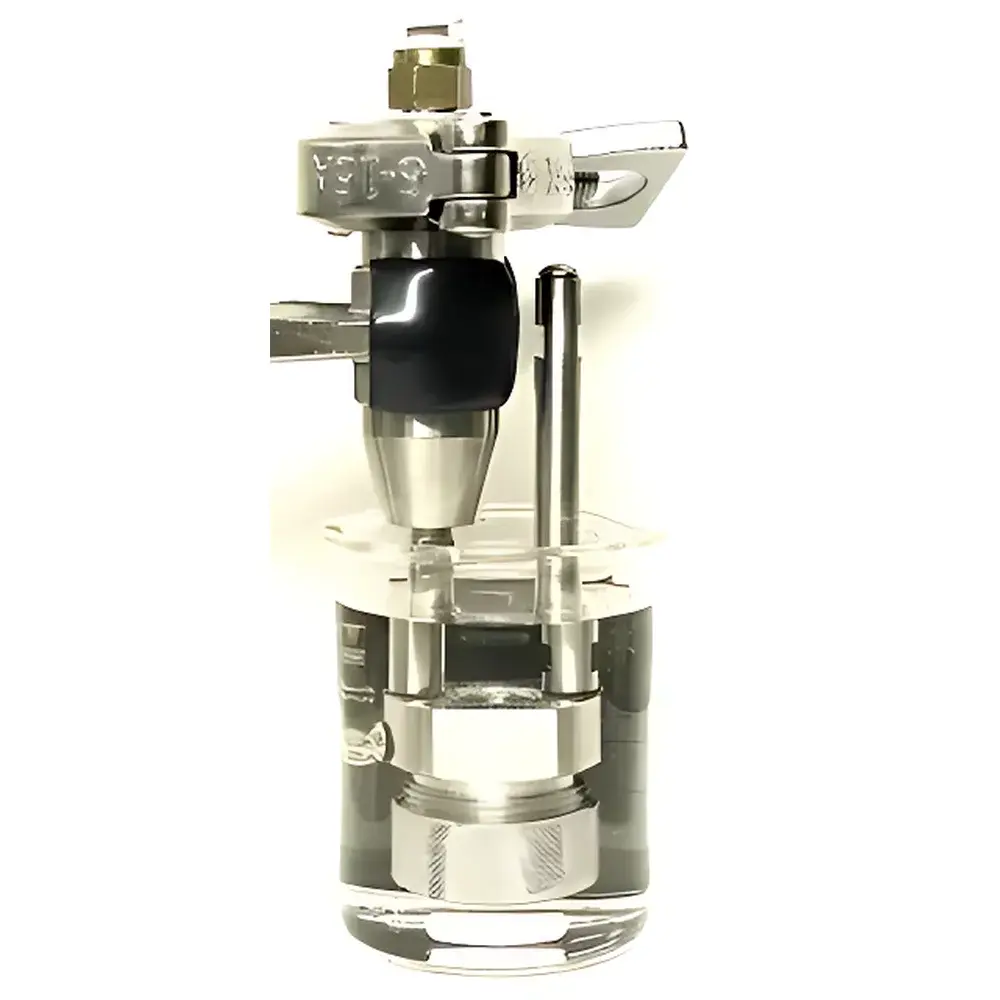
SPG MG-20 External-Pressure Membrane Emulsifier
| Brand | SPG |
|---|---|
| Origin | Japan |
| Model | MG-20 |
| Max Operating Pressure | 500 kPa |
| SPG Membrane Dimensions | Φ10 × L20 mm |
| Effective Membrane Length | 10 mm |
| Minimum Applicable Pore Size | 0.3 µm |
| Continuous Phase Volume | 50–200 mL |
| Dispersed Phase Volume | 3–10 mL |
Overview
The SPG MG-20 External-Pressure Membrane Emulsifier is a precision-engineered laboratory-scale device designed for the controlled, reproducible generation of monodisperse emulsions and micro/nano-droplet suspensions via membrane emulsification. Unlike conventional high-shear or ultrasonic methods, this system operates on the principle of pressure-driven displacement of dispersed phase through a uniform, interconnected porous glass (SPG®) membrane—where the dispersed phase resides externally and is pressurized by regulated nitrogen gas, while the continuous phase flows internally and is homogenized via magnetic stirring. This configuration minimizes droplet deformation and coalescence, enabling narrow droplet size distributions (CV < 10%) with high batch-to-batch repeatability. The MG-20 is optimized for R&D workflows in pharmaceutical formulation (e.g., nanoemulsion-based drug delivery), functional food development, cosmetic emulsion design, and catalyst precursor synthesis—where precise control over interfacial area, droplet size, and composition stability is critical.
Key Features
- External-pressure architecture: Dispersed phase is pressurized directly against the outer surface of the SPG membrane, ensuring uniform transmembrane flux and reduced shear-induced degradation of sensitive actives.
- Integrated magnetic stirrer: Provides gentle yet effective mixing of the continuous phase within the inner chamber, enhancing mass transfer and preventing localized concentration gradients.
- Stainless-steel and borosilicate glass construction: Ensures chemical compatibility with organic solvents, aqueous surfactant systems, and mild acidic/basic media; fully autoclavable components support GLP-compliant cleaning protocols.
- Regulated nitrogen supply interface: Equipped with a calibrated pressure regulator and digital pressure gauge (0–500 kPa range), enabling fine-tuned control over droplet formation kinetics and size distribution.
- Modular SPG membrane holder: Accepts standard Φ10 × L20 mm SPG® membranes with defined pore sizes ≥0.3 µm; quick-release design facilitates rapid membrane replacement and cross-contamination prevention between formulations.
- Compact footprint and leak-tight sealing: Designed for benchtop use in ISO Class 5–7 cleanrooms or standard analytical labs; O-ring sealed joints meet ASTM E2914-13 requirements for low-particulate fluid handling.
Sample Compatibility & Compliance
The MG-20 accommodates a broad spectrum of immiscible liquid pairs, including water-in-oil (W/O), oil-in-water (O/W), and multiple emulsions (W/O/W, O/W/O). Compatible dispersed phases include silicone oils, medium-chain triglycerides (MCT), ethyl acetate, and polymerizable monomers; continuous phases span aqueous surfactant solutions (e.g., polysorbate 80, lecithin), glycerol-water mixtures, and low-viscosity ionic liquids. All wetted parts comply with USP Class VI biocompatibility standards. The system supports documentation traceability required under FDA 21 CFR Part 11 when integrated with compliant data acquisition software—pressure, time, and volume parameters are recordable for audit-ready batch reports.
Software & Data Management
While the MG-20 operates as a manually controlled instrument, it is compatible with third-party PC-based data loggers (e.g., LabVIEW, MATLAB, or Python-based DAQ systems) via analog 0–5 V output from its integrated pressure transducer. Users may configure custom scripts to log real-time pressure profiles, correlate them with emulsion collection time, and calculate volumetric throughput (mL/min) and theoretical droplet generation rate. Exported CSV datasets integrate seamlessly into statistical process control (SPC) platforms for Cp/Cpk analysis of droplet size consistency across experimental runs.
Applications
- Preclinical formulation of lipid-based nanocarriers for oral or topical drug delivery
- Production of calibration standards for laser diffraction (ISO 13320) and dynamic light scattering (ISO 22412) particle analyzers
- Controlled synthesis of polymeric microparticles via solvent evaporation or interfacial polymerization
- Rheological modifier dispersion in high-value coatings and inks
- Encapsulation of probiotics, enzymes, or volatile flavors in food-grade matrices
- Fundamental studies of membrane wetting dynamics, capillary number effects, and Marangoni-driven stabilization
FAQ
What is the recommended maintenance schedule for the SPG membrane?
SPG membranes should be rinsed immediately after each use with appropriate solvents (e.g., ethanol for oil residues, deionized water for surfactants), followed by drying under inert gas. Long-term storage requires desiccation. Membrane lifetime depends on fouling resistance and typically exceeds 50 cycles under validated cleaning procedures.
Can the MG-20 be used with corrosive dispersed phases such as chlorinated solvents?
Yes—provided the SPG membrane grade is selected for chemical resistance (e.g., fluorinated SPG variants), and all elastomer seals (FKM or EPDM) are verified for compatibility per manufacturer’s chemical resistance charts.
Is temperature control available as an option?
The base MG-20 does not include jacketing or Peltier elements; however, the vessel can be placed inside a thermostatic chamber or immersed in a circulating water bath (with appropriate sealing adaptations) to maintain continuous phase temperatures between 5 °C and 60 °C.
How is droplet size correlated with operating pressure and pore size?
Droplet diameter scales approximately linearly with SPG pore diameter under constant pressure and interfacial tension; empirical calibration using optical microscopy or Coulter counting is recommended for each formulation to establish the pressure–size relationship prior to scale-up.



