
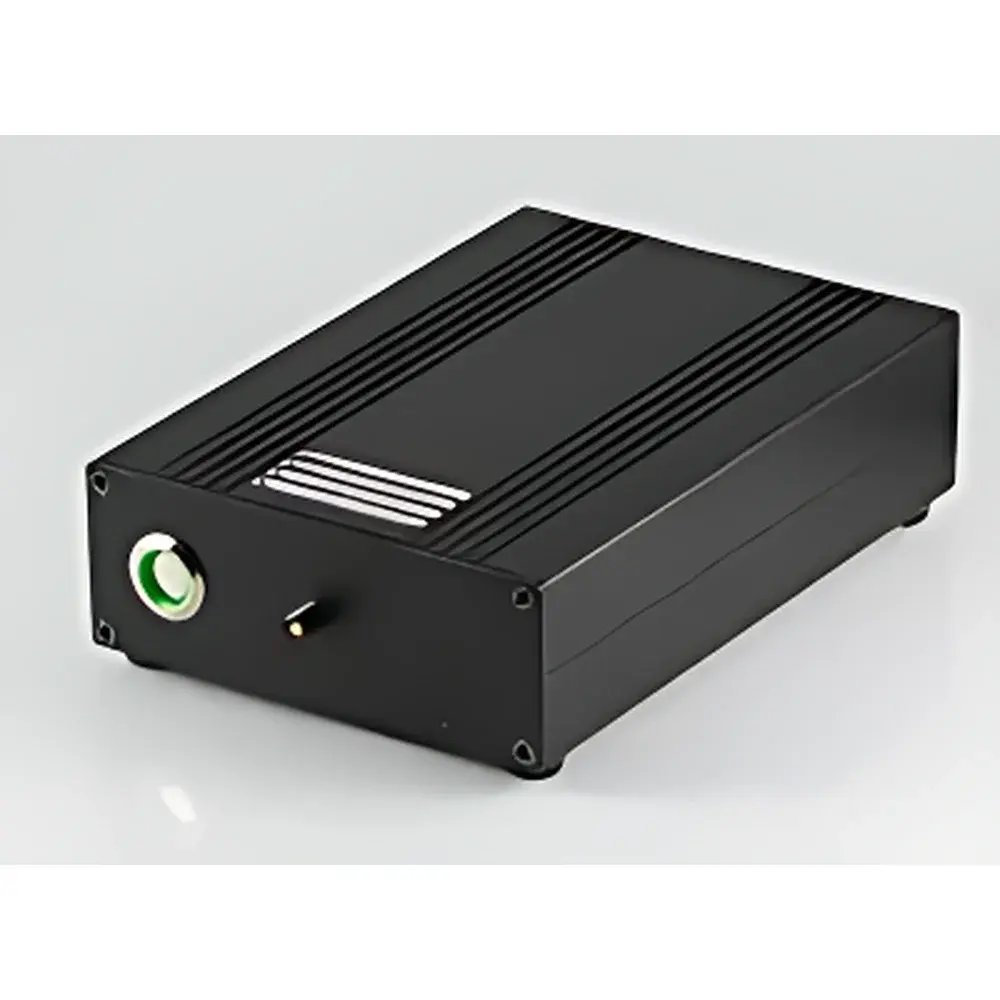
SPL-HL Compact Air-Cooled Tungsten-Halogen Fiber-Coupled Light Source
| Brand | SPL |
|---|---|
| Model | SPL-HL |
| Type | Tungsten-Halogen Broadband Light Source |
| Cooling | Active Air-Cooled |
| Output Coupling | SMA905 Connector |
| Dimensions | 150 × 106 × 40 mm |
| Electrical Input | 5 V DC, 1.3 A (6.5 W) |
| Spectral Range | 360 nm – 2500 nm |
| Color Temperature | 3100 K |
| Luminous Intensity | 74 MSCP (74,000 foot-candles) |
| Power Stability | ±0.2% RMS over 1 h |
| Drift Rate | <0.1% per hour |
| Warm-up Time | ≤5 min |
| Bulb Lifetime | 900 h |
| Operating Temperature | 0 °C – 40 °C |
| Operating Humidity | 5–95% RH (non-condensing at 40 °C) |
| Fiber Compatibility | Up to 600 µm core diameter multimode fiber |
Overview
The SPL-HL is a compact, air-cooled tungsten-halogen broadband light source engineered for stable, reproducible illumination across the visible and near-infrared (VIS-NIR) spectrum (360 nm – 2500 nm). Unlike pulsed or arc-based sources, it operates on continuous-wave (CW) thermal emission principles—relying on resistive heating of a tungsten filament within a halogen-filled quartz envelope. This enables blackbody-like spectral continuity, high radiance, and excellent temporal stability—critical for quantitative optical measurements such as spectrophotometry, reflectance calibration, fiber-optic sensor excitation, and spectroscopic reference applications. Its integrated optical train is optimized for efficient coupling into multimode optical fibers up to 600 µm core diameter via an SMA905 receptacle, minimizing coupling loss and spatial non-uniformity. The source employs precision constant-current regulation to suppress intensity fluctuations, achieving ≤0.2% RMS power stability over one hour and a long-term drift rate of less than 0.1% per hour—performance validated under controlled ambient conditions (23 °C, 45% RH).
Key Features
- Stable CW broadband output from 360 nm to 2500 nm with smooth spectral continuity and minimal line structure
- High color temperature (3100 K) and luminous efficacy (74 MSCP), suitable for photometric and radiometric calibration tasks
- Integrated active airflow management system with adjustable fan speed to maintain optimal thermal load on the lamp envelope and heat sink
- Modular lamp module design enabling tool-free bulb replacement in under 90 seconds—no realignment required
- Low-power operation (6.5 W at 5 V DC) compatible with standard laboratory DC power supplies and OEM integration platforms
- Rugged aluminum chassis (150 × 106 × 40 mm) with EMC-compliant shielding and industrial-grade connectors
Sample Compatibility & Compliance
The SPL-HL is designed for use with silica-based multimode fibers (e.g., UV-VIS, VIS-NIR, or solarization-resistant grades) and fiber bundles up to 600 µm core diameter. It complies with IEC 61000-6-3 (EMI emission limits) and IEC 61000-6-2 (immunity to electrostatic discharge and conducted RF disturbances). While not certified for medical or explosive environments, its electrical isolation, low-voltage input, and absence of mercury or xenon make it suitable for ISO/IEC 17025-accredited laboratories performing optical calibration per ASTM E308 (computing color coordinates), ISO 13406-2 (display luminance uniformity), or USP (spectrophotometer qualification). The source meets general requirements for GLP-compliant instrument qualification when used with documented operational checks (e.g., daily stability verification using a calibrated photodiode sensor).
Software & Data Management
The SPL-HL operates as a standalone analog light source with no embedded firmware or digital interface. However, it integrates seamlessly into automated test systems via external monitoring: output intensity can be tracked using a NIST-traceable photodiode or spectrometer connected to data acquisition hardware (e.g., National Instruments DAQ or Thorlabs PM100D). LabVIEW, Python (with PyVISA), or MATLAB scripts may log stability metrics, warm-up profiles, and lifetime degradation trends. Audit trails—including timestamped power readings, environmental logs, and maintenance records—are recommended for compliance with FDA 21 CFR Part 11 when used in regulated pharmaceutical or clinical optics workflows.
Applications
- Calibration of spectrometers, CCD/CMOS array detectors, and integrating sphere systems
- Excitation source for fluorescence lifetime imaging (FLIM) reference standards and time-resolved reflectance phantoms
- Illumination for optical coherence tomography (OCT) system alignment and axial resolution verification
- Benchmark source in comparative studies of LED, laser diode, and supercontinuum performance in VIS-NIR
- Reference irradiance source in material transmittance/absorbance measurements per ASTM E903 and ISO 9050
- OEM integration into portable NIR analyzers, environmental sensors, and educational optics kits
FAQ
What is the expected spectral irradiance uniformity across the 360–2500 nm range when coupled into a 600 µm fiber?
Measured spectral flatness (±3 dB) spans 400–1800 nm; below 400 nm and above 1800 nm, output falls off gradually due to quartz envelope transmission limits and filament emissivity roll-off.
Can the SPL-HL be operated continuously for >8 hours without derating?
Yes—continuous operation is supported within the specified ambient temperature (≤40 °C) and humidity (≤95% RH non-condensing); thermal management maintains junction temperature below 120 °C.
Is the SMA905 output port keyed or polarization-maintaining?
No—the SMA905 interface is standard non-keyed and does not preserve polarization; it is intended for unpolarized broadband delivery.
Does SPL provide NIST-traceable spectral irradiance calibration data with each unit?
Calibration certificates are available upon request (additional lead time and fee apply); default shipment includes factory-measured relative spectral power distribution (RSPD) and total radiant flux at 5 V DC.
How does bulb aging affect spectral output stability over the 900-hour lifetime?
Gradual tungsten evaporation causes slow reduction in UV output (<400 nm) and slight red-shift in correlated color temperature (≤50 K over full life); VIS-NIR radiance remains within ±2% of initial value until end-of-life.





