
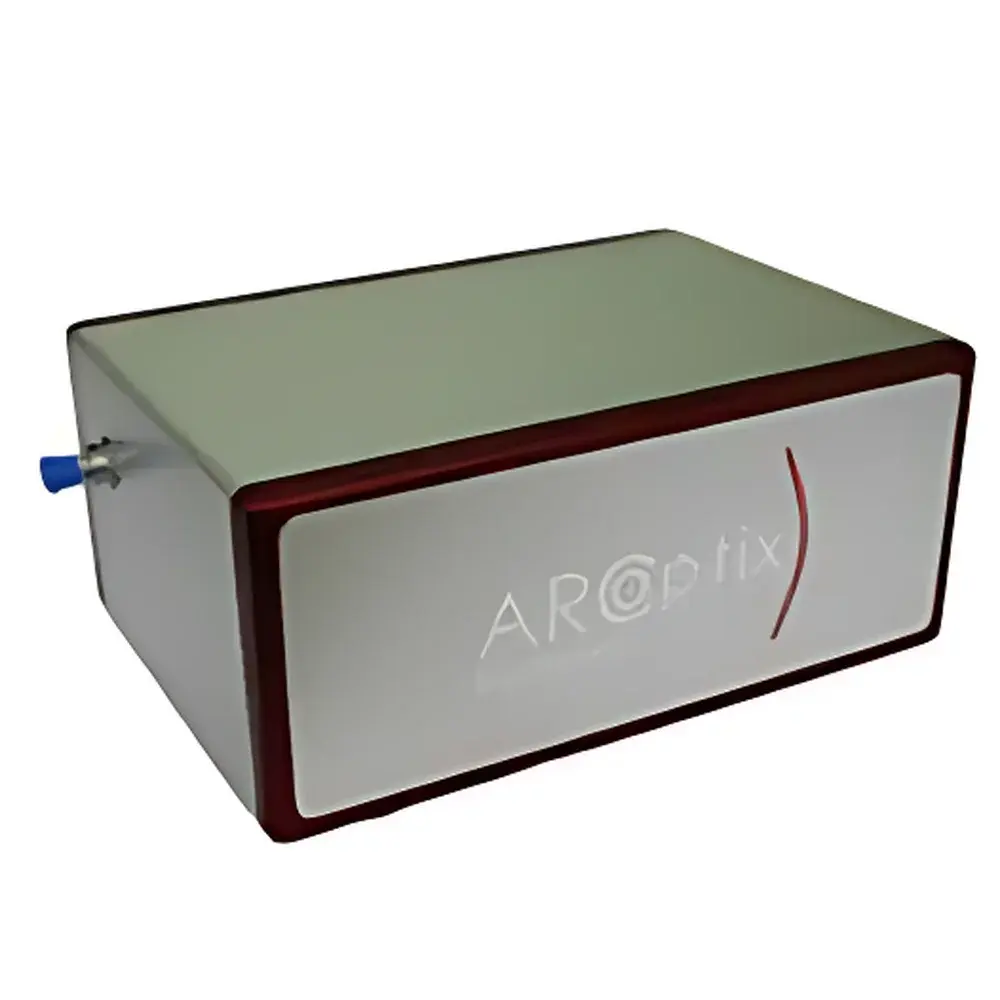
SPL Photonics FT-NIR Rocket Fourier Transform Near-Infrared Spectrometer
| Origin | Canada |
|---|---|
| Supplier Type | Authorized Distributor |
| Origin Category | Imported |
| Model | FT-NIR Rocket |
| Component Category | Light Source |
| Power Supply | USB-powered |
| Wavelength Range | 0.9–2.6 µm |
| Spectral Resolution | 1–9 nm |
| Detector | Single-element InGaAs photodiode |
| Interferometer Type | Sealed, self-compensating Michelson interferometer with solid-state reference laser |
| Fiber Coupling | Multimode NIR fiber (SMA 905) |
| Compliance | CE, RoHS |
Overview
The SPL Photonics FT-NIR Rocket is a compact, robust Fourier transform near-infrared (FT-NIR) spectrometer engineered for high-stability, high-reproducibility spectroscopic analysis in the 0.9–2.6 µm spectral region. Unlike dispersive grating-based NIR instruments, the FT-NIR Rocket employs a sealed, self-compensating Michelson interferometer architecture—optically balanced and mechanically symmetric—to deliver intrinsic immunity to thermal drift, mechanical vibration, and alignment sensitivity. Its core measurement principle follows the Fourier transform spectroscopy paradigm: broadband NIR light from a stabilized source is split, recombined after path-length modulation, and detected as an interferogram; fast Fourier transformation then yields high-fidelity absorbance or reflectance spectra. This approach ensures superior wavelength accuracy (< ±0.1 nm), long-term baseline stability (no observable baseline drift over 8-hour continuous operation), and absence of higher-order diffraction artifacts (e.g., ghost peaks) common in grating spectrometers. Designed for integration into portable or OEM analytical platforms, the system operates exclusively via USB 3.0 bus power—eliminating external power supplies—and interfaces seamlessly with standard NIR fiber optics (multimode, 400–1000 µm core).
Key Features
- Sealed, self-compensating interferometer with integrated solid-state reference laser—enabling sub-micron optical path difference (OPD) control without He-Ne lasers or high-voltage drivers
- Single-element InGaAs photodiode detector optimized for 0.9–2.6 µm, delivering >100 dB dynamic range and low-noise signal acquisition
- Wavelength resolution adjustable from 1 nm to 9 nm via software-controlled mirror scan velocity and apodization
- USB-powered, fanless design with < 250 g mass and < 120 mm × 85 mm × 45 mm footprint—ideal for field-deployable or embedded process monitoring
- Optical path fully enclosed and purged-compatible; no internal moving parts beyond the scanning mirror—minimizing maintenance intervals
- Real-time intensity normalization using built-in reference channel, ensuring stable radiometric response across ambient temperature fluctuations (15–35 °C)
Sample Compatibility & Compliance
The FT-NIR Rocket supports transmission, diffuse reflectance, and attenuated total reflectance (ATR) configurations via standard SMA-905 NIR fiber coupling. It is compatible with industry-standard sample interfaces—including flow cells (1–5 mm pathlength), integrating spheres (30–50 mm diameter), and handheld probes—for solids, liquids, slurries, and gases. The instrument meets CE marking requirements for electromagnetic compatibility (EN 61326-1) and safety (EN 61010-1). Its firmware and data acquisition protocols support audit-trail-capable operation per GLP and GMP guidelines when integrated with compliant third-party software. While not FDA 21 CFR Part 11–certified out-of-the-box, its raw data export (ASCII, CSV, JCAMP-DX) and metadata tagging (timestamp, integration time, resolution, gain) enable full traceability in regulated environments.
Software & Data Management
The spectrometer ships with SPL’s SpectraView Pro software (Windows 10/11, 64-bit), providing real-time interferogram visualization, FFT processing, baseline correction (Rubberband, Asymmetric Least Squares), and peak integration. Export formats include .csv (wavenumber/intensity), .jdx (JCAMP-DX v5.01), and .spc (Galactic format) for compatibility with chemometric platforms such as Unscrambler X, MATLAB, and Python (SciPy, scikit-learn). An SDK (C/C++, Python 3.8+, .NET) enables OEM integration, custom calibration model deployment, and synchronization with PLCs or DAQ systems. All acquired spectra retain embedded hardware metadata—critical for method validation and instrument qualification (IQ/OQ/PQ).
Applications
- Quantitative analysis of moisture, protein, fat, and starch in food, dairy, and agricultural commodities (aligned with ISO 12099:2017 and AOAC 2016.07)
- In-line monitoring of polymer composition, solvent content, and crosslinking density during extrusion or coating processes
- Characterization of photovoltaic materials—including Si wafer doping uniformity, perovskite film thickness, and encapsulant degradation—via absorption edge analysis
- Gas-phase detection of CH₄, CO₂, NH₃, and H₂O vapor using tunable diode laser absorption spectroscopy (TDLAS)-compatible spectral libraries
- Non-destructive quality control of pharmaceutical tablets (API concentration, blend homogeneity) per USP and Ph. Eur. 2.2.40
- Soil organic carbon and nitrogen mapping in precision agriculture using PLS regression models trained on laboratory reference data
FAQ
Is the FT-NIR Rocket suitable for quantitative chemometric modeling?
Yes—its high wavelength reproducibility (< ±0.05 cm⁻¹ over 24 h) and intensity stability (< 0.5% RSD over 100 scans) meet the instrumental prerequisites for robust PLS and PCR model development.
Can it be used in hazardous environments?
The unit itself is not ATEX-certified; however, fiber-coupled remote measurement configurations allow placement of the spectrometer outside classified zones while probing via explosion-proof NIR fiber.
What is the typical signal-to-noise ratio (SNR)?
At 16 cm⁻¹ resolution and 32 co-added scans, SNR exceeds 15,000:1 (peak at 1550 nm, 1 s integration).
Does it support external triggering?
Yes—TTL-compatible trigger input (BNC) enables synchronization with pulsed lasers, motorized stages, or process events.
Is calibration transfer between units possible?
Yes—using SPL’s included Transfer Calibration Utility, which applies slope/offset corrections based on NIST-traceable polystyrene or rare-earth oxide reference standards.





