
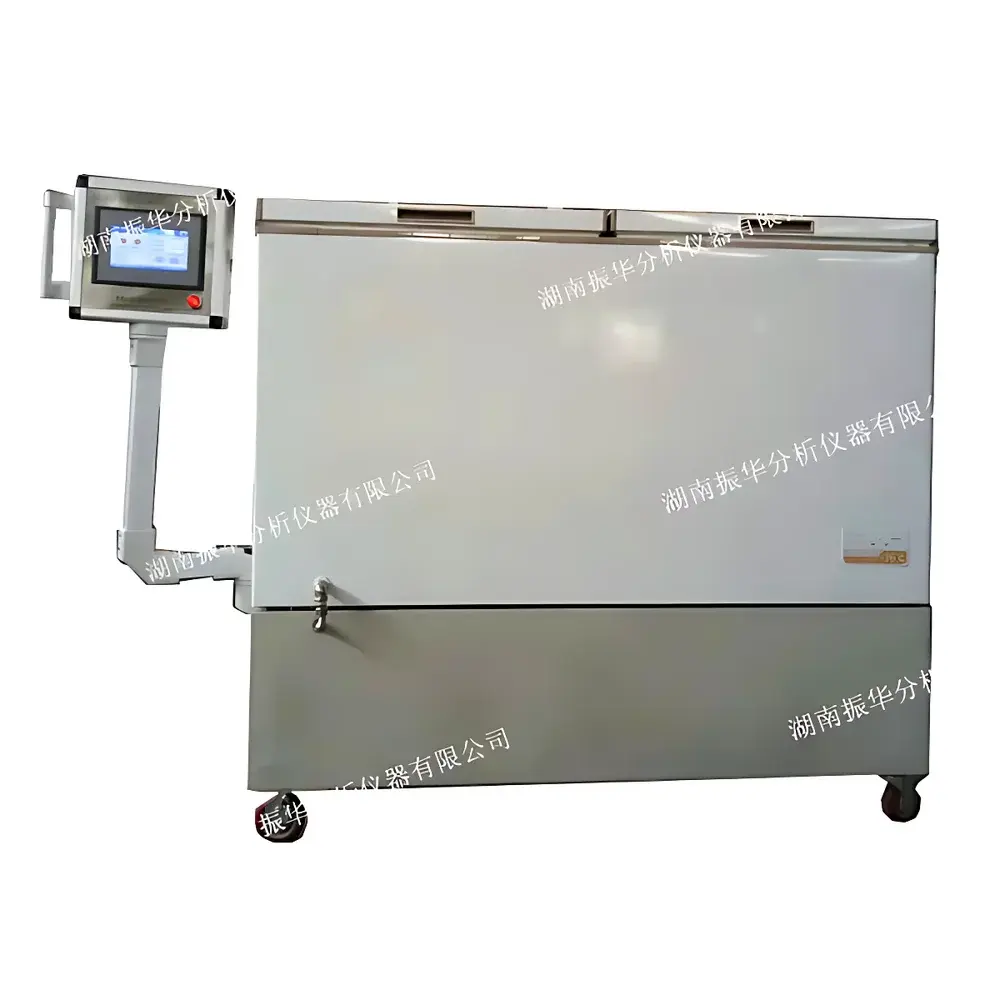
SQ007 Ceramic Tile Freeze-Thaw Resistance Testing Chamber
| Origin | Hunan, China |
|---|---|
| Manufacturer Type | Authorized Distributor |
| Origin Category | Domestic (China) |
| Model | SQ007 |
| Price Range | USD 1,400 – 2,800 |
| Temperature Range | −20 °C to +25 °C |
| Internal Chamber Dimensions | 450 × 450 × 450 mm |
| Temperature Control Accuracy | ±1 °C |
| Power Supply | 220 V ±10%, 50 Hz, 2.7 kW |
| Automation | Fully programmable freeze-thaw cycle sequencing |
| Compliance | GB/T 3810.12–2016 |
Overview
The SQ007 Ceramic Tile Freeze-Thaw Resistance Testing Chamber is a purpose-built environmental test system engineered for the standardized evaluation of ceramic tile durability under repeated low-temperature stress. It operates on the principle of controlled cyclic freezing and thawing—mimicking long-term exposure to climatic freeze-thaw conditions in cold and temperate regions. Designed explicitly to fulfill the procedural and instrumentation requirements of GB/T 3810.12–2016 (“Methods of test for ceramic tiles — Part 12: Determination of resistance to frost”), the chamber enables reproducible simulation of thermal shock, ice formation, and moisture expansion within porous ceramic microstructures. Its core function is not general-purpose low-temperature storage, but rather the execution of normative test sequences that quantify tile integrity loss—measured via post-cycle assessment of glaze crazing, surface spalling, or dimensional change—according to national standard pass/fail criteria.
Key Features
- Programmable freeze-thaw cycle controller with user-defined cycle count, dwell times, and temperature ramp profiles
- Stable thermal chamber with insulated double-wall construction and forced-air circulation for uniform temperature distribution (±1 °C accuracy across full 450 × 450 × 450 mm working volume)
- Dedicated water management subsystem: integrated inlet/outlet ports, level-sensing reservoir, and timed drainage logic synchronized with thaw phases
- Industrial-grade refrigeration unit rated for continuous operation at −20 °C minimum, with thermal overload protection and condensate management
- Front-access transparent door with dual-seal gasket and anti-fog heating element for real-time visual monitoring without thermal interruption
- Embedded microcontroller-based interface with digital setpoint display, cycle counter, and fault logging (e.g., sensor timeout, power anomaly, door-open interrupt)
Sample Compatibility & Compliance
The SQ007 accommodates standard ceramic tile specimens conforming to GB/T 3810.12–2016 dimensions (typically 100 × 100 mm or 150 × 150 mm), including glazed, unglazed, porcelain, and stoneware variants. Specimen racks are configurable to ensure air and water access to all six faces during immersion and freezing phases. The system’s operational envelope—including temperature stability, timing repeatability, and water immersion control—is validated against Clause 5 (Apparatus Requirements) and Annex A (Verification Procedures) of GB/T 3810.12–2016. While not certified to ISO/IEC 17025, the chamber supports GLP-aligned testing workflows when paired with documented calibration records (temperature sensors traceable to NIM standards) and operator SOPs. It does not meet UL 61010-1 or IEC 60068-2-1/-2 environmental qualification out-of-the-box; third-party safety certification is recommended prior to integration into accredited laboratory infrastructure.
Software & Data Management
The SQ007 utilizes embedded firmware—not PC-hosted software—with non-volatile memory for storing up to 99 test programs and 200 cycle logs. Each log entry captures start time, total cycles completed, max/min chamber temperature per phase, and any triggered alarms. Data export is via USB flash drive (FAT32 format) in CSV, enabling traceability for internal quality audits. No cloud connectivity or remote access capability is provided. For laboratories operating under FDA 21 CFR Part 11 or ISO 13485 frameworks, manual audit trails must be maintained externally using printed log sheets signed by operators and supervisors—consistent with GB/T 3810.12–2016 documentation requirements for “test record retention.”
Applications
- Quality assurance testing of ceramic tiles prior to domestic market release in northern and high-altitude regions of China
- R&D validation of new glaze formulations, body compositions, or firing schedules for improved frost resistance
- Third-party certification testing for CMA-accredited inspection bodies performing GB-compliant tile evaluations
- Comparative durability benchmarking between imported and domestically produced tile batches
- Supporting technical documentation for CCC (China Compulsory Certification) submissions where freeze-thaw performance is a declared parameter
FAQ
Does the SQ007 comply with ASTM C1026 or EN 202?
No. The SQ007 is designed exclusively for GB/T 3810.12–2016 compliance. ASTM C1026 (Standard Test Method for Determining Resistance of Ceramic Glazed Wall Tile to Frost Action) and EN 202 (Ceramic Tiles — Determination of Resistance to Frost) specify distinct chamber geometries, immersion protocols, and temperature tolerances not implemented in this model.
Can the chamber operate continuously for 300+ cycles without maintenance?
Yes—under nominal load (≤15 kg total specimen mass, ambient room temperature ≤30 °C, stable water supply). Recommended preventive maintenance includes biannual refrigerant pressure verification and quarterly cleaning of condenser coils and drain lines.
Is calibration service available outside mainland China?
Calibration support is limited to authorized service centers in China. International users must arrange local NIST-traceable temperature probe calibration and document equivalence to GB/T 3810.12–2016 verification procedures.
What is the maximum specimen weight the chamber can accommodate?
The internal chamber volume supports up to 20 standard 150 × 150 × 10 mm tiles immersed simultaneously, totaling approximately 12–14 kg depending on tile density. Overloading may impair thermal uniformity and extend cycle duration beyond standard limits.
Does the system include data analysis tools for crack quantification or strength loss calculation?
No. The SQ007 performs only the environmental conditioning phase. Post-test evaluation—including visual rating per GB/T 3810.12–2016 Section 7, bending strength measurement (GB/T 3810.4), or SEM imaging—must be conducted separately using dedicated metrology equipment.
Related Products



